Maja Dumat / CC BY 2.0, via Wikimedia Commons
Grefsheim spiraea: complete guide
Spiraea × cinerea
Want to see Grefsheim spiraea: complete guide in your garden?
Full design in HD: €7.99
Look after your Grefsheim spiraea with the GardenWorld app
Identify plants with your camera and get a care calendar with reminders for this plant.


Overview
Spiraea × cinerea is one of the first shrubs to turn white in spring. In April, sometimes as early as late March, its long, slender branches arch under thousands of tiny white flowers until the whole shrub looks dusted with snow. Garden centres almost always sell the cultivar 'Grefsheim', which is so widely grown that many gardeners simply know the plant as Grefsheim spiraea.
This spiraea is a hybrid between Spiraea cana and Spiraea hypericifolia, two species from eastern Europe and central Asia. 'Grefsheim' was selected around 1949 at the Grefsheim nursery in Norway. That northern origin explains why it is so tough: frost barely bothers it.
The shrub grows 1.5 to 2 m tall and as wide, with a loose, arching habit. It grows at a moderate pace and reaches full size after three or four years. You can plant it as a single specimen, in a group or as an informal flowering hedge. On gardenworld.app you can have a garden design made that gives this spiraea a spot where it really stands out in spring, for example beside a path, at the edge of a lawn or against a dark backdrop of hornbeam or yew.
Appearance and bloom cycle
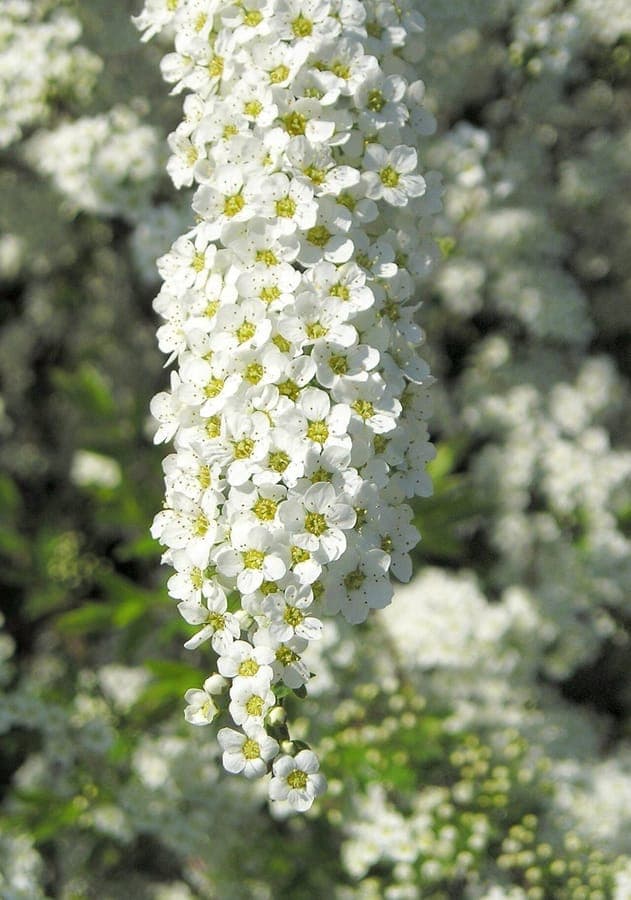
The flowers are pure white and only 6 to 8 mm across. They are carried in small, stalkless clusters of four to ten along the full length of the previous year's shoots. Because every centimetre of stem flowers, the branches become long white garlands that bow gracefully towards the ground. The photo shows this well: a large, rounded shrub on a lawn, white from top to bottom, against a background of fresh green trees.
Flowering runs through April into early May, depending on the weather. Spiraea × cinerea blooms earlier than the better-known bridal wreath (Spiraea × vanhouttei), which only gets going in May. The flowers have a light, honeyed scent and attract early bees, hoverflies and bumblebees at a time when there is little else on offer.
The leaves appear with or just after the flowers. They are narrow, lance-shaped, 2 to 4 cm long and greyish green, which explains the name cinerea, meaning ash-grey. In summer the shrub is a calm, fine-textured mass of green. In autumn the leaves turn yellow to orange-yellow before they fall.
Ideal location
Grefsheim spiraea flowers most freely in full sun. Light partial shade, with morning or afternoon sun, works too, but you will get fewer flowers. In deep shade the shrub becomes thin and barely blooms.
It is not fussy about its surroundings. Wind, an exposed site or a town garden are no problem. Because the branches arch so beautifully, it does need room: do not squeeze it into a narrow bed where it has to be cut back every year, or you will lose its graceful outline. Allow 1.5 to 2 m across per plant.
For an informal flowering hedge, plant two to three shrubs per metre. Such a hedge is not clipped tight but keeps its natural shape. For a group of individual shrubs, space them 1.2 to 1.5 m apart.
Soil requirements
Spiraea × cinerea grows in almost any ordinary garden soil: sand, loam or clay, slightly acidic to chalky. The one thing it will not tolerate is ground that stays waterlogged for long periods. On heavy, wet clay, dig in some coarse grit and compost when planting to improve drainage.
Mix a few spadefuls of compost into the planting hole. After that, feeding is hardly needed. A layer of compost or well-rotted manure in March is enough to keep the shrub healthy. Too much fertiliser produces lots of leaves and long shoots, but not more flowers.
Watering
Water regularly in the first year after planting, especially during dry spells in spring and summer. About 10 litres per shrub once a week is a good guide. After that the shrub is quite drought tolerant and seldom needs extra water in a normal British or northern European summer. Only in prolonged drought, when the leaves droop or brown at the edges, should you give it a thorough soak.
A mulch of bark or compost around the base holds moisture and keeps weeds down. If you grow this spiraea in a large container, it will need water much more often in summer, sometimes daily in hot weather.
Free preview
Want to see Grefsheim spiraea: complete guide in your garden? Make a free preview of your design.
Pruning
The key thing to know: Spiraea × cinerea flowers on the previous year's wood. So never prune it in winter or early spring, or you will cut off the flower buds.
The right time is straight after flowering, in May. Cut the stems that have flowered back to just above a strong, young side shoot. Those new shoots grow on through summer and carry next spring's flowers. In addition, every year or two, remove about a quarter of the oldest, thickest stems at ground level. This keeps the shrub young, open and free-flowering.
A neglected, bare old shrub can be renovated by cutting the whole thing back to 20 to 30 cm in one go. It will regrow, but you lose a year of flowers. Never cut all the stems to the same height: the arching shape disappears and you end up with a broom of upright shoots.
Maintenance calendar
March: Spread a thin layer of compost around the base. Remove dead wood, but leave healthy stems alone.
April–early May: Full flower. Enjoy it and cut a few stems for a vase.
May: Prune straight after flowering. Cut back flowered stems and remove some of the oldest wood.
June–August: Growing season. Water young plants in dry weather. Keep the base free of weeds.
September–October: Yellow autumn colour. A good time to plant new shrubs.
November–February: Dormant. Plant bare-root or container shrubs while the ground is not frozen.
For a month-by-month overview of every job in your garden, have a look at the planting calendar on gardenworld.app.
Winter hardiness
Spiraea × cinerea 'Grefsheim' is extremely hardy and copes with temperatures down to about -30 °C (USDA zone 4). That makes it suitable for any garden in Britain and the Low Countries, including cold, exposed sites. No winter protection is needed.
A late frost during flowering can brown the open flowers, but the shrub itself is unharmed. The flower buds are fairly frost resistant.
Spiraea is not known to be toxic to people or pets and does not appear on lists of poisonous garden plants. Nor is it invasive: it hardly self-seeds in our climate. Pests and diseases are rare. In a very dry summer you may see some powdery mildew or aphids, but this is seldom serious.
Companion plants
Because this spiraea flowers so early, it pairs best with other spring bloomers. Bulbs at its feet are ideal: grape hyacinths (Muscari armeniacum) make a blue carpet under the white branches, and tulips (Tulipa gesneriana) in pink, red or purple give a strong contrast. Wild daffodils (Narcissus pseudonarcissus) add yellow and flower just a little earlier.
Among shrubs, star magnolia (Magnolia stellata) shares the white spring flowers, and flowering currant (Ribes sanguineum) has pink tassels that stand out against the white. Beneath and in front of the shrub, shade-tolerant perennials such as Lenten rose (Helleborus orientalis) do well, flowering from February to April.
After flowering, Grefsheim spiraea becomes a green backdrop. So plant summer flowers in front of it, such as hardy geraniums or salvias, to keep the border interesting in July and August.
Final thoughts
Spiraea × cinerea 'Grefsheim' is a reliable, tough shrub for anyone who wants spring to start with a burst of white. It is hardy, adapts to almost any soil and asks for just one real rule: prune straight after flowering and never in winter.
Give it room to let its branches cascade, tuck a few bulbs around its base, and every April you will have one of the loveliest spots in the garden.
Frequently asked questions about Grefsheim spiraea
Is Grefsheim spiraea winter hardy?
Spiraea × cinerea 'Grefsheim' is extremely hardy and copes with temperatures down to about -30 °C (USDA zone 4). That makes it suitable for any garden in Britain and the Low Countries, including cold, exposed sites.
When and how do you prune Grefsheim spiraea?
The key thing to know: Spiraea × cinerea flowers on the previous year's wood. So never prune it in winter or early spring, or you will cut off the flower buds.
How much water does Grefsheim spiraea need?
Water regularly in the first year after planting, especially during dry spells in spring and summer. About 10 litres per shrub once a week is a good guide.
Where does Grefsheim spiraea grow best?
Grefsheim spiraea flowers most freely in full sun. Light partial shade, with morning or afternoon sun, works too, but you will get fewer flowers.
What soil does Grefsheim spiraea need?
Spiraea × cinerea grows in almost any ordinary garden soil: sand, loam or clay, slightly acidic to chalky. The one thing it will not tolerate is ground that stays waterlogged for long periods.

See it in your garden
See Grefsheim spiraea in your garden
One photo of your garden and a few questions. You see the result in about a minute.
Try it with a photoIdentify this plant in your own garden. Identify a plant
Similar plants
Common grape-hyacinth: complete guide
Muscari armeniacum
Muscari armeniacum blooms in early spring with dense clusters of blue, grape-like flowers. Hardy, low-maintenance, and bee-friendly, it's perfect for borders, lawns, and naturalized plantings.
Tulip: complete guide
Tulipa gesneriana
Everything about the tulip (Tulipa gesneriana): planting, care, the finest groups and cultivars. Practical tips for a colourful spring full of tulips.
Star Magnolia: complete guide
Magnolia stellata
Everything about Star Magnolia (Magnolia stellata): planting, care, pruning and siting. Practical tips for spectacular star-shaped spring flowers.
