
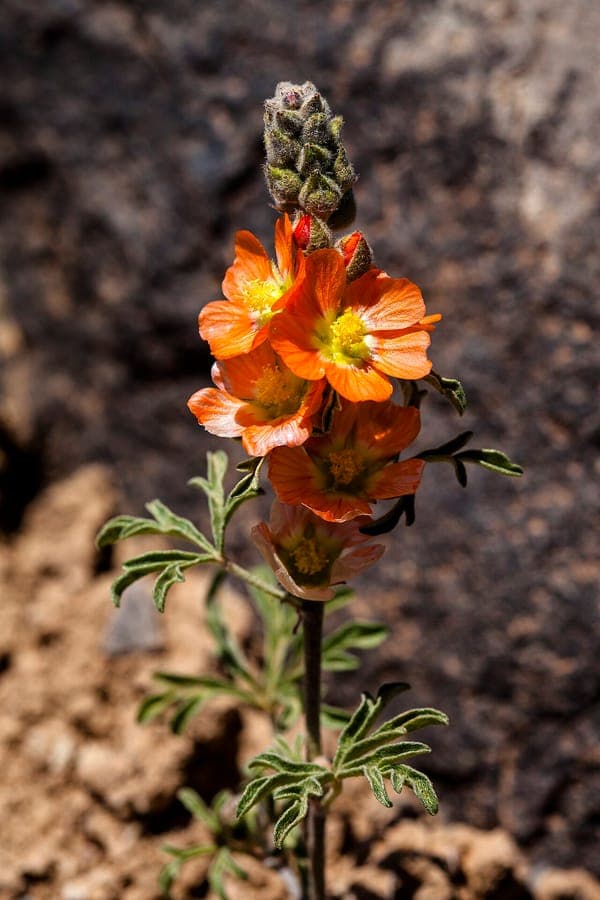
Hovenweep National Monument / CC BY 2.0, via Wikimedia Commons
Scarlet globemallow: complete guide
Sphaeralcea coccinea
Want to see Scarlet globemallow: complete guide in your garden?
1 minute, no credit card
Overview
Scarlet globemallow (Sphaeralcea coccinea) is a tough prairie perennial belonging to the mallow family Malvaceae. Native to the grasslands and open plains stretching from western Canada through the central United States all the way to northeastern Mexico, this plant has earned a devoted following among gardeners who want reliable colour with minimal fuss. Described by botanist Per Axel Rydberg in 1913, the species has accumulated a charming collection of common names: copper mallow, prairie mallow, orange globemallow, and scarlet mallow all refer to the same fiery-bloomed plant. At gardenworld.app you can explore full garden design ideas that incorporate this striking species alongside compatible drought-tolerant companions.
Appearance and bloom cycle
Sphaeralcea coccinea grows as a multi-stemmed subshrub, typically reaching 30 to 50 cm in height with a similar spread. The stems are upright to slightly arching and densely covered in fine stellate hairs that give the whole plant a soft, silvery-grey appearance even when not in flower. The leaves are palmately lobed, roughly 3 to 6 cm across, grey-green in colour and similarly hairy. This coating serves as the plant's primary defence against moisture loss in its native arid environment. Flowers appear from May onwards in loose racemes along the upper portions of the stems. Each bloom is roughly 2 to 3 cm in diameter, cup-shaped, with five petals in shades ranging from bright vermilion to deep copper-orange, depending on the population and growing conditions. The flowering season extends from May through September, with peak bloom in June and July. Cutting the stems back by half after the first flush triggers a second wave of flowers in late summer. Small round fruits follow the flowers and persist attractively through autumn.
Ideal location
Full sun is non-negotiable for this species. Aim for a spot receiving at least six hours of direct sunlight per day; more is better. South-facing or south-west-facing beds backed by a warm wall are ideal. The plant thrives in heat and becomes more floriferous as temperatures rise. Avoid positions with stagnant moisture, deep shade, or cold northerly winds. Raised beds, gravel gardens, dry slopes, and the base of south-facing stone walls all suit scarlet globemallow perfectly. Its deep taproot system makes it remarkably resilient once established, allowing it to seek out moisture well below the surface during dry spells.
Soil requirements
Free-draining soil is the single most important requirement. In its native range the plant grows in sandy, loamy, or rocky soils that shed water rapidly. In garden conditions, a mix of sharp sand and ordinary garden soil in a 1:1 ratio works well; add fine grit for extra drainage if you are working with heavier ground. The species tolerates a wide pH range from 6.5 to 8.4, meaning it adapts readily to neutral and mildly alkaline soils. Poor to moderately fertile soil actually produces better flowering than rich, nitrogen-heavy ground, which encourages leafy growth at the expense of blooms. Avoid clay soils or improve them significantly before planting. Raised beds or berms are an excellent alternative where drainage is problematic.
Watering
Once established, scarlet globemallow is one of the most drought-tolerant perennials you can grow. In the first season after planting, water weekly to help the taproot establish. After that, supplemental watering is rarely needed in temperate European climates outside of prolonged dry spells lasting more than three weeks. When you do water, do so deeply and infrequently rather than little and often. Overwatering is the leading cause of failure with this species: roots are highly susceptible to rot in waterlogged conditions. Drip irrigation directed at the root zone rather than overhead watering is preferable. A layer of coarse grit mulch around the crown helps keep the base dry and prevents surface moisture from accumulating.
Free design
Want to see Scarlet globemallow: complete guide in your garden? Make a free design now.
Pruning
Scarlet globemallow requires minimal attention but responds well to timely cutting. After the first main flush of flowers, cut the stems back to roughly 10 cm above ground. New shoots will appear within three to four weeks, carrying a second wave of blooms into autumn. In early spring, once the frost risk has passed and new growth is visible at the base, remove any dead stems from the previous year down to just above the crown. Avoid cutting into the woody crown itself. Leave the dry stems standing through winter - they provide valuable overwintering habitat for solitary insects and look attractive when frosted.
Maintenance calendar
January and February: the plant is dormant; no action needed. Keep the crown dry. March: remove last year's dead stems as soon as new basal growth appears. April: apply a thin layer of coarse grit around the crown to reduce splash-back. May: first flowers open; enjoy the display. June and July: peak bloom; water only during extended dry periods. August: cut back after the first flush for a second wave; check for aphids. September: second flush of bloom; seeds ripen if you want to collect for propagation. October: leave stems standing for overwintering insects. November and December: no action needed; consider a light grit mulch if a hard winter is forecast.
Winter hardiness
Sphaeralcea coccinea is rated USDA zone 3 to 9, tolerating temperatures as low as -40 degrees Celsius when drainage is good. In practice, this makes it fully winter-hardy across the entire UK, the Netherlands, Belgium, and most of France and Germany. The one enemy is wet winter cold: waterlogged roots during winter will kill the plant. Ensure perfect drainage and apply a collar of coarse grit or broken gravel around the crown before the first frosts. In areas with milder Atlantic climates, no additional protection is normally needed. The taproot stores enough energy to regenerate even when the top growth is damaged by late frosts.
Companion plants
Scarlet globemallow pairs beautifully with other sun-loving drought-tolerant species. Russian sage (Perovskia atriplicifolia) provides a striking blue-purple contrast to the red blooms. Fine-textured ornamental grasses such as Stipa tenuissima or Nassella pulchra echo the silvery foliage and add movement in the breeze. Echinacea purpurea shares the same site requirements and complements the red-orange tones with its pink-purple cones. Gaillardia, Salvia nemorosa, and low-growing Sedum species all make excellent neighbours, preferring the same free-draining, sunny conditions. At gardenworld.app you will find garden designs that combine these plants into cohesive, low-maintenance planting schemes. For late-season interest, Kniphofia and Agapanthus can extend the season while keeping to the same sunny, well-drained palette.
Closing thoughts
Scarlet globemallow rewards the gardener who is willing to resist the urge to water and fuss. Give it full sun, sharp drainage, lean soil, and a little patience through the first season, and you will have a plant that outperforms many showier perennials while asking for almost nothing in return. The fiery blooms, silvery foliage, and extraordinary resilience make it one of the most versatile additions to any sunny, dry border. It looks equally at home in a wildlife garden, a gravel planting, or a formal drought-tolerant border. Once you have grown it, it is hard to imagine a sunny garden without it.
Want to see Scarlet globemallow: complete guide in your garden? Make a free design now.
Upload a photo, pick a style, and get a photorealistic design with plant list in under a minute.
10,000+ gardens designed already
No credit card required


Similar plants
Crimean linden: complete guide
Tilia × euchlora
Crimean linden is an elegant, fast-growing shade tree ideal for large gardens. Discover cultivars, spacing, maintenance tips and winter hardiness.
California flannelbush: complete guide
Fremontodendron californicum
Everything about California flannelbush (Fremontodendron californicum): sunny placement, drainage, pruning and care for this spectacular yellow-flowering shrub.
Hairy rose mallow: complete guide
Hibiscus moscheutos subsp. lasiocarpos
Full growing guide for hairy rose mallow (Hibiscus moscheutos subsp. lasiocarpos): location, soil, watering, winter hardiness and garden design tips.