
Diego Delso / CC BY-SA 3.0, via Wikimedia Commons
California flannelbush: complete guide
Fremontodendron californicum
Want to see California flannelbush: complete guide in your garden?
1 minute, no credit card
Overview
Fremontodendron californicum, commonly known as California flannelbush or simply flannelbush, is one of the most visually striking flowering shrubs you can grow in a warm, sunny garden. A member of the mallow family (Malvaceae) - the same family as hibiscus, hollyhock and lavatera - it is native to the dry chaparral slopes and rocky hillsides of California and adjacent northwestern Mexico, where it experiences long, hot, dry summers and mild, slightly wetter winters. The species was formally described in 1893 by Thomas Coulter and named in honour of the American explorer and military officer John C. Fremont, who documented the plant in the nineteenth century during his surveys of western North America.
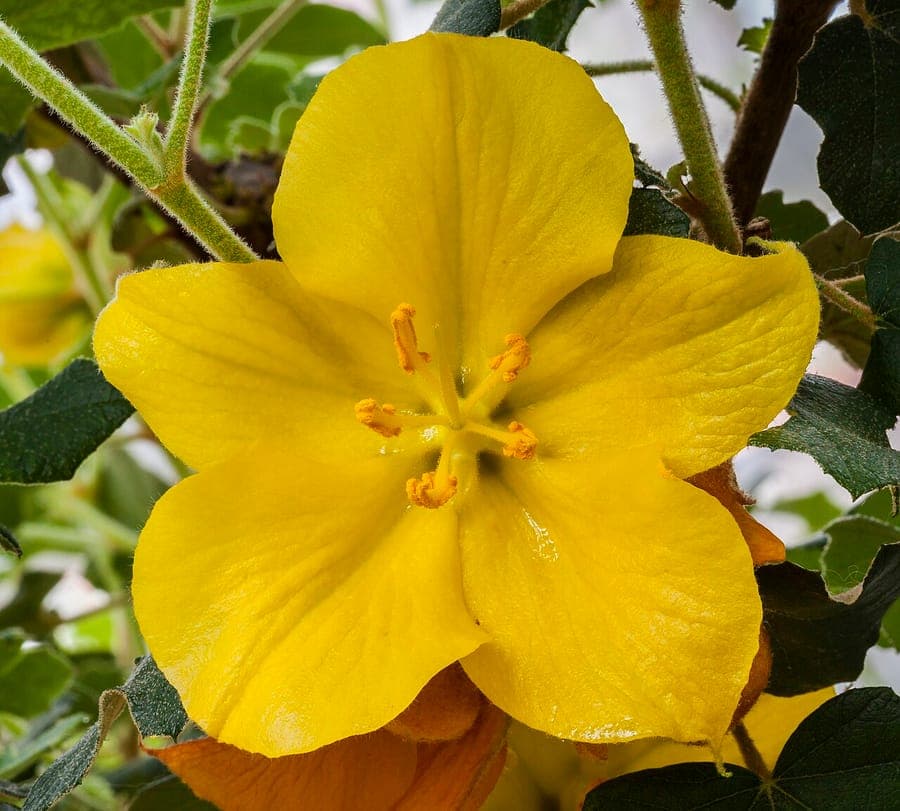
What makes California flannelbush exceptional in a garden setting is the combination of spectacular blooms and extreme drought tolerance. The large, saucer-shaped flowers are technically formed from five showy sepals - true petals are absent in this genus - and reach 5 to 8 cm across. They are produced in extraordinary abundance from early spring through to late summer, with hundreds to thousands open simultaneously on a mature plant. The effect is remarkable: a wall or slope covered in full-blooming flannelbush looks like a cascade of molten gold.
In European gardens, California flannelbush is most successfully grown as a wall shrub in espalier training against a warm, south-facing wall, or as a freestanding specimen on a sheltered sunny slope with excellent drainage. It suits Mediterranean-style planting schemes, gravel gardens and coastal gardens perfectly. At gardenworld.app you can find expert garden design tools to incorporate drought-tolerant feature shrubs like California flannelbush into a cohesive and low-maintenance planting plan.
One important safety note: the fine hairs covering all surfaces of the plant - leaves, stems, fruits and seed capsules - are mildly irritating to skin and mucous membranes. Always wear gloves and consider wearing a dust mask during pruning and any close-contact work with the plant.
Appearance & bloom cycle
California flannelbush is a vigorous, multi-stemmed, semi-evergreen shrub or small tree. In its native California habitat it reaches 3 to 6 metres in height; in European gardens it typically grows 2 to 4 metres tall with a spread of 1.5 to 3 metres. When trained against a wall it can cover a large surface area over several years. The growth rate is moderate to fast once established.
The leaves are the source of the common name: three-lobed to five-lobed, 3 to 7 cm across, and covered on both surfaces with a dense layer of tiny star-shaped hairs that give the foliage its characteristic flannel-like texture and a pale grey-green colour. The undersurface is more densely felted than the upper surface. The leaves are semi-persistent, remaining on the plant through mild winters but dropping in colder conditions.
The flowers are the centrepiece of this plant's appeal. Each is saucer-shaped, 5 to 8 cm across, with five broad golden-yellow sepals surrounding a central column of stamens. Flowering begins as early as March or April on a warm wall in a sheltered garden and continues - with varying intensity - until September or October. The bloom sequence is not a single explosion but a sustained, rolling display of fresh blooms opening continuously as older flowers fade. On a mature espalier-trained specimen in full bloom, the visual impact is extraordinary.
After flowering, ovoid seed capsules 2 to 3 cm long develop, densely covered in irritating hairs, and remain ornamental on the plant throughout winter before opening to release seeds.
Ideal location
California flannelbush demands full sun - a minimum of six to eight hours of direct sunlight per day - and does not tolerate shade. The ideal position mirrors its natural habitat: a warm, sheltered, south-facing aspect, ideally against a south- or south-west-facing masonry wall that absorbs heat during the day and re-radiates it at night, moderating winter cold. In cooler, damper parts of Europe, wall cultivation is often the key to success with this plant.
Ideal garden positions include: espalier-trained against a warm south-facing wall; freestanding on a south-facing slope with excellent natural drainage; as a structural specimen in a gravel garden or Mediterranean border; or in sheltered walled gardens where walls create a favourable microclimate. Exposure to cold, wet winter winds is detrimental. A sheltered microclimate combined with sharp drainage is far more important than a continental-scale mild climate.
In the UK, the Netherlands, Belgium and Germany, the plant is at the edge of its hardiness and benefits greatly from wall protection. In the milder areas of western Europe - coastal Brittany, the Riviera, southern England, Iberia - it can be grown more freely in open positions.
Soil requirements
Soil is critical for California flannelbush, and the requirements differ fundamentally from most ornamental shrubs. This plant is adapted to lean, rocky, perfectly drained soil with a neutral to mildly alkaline pH of 7.0 to 7.5. It actively dislikes rich, fertile, heavy or moisture-retentive soils and consistently underperforms or dies prematurely when planted in typical garden soil without amendment.
The golden rule: drainage before everything else. On heavy clay soils, California flannelbush rarely establishes well. If planting in heavy soil, the only reliable approach is to raise the planting position - on a built-up mound, a terrace, or a slope - and to incorporate generous quantities of sharp grit and coarse sand. A planting mixture of approximately 40% coarse sharp sand, 20% fine gravel and 40% lean loam creates the fast-draining, open structure this plant needs.
Feed sparingly or not at all: excess nitrogen produces lush, weak growth with fewer flowers and increases frost vulnerability. A thin layer of dry gravel mulch around the base is preferable to thick organic mulch. Do not transplant established plants: the deep root system does not tolerate disturbance, and moved specimens rarely recover well. Buy small plants in narrow pots and plant directly into their permanent position.
Free design
Want to see California flannelbush: complete guide in your garden? Make a free design now.
Watering
Once established, California flannelbush is among the most drought-tolerant ornamental shrubs available to European gardeners. In its California homeland, mature plants survive summer-long drought without any supplemental water. In the European garden context, established specimens need water only during genuinely extended dry spells.
In the first growing season after planting, water regularly to encourage root establishment: once weekly during dry periods, applying 15 to 20 litres per plant directly to the root zone using a slow trickle or drip system. Avoid overhead watering. From the second year onwards, reduce watering progressively. A mature, well-established flannelbush in a typical northwest European summer may need supplemental water only during extended droughts of four to six weeks or more.
The most important seasonal rule: keep the roots dry in winter. Waterlogged soil during winter dormancy is one of the most common causes of California flannelbush death in European gardens. Ensure drainage is unimpeded before autumn rains arrive. When in doubt, withhold water - this plant handles drought far better than wet conditions.
Pruning
California flannelbush responds best to a consistent, modest pruning regime rather than occasional drastic interventions. The ideal time to prune is immediately after the main flowering period - typically in late spring or early summer - when the plant is still in active growth and can quickly seal pruning wounds.
In the annual maintenance prune, remove: all dead, damaged or crossing branches; any branches growing out from the wall or trellis on an espalier; and any congested wood deep inside the canopy that reduces airflow. Avoid pruning in autumn or winter, as this stimulates tender new growth vulnerable to frost damage. Do not cut back hard into old wood: unlike many shrubs, California flannelbush does not regenerate reliably from old, bare stems.
Always wear gloves and consider a dust mask when pruning, due to the irritating hairs on stems and seed capsules. Small, regular annual cuts are far preferable to infrequent heavy pruning. After frost damage, wait until early spring to assess which stems have died before removing them.
Maintenance calendar
January-February: Dormancy. No active work required. Check that drainage around the root zone is functioning after winter rainfall. Ensure no water pools at the base.
March: Early buds begin to show. Assess any frost damage but do not prune until it is clear which stems are genuinely dead. First flowers open in sheltered positions.
April-May: Peak bloom. No pruning needed. Water only in exceptionally dry spring conditions.
June: Bloom continues. Light maintenance pruning after the first flowering wave: remove dead wood and crossing branches. Replace gravel mulch around the base if needed.
July-August: Second flush of flowers in well-positioned specimens. Water once if drought extends beyond four weeks. Monitor for any signs of root rot - unlikely in well-drained conditions.
September: Bloom declines. Seed capsules ripen. No further pruning this year.
October-November: Plant enters dormancy. Ensure drainage is clear before the wet season begins. Protect vulnerable specimens with fleece if hard frosts are forecast.
December: Full dormancy. Maintain protection if needed. Do not water.
Winter hardiness
California flannelbush is moderately cold hardy, performing reliably in USDA zones 8b to 10 - corresponding to areas where temperatures rarely fall below -10 to -12 degrees Celsius. In the mildest coastal regions of western Europe, the plant overwinters without any protection. In continental climates with cold winters, it requires wall protection and a sheltered microclimate.
Against a warm south-facing masonry wall, the stored heat mitigates night frosts significantly and the plant can often survive temperatures to -12 or -15 degrees Celsius with minimal damage. Below these temperatures, stems may be killed back, though the plant may regenerate from the base if roots have not been damaged by waterlogging. The combination of cold and wet soil is far more lethal than cold alone.
In marginal climates, protect the root zone with a dry mulch of straw or pine needles, 10 to 15 cm deep, before the first hard frosts. Wrap the lower stems and the base of the canopy in two to three layers of horticultural fleece. Container-grown specimens should be moved to an unheated but frost-free space - an unheated greenhouse, garage or conservatory - before temperatures drop below -5 degrees Celsius.
Companion plants
California flannelbush combines naturally with other sun-loving, drought-tolerant plants that share its preference for lean, well-drained soil. Excellent companions available at specialist garden centres include:
- Cistus x purpureus or Cistus ladanifer (rock rose): the same preference for poor, dry soil and full sun; pink or white flowers with dark basal blotches create a beautiful colour contrast alongside the golden-yellow of flannelbush.
- Rosmarinus officinalis (rosemary): shared drought tolerance and a classic Mediterranean companion, adding aromatic interest and structure.
- Phlomis fruticosa (Jerusalem sage): grey-silver foliage and yellow flowers that harmonise perfectly with flannelbush in a dry-garden scheme.
- Artemisia 'Powis Castle' (wormwood): the fine, silver-grey foliage provides strong visual contrast and reinforces the Mediterranean-Californian character of the planting.
- Salvia clevelandii (Cleveland sage): from the same California chaparral habitat as flannelbush, this aromatic sage makes an authentic companion in a Californian-inspired planting.
- Achillea millefolium in yellow or cream cultivars: low-growing groundcover that fills in around the feet of taller specimens and suppresses weeds in dry conditions.
Combining these plants with California flannelbush creates a coherent, seasonally interesting and genuinely low-maintenance dry garden that references the beauty of California's native flora. Visit gardenworld.app for professional design tools to help you build a Mediterranean or drought-tolerant garden scheme tailored to your outdoor space.
Closing
Fremontodendron californicum is a spectacular and genuinely memorable shrub for the warm, sunny and well-drained European garden. The months-long display of large golden flowers, the extraordinary drought tolerance, the characterful flannel-textured foliage and the ability to cover a large wall with minimal inputs make this one of the most rewarding shrubs for gardeners willing to provide the right conditions.
The rule for success is straightforward: give it the driest, sunniest, leanest spot in your garden, restrict watering and feeding almost completely once established, and this remarkable Californian shrub will reward you with a seasonal floral display that few other plants can match. For inspiration and professional garden design support, visit gardenworld.app and explore planting plans built around drought-tolerant feature plants like California flannelbush.
Want to see California flannelbush: complete guide in your garden? Make a free design now.
Upload a photo, pick a style, and get a photorealistic design with plant list in under a minute.
10,000+ gardens designed already
No credit card required


Similar plants
Crimean linden: complete guide
Tilia × euchlora
Crimean linden is an elegant, fast-growing shade tree ideal for large gardens. Discover cultivars, spacing, maintenance tips and winter hardiness.
Hairy rose mallow: complete guide
Hibiscus moscheutos subsp. lasiocarpos
Full growing guide for hairy rose mallow (Hibiscus moscheutos subsp. lasiocarpos): location, soil, watering, winter hardiness and garden design tips.
Island mallow: complete guide
Malva assurgentiflora
Island mallow (Malva assurgentiflora) is a fast-growing flowering shrub with bold pink-purple blooms, perfect for warm, sunny gardens.