
Curtis Clark / CC BY-SA 2.5, via Wikimedia Commons
Island mallow: complete guide
Malva assurgentiflora
Want to see Island mallow: complete guide in your garden?
1 minute, no credit card
Overview
Island mallow (Malva assurgentiflora) is a vigorous, shrubby plant belonging to the Malvaceae family. Native to the Channel Islands off the California coast, this species has found enthusiastic admirers across warm-temperate gardens worldwide. With its spectacular long-lasting flowers and rapid establishment, it stands out as one of the most rewarding choices for gardeners who want vivid colour from spring through autumn. On gardenworld.app you can find inspiration for designing garden spaces that highlight bold flowering shrubs like island mallow.
Appearance and bloom cycle
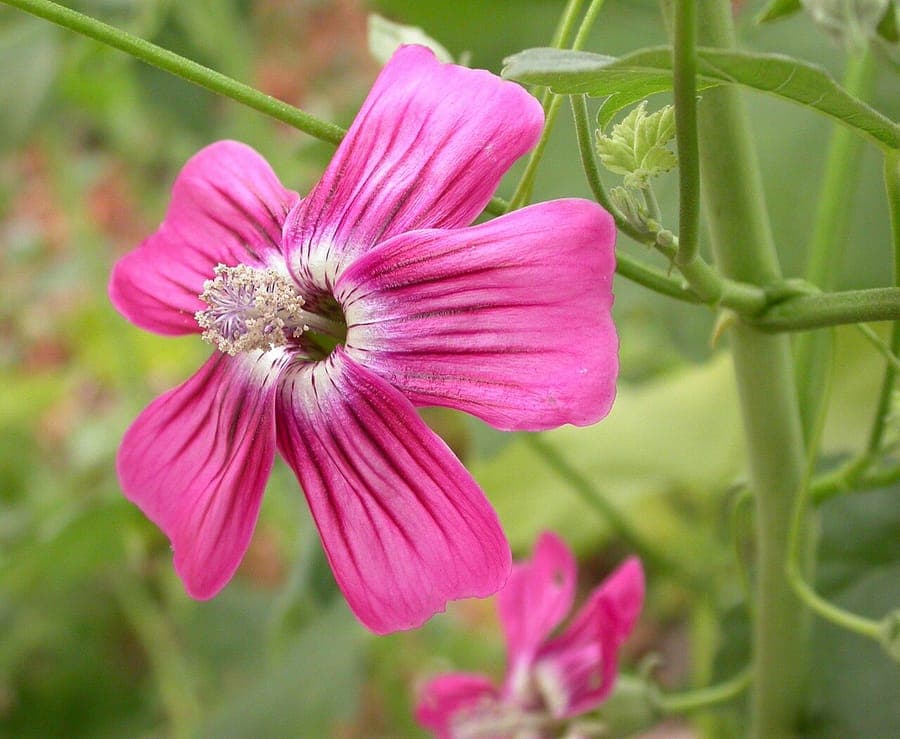
Island mallow grows as a loose, semi-woody shrub reaching 200 to 400 cm in height when mature. The stems are light grey-green and slightly hairy. Leaves are large, palmately lobed with five to seven lobes, and have a notably coarse texture. They closely resemble common mallow foliage but on a grander scale. The flowers are the real showpiece: measuring 6 to 8 cm across, each bloom presents five broad, shallowly notched petals in vibrant pink-purple with darker veining toward the centre. The blooming period extends from April through October, sometimes even longer in mild coastal climates. This extraordinarily long season ensures months of reliable colour in the garden.
Ideal location
This shrub performs best in a warm, open position with full sun for at least six to eight hours daily. A sheltered spot against a south-facing wall or fence helps plants survive winter in cooler regions. In Mediterranean or oceanic climates, island mallow thrives in open garden beds without any special protection. In areas with more continental winters, container growing is a practical choice, allowing the plant to be moved under cover when temperatures drop. The species is notably tolerant of salt-laden coastal winds, making it a fine choice for seaside gardens.
Soil
Island mallow is undemanding about soil type but prefers well-drained, moderately fertile ground. A slightly sandy or loamy soil with a pH between 6.8 and 7.5 suits it perfectly. Heavy clay soils that remain wet for extended periods are problematic, as the roots are prone to rot in poorly drained conditions. If your garden has clay-heavy soil, work in coarse grit or sand before planting to improve drainage. Adding a shovelful of compost at planting time gives the shrub a good start, but avoid excess nitrogen, which promotes leafy growth at the expense of flowers.
Watering
Once established, island mallow is reasonably drought-tolerant and copes well with dry spells. During the first growing season, regular watering is important to help the plant develop a strong root system. Established specimens can handle short dry periods without visible stress. During prolonged summer heat, a deep weekly watering at the base of the plant is beneficial. Avoid waterlogging and standing water around the roots at all times. Container plants dry out faster than those grown in open ground and will need watering more frequently. A mulch layer of straw or bark chips around the base helps retain moisture and suppress competing weeds.
Free design
Want to see Island mallow: complete guide in your garden? Make a free design now.
Pruning
Island mallow responds well to cutting back. After winter, when the risk of frost has passed, cut the shrub back hard - to about 30 to 50 cm above ground level - to rejuvenate it and maintain a compact, tidy form. This encourages strong new shoots and generous flowering. During the growing season, spent blooms can be removed regularly to extend the flowering period. Dead or damaged branches should be cut out as soon as they are noticed. A light trim after the first flush of flowers in June can encourage a second wave of blooms in August and September.
Maintenance calendar
In February or March, once the hardest frosts have passed, cut the shrub back firmly and remove all dead wood. In April, apply a layer of compost or a slow-release fertiliser around the base. May sees the first flowers appear and requires regular checks for aphids or whitefly. From June to August the plant is at its most spectacular and demands little other than watering. In September you can collect dried seed capsules for future propagation. October is the time to review frost protection measures and add extra mulch around the roots. From November through January the plant rests and only occasional inspection of protective coverings is needed.
Winter hardiness
Malva assurgentiflora is only moderately frost-hardy. It tolerates light frosts down to around -5 degrees Celsius but can be cut back to the ground by sustained hard freezes. In USDA zone 9 and warmer, the plant overwinters outdoors without any protection. In zone 8, wrapping the base of the stems in hessian and covering the root zone with a thick mulch layer gives useful protection. In zone 7 and below, it is most reliably grown as an annual or kept in a container that can be brought under cover for winter. Container-grown plants overwinter well in a cool, bright room at temperatures between 2 and 8 degrees Celsius.
Frost protection in practice
Young plants are more vulnerable to cold than well-established specimens with deep root systems. In the first winter after planting, take extra precautions: protect the base with a generous mulch and wrap stems with a light horticultural fleece when frost is forecast. If the top-growth is killed by frost, do not cut the stems back until late spring, as the die-back itself offers some insulation to the crown. Plants that have been frozen back often regenerate vigorously from the base once warm weather returns.
Companion plants
Island mallow pairs beautifully with other Mediterranean and drought-tolerant plants. Lavender (Lavandula angustifolia), rosemary (Salvia rosmarinus), and various Cistus species make excellent companions, sharing similar preferences for sun and well-drained soil. For vibrant colour contrasts, try orange Kniphofia or yellow Rudbeckia alongside the pink-purple flowers. Blue-grey fescue grasses provide a pleasing textural foil. Butterflies and bees are drawn to the abundant nectar, making island mallow a valuable addition to any pollinator-friendly planting scheme. Discover how to combine it with complementary plants in a complete garden design at gardenworld.app.
Closing thoughts
Island mallow is a bold, fast-growing shrub that brings months of spectacular colour to warm, sunny gardens. It is straightforward to maintain, drought-tolerant once established, and highly attractive to pollinators. Anyone able to offer a sheltered, sunny position will enjoy years of rewarding performance from this Californian beauty. With appropriate frost protection in cooler climates and a firm annual cut-back, island mallow returns each season stronger and more floriferous than the year before.
Want to see Island mallow: complete guide in your garden? Make a free design now.
Upload a photo, pick a style, and get a photorealistic design with plant list in under a minute.
10,000+ gardens designed already
No credit card required


Similar plants
Crimean linden: complete guide
Tilia × euchlora
Crimean linden is an elegant, fast-growing shade tree ideal for large gardens. Discover cultivars, spacing, maintenance tips and winter hardiness.
California flannelbush: complete guide
Fremontodendron californicum
Everything about California flannelbush (Fremontodendron californicum): sunny placement, drainage, pruning and care for this spectacular yellow-flowering shrub.
Hairy rose mallow: complete guide
Hibiscus moscheutos subsp. lasiocarpos
Full growing guide for hairy rose mallow (Hibiscus moscheutos subsp. lasiocarpos): location, soil, watering, winter hardiness and garden design tips.