
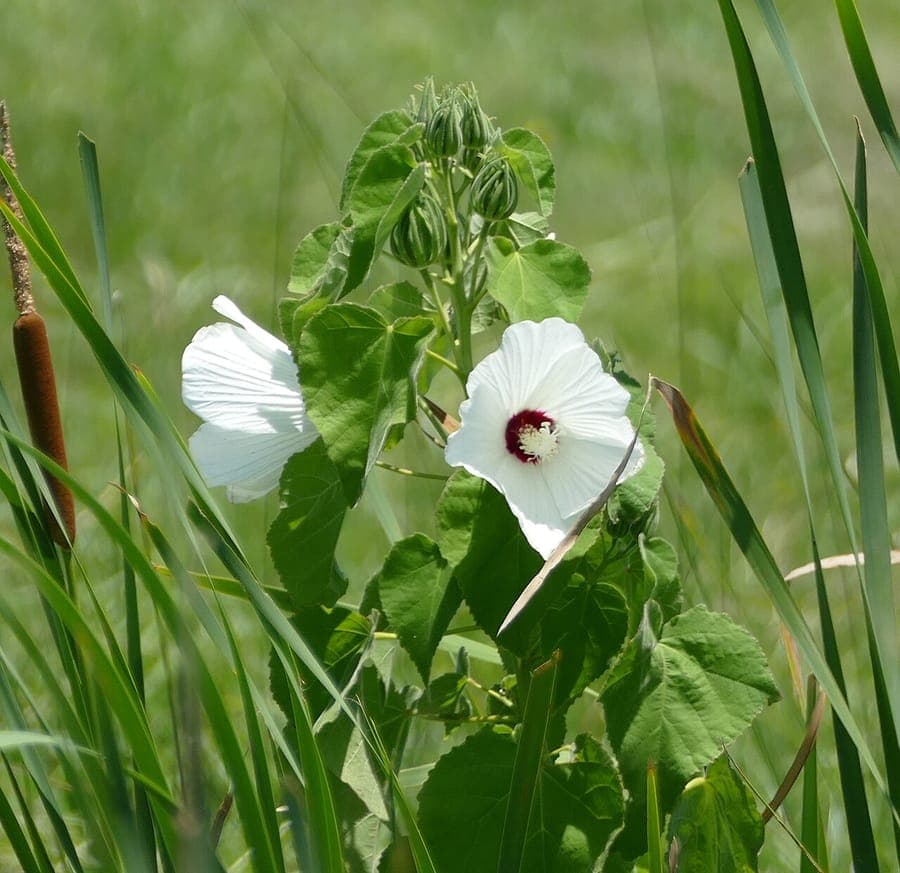
(c) Wendy McCrady, some rights reserved (CC BY) / CC BY 4.0, via Wikimedia Commons
Hairy rose mallow: complete guide
Hibiscus moscheutos subsp. lasiocarpos
Want to see Hairy rose mallow: complete guide in your garden?
1 minute, no credit card
Overview
Hairy rose mallow (Hibiscus moscheutos subsp. lasiocarpos) is a bold herbaceous perennial belonging to the mallow family (Malvaceae). Native to the central and southern United States, from Texas and Louisiana up through Illinois and Indiana, it grows naturally along riverbanks, in marshes, and in wet meadows. The subspecies name 'lasiocarpos' is derived from the Greek for 'hairy fruit', a reference to the densely pubescent seed capsules that form after flowering. Gardeners seeking a plant that delivers a tropical impression while being fully winter hardy will find this rose mallow a rewarding choice. You can explore garden layouts featuring this plant on gardenworld.app.
Appearance and bloom cycle
Hairy rose mallow forms a multi-stemmed herbaceous clump that typically reaches 100 to 180 cm in height during a single growing season. Stems are robust and covered with a dense grey-white pubescence that gives the plant a distinctive soft texture. Leaves are broadly heart-shaped to shallowly lobed, with coarsely toothed margins and a velvety undersurface. The flowers are the star attraction: each bloom can measure 20 to 25 cm across, with five broad overlapping petals in shades of clear pink or white, often featuring a dark crimson or burgundy eye at the centre. The stamens are fused into the characteristic central column typical of the Malvaceae family. In temperate gardens, flowering generally begins in July and continues into September. Each individual flower lasts only a single day, but a well-established plant produces so many buds that fresh blooms open continuously over a period of weeks. After flowering, hairy capsular fruits develop, packed with small round seeds that can be collected and sown.
Ideal location
This mallow thrives in a position with full sun exposure, requiring at least six hours of direct sunlight daily to produce abundant blooms. A sheltered spot, protected from strong winds, is advisable because the tall stems can snap or fall over in severe storms. In the garden, it excels at the back of a border, beside a water feature, or as a standalone accent plant in a lawn. It tolerates light partial shade but flowers less freely there. In a south-facing front garden with reliable soil moisture, it will perform at its absolute best.
Soil
Hairy rose mallow has a strong preference for consistently moist, humus-rich soil. It will not thrive in dry, sandy conditions unless copious quantities of organic material are incorporated and regular mulching keeps moisture in. Clay-rich soils suit it well, provided there is no permanent waterlogging, which leads to root problems. The acceptable pH range is broad, from 4.0 to 7.5, meaning the plant adapts to most ordinary garden soils. Before planting, work in a generous layer of well-rotted compost or leaf mould, and top-dress with a mulch of bark chips or straw. Local garden centres stock moisture-retentive planting composts that work particularly well for this species.
Watering
Being a natural wetland plant, hairy rose mallow reacts quickly to drought stress: leaves droop, flower buds abort, and the display ends prematurely. During the growing season, deep watering two to three times per week is recommended in dry spells. The goal is to encourage roots to penetrate deeply rather than remaining near the surface. A thick layer of mulch around the base of the plant - 5 to 10 cm of bark or straw - dramatically reduces the watering workload by conserving soil moisture. In gardens with heavy clay that retains moisture naturally, supplemental watering may be needed only during prolonged dry periods.
Free design
Want to see Hairy rose mallow: complete guide in your garden? Make a free design now.
Pruning
Although technically a perennial, all above-ground growth dies back completely each winter. New shoots emerge slowly in spring - often not until mid-May or later in cooler climates - which frequently causes concern among gardeners who assume the plant has died. Resist the urge to dig it up. The simplest approach is to cut old stems back to about 15 cm above ground level in autumn after the first frosts, leaving a stub that marks the plant's position and provides a little insulation. Alternatively, leave the stems standing over winter to trap snow and debris, then remove everything in spring once new red or green shoots are visible at the base. No pinching, staking of individual shoots, or deadheading is required.
Maintenance calendar
March and April require no action - the roots are alive underground but growth is not yet visible. In May, remove old stem stubs as soon as new shoots emerge. In June, apply a mulch layer around the base and ensure soil moisture is maintained as warmer weather arrives. July and August are the peak flowering months - water regularly and enjoy the display. September and October bring the end of flowering; after the first hard frost, cut stems to 15 cm. November and December: add a protective layer of dry leaves or straw over the crown if hard winters are expected.
Winter hardiness
Hairy rose mallow is rated for USDA hardiness zones 5 to 9, meaning the roots can withstand minimum temperatures of around -28 degrees Celsius when properly protected. Across most of northern and western Europe it survives outdoors reliably, provided the roots are not sitting in permanently waterlogged soil during winter. In colder regions or in containers that cannot be protected in place, bringing the pot into a frost-free garage or shed is prudent. The key point is that this plant is considerably slower to emerge in spring than most perennials - patience until late May is often needed.
Companion plants
The large, dramatic flowers of hairy rose mallow work best alongside plants with finer foliage or more modest flower size to avoid visual clutter. Excellent partners include maiden grass (Miscanthus sinensis), daylilies (Hemerocallis), purple coneflower (Echinacea purpurea), or tall meadow rue (Thalictrum). Beside a pond it combines naturally with purple loosestrife (Lythrum salicaria) and meadowsweet (Filipendula ulmaria). In a late summer border, deep red dahlias or orange crocosmia provide contrast in colour while echoing the bold, tropical mood.
Closing
Hairy rose mallow (Hibiscus moscheutos subsp. lasiocarpos) is one of the most impressive hardy perennials available to temperate gardeners. Its enormous blooms and lush foliage create an unmistakable tropical atmosphere, while the plant's cold hardiness means no special winter protection is needed in most gardens. Give it moisture, sunshine, and patience in spring, and it will reward you with weeks of spectacular flowering year after year. Visit gardenworld.app to see how this plant can transform a damp corner of your garden into a bold focal point.
Want to see Hairy rose mallow: complete guide in your garden? Make a free design now.
Upload a photo, pick a style, and get a photorealistic design with plant list in under a minute.
10,000+ gardens designed already
No credit card required


Similar plants
Mallow-rose: complete guide
Hibiscus moscheutos
A practical guide to growing Hibiscus moscheutos in temperate gardens. Learn about soil, sun, watering, and how to keep it blooming all summer.
Rose-of-sharon: complete guide
Hibiscus syriacus
Hibiscus syriacus, or Rose-of-sharon, is a deciduous shrub with large purple flowers in late summer. Hardy in zones 5–9. Full care guide for gardeners.
Malva sylvestris: complete guide
Malva sylvestris
Malva sylvestris: Common mallow with magenta blooms and dark purple veins. Versatile, hardy, easy-growing. European classic.