Wouter Hagens / CC BY-SA 4.0, via Wikimedia Commons
Skimmia × confusa 'Kew Green': complete guide
Skimmia × confusa
Want to see Skimmia × confusa 'Kew Green': complete guide in your garden?
Full design in HD: €7.99
Look after your Skimmia × confusa 'Kew Green' with the GardenWorld app
Identify plants with your camera and get a care calendar with reminders for this plant.


Overview
Skimmia × confusa is a compact evergreen shrub that looks tidy all year round and, in early spring, ranks among the most fragrant plants in the garden. It belongs to the rue family (Rutaceae), the same family as citrus, and you can tell: crush a leaf between your fingers and it releases a spicy, faintly citrus scent.
The plant is a hybrid between Skimmia anquetilia from the Himalaya and the familiar Skimmia japonica. In garden centres it is nearly always sold as the cultivar 'Kew Green', a male clone selected at the Royal Botanic Gardens, Kew, which holds the RHS Award of Garden Merit. Because 'Kew Green' is male, it does not produce berries. It is, however, an excellent pollinator for female Skimmia japonica nearby, helping them set more of their red berries.
The shrub grows 50 cm to 1 m tall and 1 to 1.5 m wide, forming a broad dome. It grows slowly, so it stays in scale for many years in a border, a shady front garden or a large container on the patio.
Appearance and bloom cycle
The leaves are lance-shaped, 8 to 15 cm long, smooth-edged and glossy mid to dark green. They stay on through winter and are held in whorls at the ends of the shoots, which gives the shrub a dense, well-groomed look.
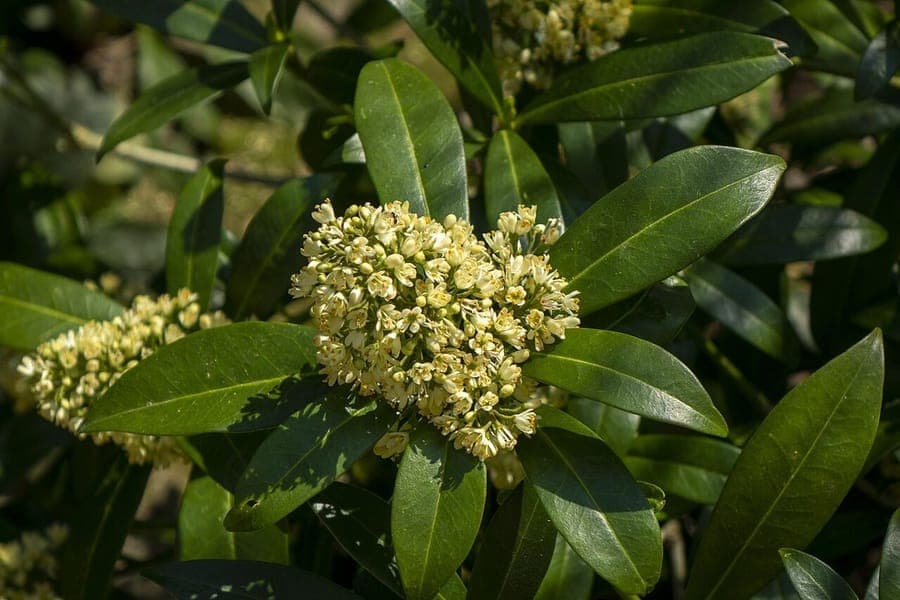
The flower buds appear as early as autumn, in conical heads 8 to 12 cm long. On 'Kew Green' they are pale green and remain on show all winter, so the plant is decorative in November and December too. In March and April the buds open into creamy white to cream-yellow, star-shaped flowers with prominent yellow stamens, as in the photo. The scent is sweet and strong, reminiscent of lily of the valley, and on a mild spring day you can smell it several metres away. Early bees and bumblebees visit eagerly at a time when there is little nectar about.
Ideal location
Skimmia × confusa does best in partial or light shade in a sheltered spot. Morning and evening sun are fine, but fierce midday sun and drying winds turn the leaves yellow or bleached. A position on the north or east side of the house, under tall trees or in the lee of a hedge is ideal. 'Kew Green' takes a little more light than most skimmias, but full sun on dry soil is still best avoided.
Plant it where you pass by: beside the front door, along a path or near a seat, so you get the full benefit of the scent in spring. It also does well in containers on a shady balcony or patio. Space plants 80 cm to 1 m apart for a group or a low, informal hedge.
Soil requirements
Skimmia likes humus-rich soil that stays cool and slightly moist but never waterlogged. It prefers slightly acid to neutral conditions. Skimmia × confusa tolerates a little more lime than Skimmia japonica, but on clearly chalky soil the leaves often turn yellow between the veins. That is chlorosis caused by iron deficiency.
When planting, work plenty of leaf mould or compost into the top 30 cm. On heavy clay, open the soil up with compost and some grit so water does not lie around the roots. Wet roots in winter easily lead to root rot. In containers, use ericaceous compost, the kind sold for rhododendrons, with a drainage hole and a layer of crocks. A mulch of fine bark or leaf mould keeps the soil cool and moist.
Watering
In the first year after planting, water regularly, about once a week in dry weather, until the roots are established. After that, a skimmia in open ground usually manages on rainfall. Only during long summer droughts, especially under trees where roots compete, give it an occasional thorough soaking of around 10 litres.
Container plants need more attention. In summer, check every few days and water when the top few centimetres feel dry. Rainwater is best, because hard tap water gradually makes the compost less acidic. Do not let the root ball dry out completely in winter either: evergreens still lose water through their leaves, especially in sun and wind.
Feeding needs are modest. A handful of ericaceous fertiliser or a layer of compost in March is enough. The plant calendar at gardenworld.app shows month by month what your plants need, so feeding and mulching happen at the right moment.
Free preview
Want to see Skimmia × confusa 'Kew Green': complete guide in your garden? Make a free preview of your design.
Pruning
Skimmia × confusa is naturally compact and needs very little pruning. If you want to tidy its shape, do it straight after flowering, in April or May. Cut overlong or wayward shoots back to just above a whorl of leaves. Avoid pruning in late summer or autumn, as you would remove next spring's flower buds.
Remove dead or frost-damaged twigs in spring. Older shrubs that have become bare at the base can be rejuvenated gradually by cutting one or two of the oldest stems low down each year. Sprigs with buds also look lovely in a vase or a winter arrangement.
Maintenance calendar
March-April: Flowering, with a strong scent. Apply ericaceous feed or compost and renew the mulch.
April-May: Lightly shape after flowering if needed. A good time to plant or repot.
June-August: Water in dry spells, especially container plants. Check the undersides of leaves for scale insects.
September-October: New flower buds appear. Stop pruning. Another good planting window.
November-February: The buds decorate the shrub. Protect container plants in hard frost and keep the root ball from drying out.
Winter hardiness
Skimmia × confusa is reliably hardy. The Royal Horticultural Society rates 'Kew Green' H5, which corresponds to roughly -15 °C. In the Low Countries and most of Britain it comes through normal winters in open ground without protection. In long, hard frosts combined with bright sun and wind, the leaves may develop brown edges, which a sheltered spot helps prevent.
In containers the plant is more vulnerable because the roots are less insulated. In severe frost, move the pot against a wall, raise it on pot feet or a sheet of insulation, and wrap it in hessian or bubble wrap if needed.
Note that the RHS classes skimmia as potentially harmful if eaten. The leaves and berries contain alkaloids that can cause nausea or stomach upset in people and pets. 'Kew Green' bears no berries, but keep children and pets from chewing the foliage.
Companion plants
Skimmia × confusa makes a strong backbone for a shady border of acid-loving plants. Pieris (Pieris japonica) shares its needs and flowers at about the same time with white bell-shaped clusters, while its young growth emerges red. At its feet, try Lenten roses (Helleborus orientalis), which flower from February to April, and the low checkerberry (Gaultheria procumbens) with its red winter berries.
For more height and winter flowers, laurustinus (Viburnum tinus) works well as a backdrop. Sedges such as Carex morrowii, with their narrow, often white-edged leaves, add movement against the rounded outline of the skimmia. You can also pair 'Kew Green' with a female Skimmia japonica for red berries beside the green buds.
Want to make the most of a shady corner or front garden? At gardenworld.app you can have a garden design made in which skimmia, ferns and other shade plants come together as a calm, evergreen whole.
Final thoughts
Skimmia × confusa is one of the best evergreen shrubs for partial shade. It stays compact, looks smart all year, decorates the winter with its buds and fills the spring air with scent. Care is simple: humus-rich, rather acid soil, no full midday sun, water during dry spells and hardly any pruning. Plant it near the front door or a path, and every spring you will be reminded why gardeners are so fond of it.
Frequently asked questions about Skimmia × confusa 'Kew Green'
Is Skimmia × confusa 'Kew Green' winter hardy?
Skimmia × confusa is reliably hardy. The Royal Horticultural Society rates 'Kew Green' H5, which corresponds to roughly -15 °C.
When and how do you prune Skimmia × confusa 'Kew Green'?
Skimmia × confusa is naturally compact and needs very little pruning. If you want to tidy its shape, do it straight after flowering, in April or May.
How much water does Skimmia × confusa 'Kew Green' need?
In the first year after planting, water regularly, about once a week in dry weather, until the roots are established. After that, a skimmia in open ground usually manages on rainfall.
Where does Skimmia × confusa 'Kew Green' grow best?
Skimmia × confusa does best in partial or light shade in a sheltered spot. Morning and evening sun are fine, but fierce midday sun and drying winds turn the leaves yellow or bleached.
What soil does Skimmia × confusa 'Kew Green' need?
Skimmia likes humus-rich soil that stays cool and slightly moist but never waterlogged. It prefers slightly acid to neutral conditions.

See it in your garden
See Skimmia × confusa 'Kew Green' in your garden
One photo of your garden and a few questions. You see the result in about a minute.
Try it with a photoIdentify this plant in your own garden. Identify a plant
Similar plants
Japanese pieris: complete guide
Pieris japonica
Complete care guide for Japanese pieris (Pieris japonica): ideal location, soil, watering, pruning and companion plants. Perfect for shaded, acidic gardens.
Lenten-rose: complete guide
Helleborus orientalis
Learn how to grow and care for Helleborus orientalis. This early-blooming perennial thrives in shady spots and flowers from February to April, adding colour when little else is blooming.
Gaultheria procumbens: complete guide
Gaultheria procumbens L.
Wintergreen is an elegant low shrub with white flowers and glossy bright red berries. Perfect for shaded corners and beautiful woodland gardens today.
