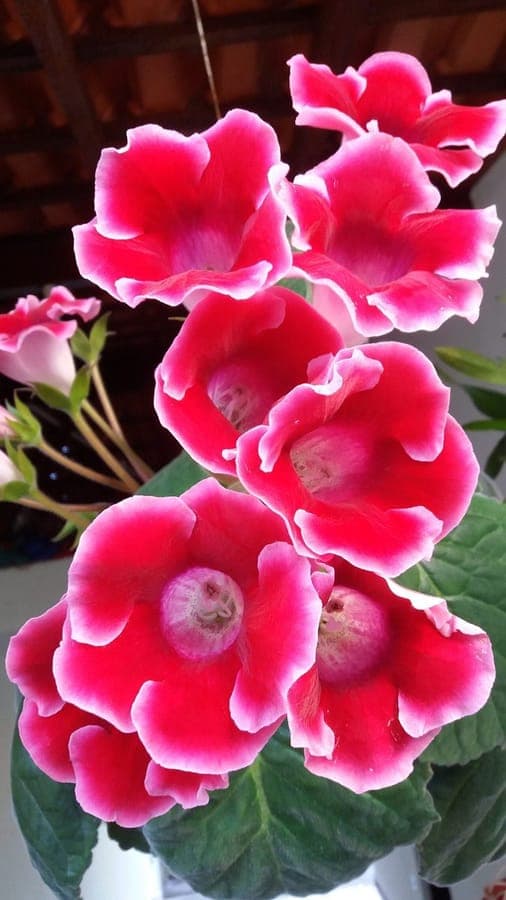
Antoninhocd / CC BY-SA 4.0, via Wikimedia Commons
Gloxinia (Sinningia speciosa): complete guide
Sinningia speciosa
Want to see Gloxinia (Sinningia speciosa): complete guide in your garden?
Full design in HD: €7.99
Look after your Gloxinia with the GardenWorld app
Identify plants with your camera and get a care calendar with reminders for this plant.


Overview
Gloxinia (Sinningia speciosa) is one of the great flowering houseplants, a pot plant that has brightened windowsills since Victorian times. Its large, velvety bells come in crimson, deep purple, pink and white, often with a contrasting white edge or a freckled throat, and they sit above a rosette of soft, downy leaves. It belongs to the Gesneriaceae family, the same family as the African violet, and shares that plant's love of warmth, bright filtered light and even moisture.
The name gloxinia is a historical leftover. Botanists once placed the plant in the genus Gloxinia, but it was later moved to Sinningia. Gardeners and growers simply kept the old name, which is why florist's gloxinia is still the usual label on the pot. The true genus Gloxinia still exists, but it holds different plants that you will rarely meet in a garden centre.
In the wild, Sinningia speciosa grows in south-eastern Brazil, on shaded rocks and slopes in the Atlantic Forest. There it forms a tuber that carries it through dry spells. That tuber is the key to keeping the plant for years: after flowering it dies back, rests for a few months and then shoots again. Plenty of people throw their gloxinia away when the last flower fades, but with a little care during the rest period the same plant will return every spring.
Appearance and flowering
Gloxinia forms a low, compact rosette 20 to 30 cm tall and about as wide. The leaves are oval, 10 to 20 cm long, dark green and covered in fine hairs that give them a velvety feel.
The flowers rise on short stalks just above the foliage. Modern cultivated forms carry upright, wide-open bells 6 to 10 cm across with five or six frilly lobes. The photo shows a classic example: rich red bells with a broad white margin and a pale, speckled throat. The wild form is quite different, with smaller, nodding, slipper-shaped purple flowers. Popular colour groups include solid reds, dark violets, whites, pinks and the tigrina types with spotted throats.
Plants are mainly sold from March to September and bloom indoors for two to three months. A healthy plant opens ten to twenty flowers in succession.
Position in the home
Choose a bright, warm spot free from draughts. An east- or west-facing windowsill is ideal. A south-facing window also works if a net curtain softens the midday sun. Keep the plant away from open windows, outside doors and air conditioning, because cold air leads to brown blotches and dropped buds.
Give the pot a quarter turn each week. Leaves and flowers lean towards the light, and turning keeps the plant neat and even.
Light
Light is what drives a generous display. During growth, gloxinia wants plenty of bright, indirect light, ideally twelve to fourteen hours a day. Too little light shows as long, floppy leaf stalks and flowers that stay small or fail to open. Too much direct sun scorches the leaves, leaving yellow or bleached patches. If your windows are dim, a small LED grow light 30 to 40 cm above the plant makes a noticeable difference.
Humidity and temperature
While growing and flowering, Sinningia speciosa is happiest between 18 and 24 °C. Below 15 °C growth stalls and the leaves become prone to rot. Above 28 °C, on a hot sill in July for instance, the flowers soon droop.
Aim for humidity of around 50 to 60 percent. Do not mist the foliage: water droplets linger on the hairy leaves and cause spots or mould. Instead, stand the pot on a tray of damp pebbles, or group several houseplants together so they raise the humidity around each other. That helps a great deal in rooms with underfloor heating or a stove.
Compost and repotting
Use an open, peat-free compost for flowering houseplants, or mix ordinary houseplant compost with a third perlite. The mix should hold moisture without staying soggy, because the tuber rots quickly in waterlogged soil. A pot with drainage holes is essential.
Never repot a plant in full flower. Repotting happens after the rest period, in February or March. Lift the tuber, remove any dead roots and set it in fresh compost in a 12 to 15 cm pot. Place it hollow side up and cover it with only a thin layer of compost. Water sparingly until the first shoots appear.
Free preview
Want to see Gloxinia (Sinningia speciosa): complete guide in your garden? Make a free preview of your design.
Watering and feeding
During growth and flowering, keep the compost evenly moist but never wet. Use water at room temperature; cold water leaves pale marks on the leaves. The safest method is to water from below: stand the pot in a saucer of water for fifteen minutes, then tip away whatever is left. If you water from above, pour around the edge of the pot rather than into the centre of the rosette.
From April to August, feed every two weeks with a liquid fertiliser for flowering plants at half the recommended strength. Stop feeding once flowering ends and the leaves start to yellow.
Rest period
After flowering, usually in autumn, the leaves turn yellow. That is not a disease but the start of dormancy. Gradually reduce watering until the foliage has withered completely, then cut it off. Leave the tuber in its dry pot and keep it somewhere dark and cool at 10 to 15 °C, such as a cupboard in a spare room or a frost-free shed. Give no water for two to four months, or only a small sip if the tuber starts to shrivel.
In February or March, repot the tuber and bring it back into a warm, bright room. New shoots usually appear within a few weeks. On large tubers, keep only two or three of the strongest shoots for a sturdier plant with bigger flowers.
Propagation
Leaf cuttings are the easiest way to propagate gloxinia. In spring or summer, cut a healthy, mature leaf with 2 to 3 cm of stalk. Insert the stalk at an angle into a small pot of moist seed and cutting compost and cover it with a clear bag or propagator lid. At 20 to 22 °C in good light, a tiny tuber forms at the base within a few weeks, followed by young leaves. Air the cover briefly each day to prevent mould.
Large tubers can also be divided at repotting time, as long as each piece has at least one growing point. Let the cut surfaces dry for a day before planting. Seed is possible too, but it is dust-fine and seedlings take five to seven months to flower.
Toxicity to pets
Good news for cat and dog owners: the ASPCA, the American animal welfare organisation that keeps a widely used list of toxic and non-toxic plants, lists Sinningia speciosa as non-toxic to dogs, cats and horses. No toxic compounds are known in the plant. That said, any animal that eats a lot of plant material can end up with a mildly upset stomach, so it is still wise to keep the pot out of reach. Chewed leaves also set the plant back considerably.
Care calendar
February-March: Wake the tuber from rest, repot in fresh compost and place in a bright spot at about 20 °C. Water sparingly until shoots appear.
April-May: Strong growth. Start feeding every two weeks. Thin shoots on large tubers.
June-August: Flowering season. Remove spent flowers with their stalks to encourage more buds. Protect from harsh midday sun and heat above 28 °C.
September-October: Flowering winds down. Stop feeding and reduce watering gradually.
November-January: Dormancy. Cut off the dead leaves and store the tuber dry and dark at 10 to 15 °C.
The plant calendar on gardenworld.app is a handy reminder for jobs such as repotting and starting the rest period, season by season.
Companion plants
Gloxinia looks lovely alongside other plants that enjoy the same warm, bright and slightly humid conditions. Its relative the African violet (Saintpaulia) is a natural partner. A painted-leaf begonia (Begonia rex) adds foliage colour without competing with the flowers. Flamingo flower (Anthurium andraeanum) and peace lily (Spathiphyllum) need very similar care. Group them on a wide windowsill or a plant table, where together they raise the humidity around their leaves.
Do you have a conservatory or covered patio? On gardenworld.app you can have a garden design made that also takes in spaces such as a veranda or garden room, so your pot plants and garden work as one.
Final thoughts
Sinningia speciosa is far more than a throwaway plant for a single season. Give it bright light without harsh sun, room-temperature water from below and a warm, draught-free spot, and it will flower generously for weeks. Respect its rest period afterwards and repot the tuber in spring, and it will return year after year, often larger and with more flowers than before. The fact that it is safe around cats and dogs makes it an easy choice for almost any household.

See it in your garden
See Gloxinia in your garden
One photo of your garden and a few questions. You see the result in about a minute.
Try it with a photoIdentify this plant in your own garden. Identify a plant
Similar plants
King Begonia: complete guide
Begonia rex
The painted-leaf begonia, Begonia rex, is a spectacular foliage plant with incredible leaf patterns in silver, red, pink, and purple. Discover everything about care, propagation, and enjoying this prima donna of the plant world.
Flamingo-lily: complete guide
Anthurium andraeanum
Discover Anthurium andraeanum - a stunning tropical houseplant with iconic red heart-shaped flowers. Our complete care guide covers watering, humidity, propagation, and interior styling.
Peace lily: complete guide
Spathiphyllum wallisii
How to grow a peace lily (Spathiphyllum wallisii): light, watering, repotting, getting it to flower again, and why it is toxic to cats and dogs.
