
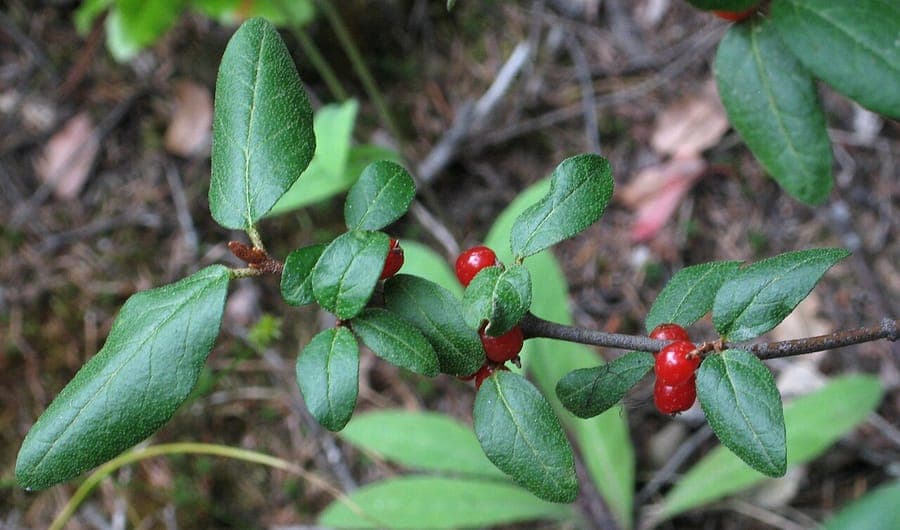
Robert Flogaus-Faust / CC BY 4.0, via Wikimedia Commons
Canadian buffalo-berry: complete guide
Shepherdia canadensis
Want to see Canadian buffalo-berry: complete guide in your garden?
1 minute, no credit card
Overview
Canadian buffalo-berry (Shepherdia canadensis) is a remarkable deciduous shrub native to an enormous swath of North America, from Alaska and the Yukon south through the Canadian provinces and into the northern and western United States. A member of the Elaeagnaceae family, this species grows naturally in open woodlands, on rocky slopes, along riverbanks, and in edge habitats on both calcareous and acidic substrates. Few shrubs in cultivation can match its combination of extreme cold hardiness, drought tolerance, and ecological value.
In the garden, Canadian buffalo-berry forms a multi-stemmed, densely branched shrub reaching 1.5 to 2.5 metres in height and similar breadth. The leaves are elliptic to lance-shaped, 3-6 cm long, with a dark green upper surface and a strikingly silvery-grey underside densely covered with scale-like hairs - a hallmark of the Elaeagnaceae family that gives the plant a shimmering, two-toned quality that is particularly beautiful when leaves move in the breeze.
The shrub is dioecious, meaning male and female flowers are borne on separate plants. Both sexes must be present for berry production. The small yellow berries ripen in summer and are avidly consumed by birds. While technically edible for humans, they are intensely bitter and were traditionally used by Indigenous peoples across North America to make a frothy beverage by whisking the berries with water.
For gardeners interested in wildlife-friendly, low-maintenance plantings, Canadian buffalo-berry deserves wide recognition. At gardenworld.app, you can design an ecological garden that incorporates bird-attracting shrubs like Shepherdia canadensis alongside other native-inspired planting combinations.
Appearance & bloom cycle
Canadian buffalo-berry is a medium-sized, densely branched shrub with a broad, rounded to irregular habit. Mature plants reach 1.5 to 2.5 metres in height and spread, depending on site conditions. Growth rate is moderately fast: young plants can gain 20-35 cm per year until approaching their mature size.
The foliage is the plant's most consistently decorative feature. Leaves are elliptic to lance-shaped, 3-6 cm long, with a dark green upper surface and a silvery-grey underside covered with the characteristic scurfy scales of the Elaeagnaceae. This contrast creates a shimmering effect in the wind, and the overall appearance of the shrub is lighter and more ornamental than many other robust, multi-purpose shrubs of similar size.
Flowering is inconspicuous and early - April, sometimes late March in mild years. The small yellowish flowers are unisexual: male plants bear staminate flowers only, female plants bear pistillate flowers only. For reliable berry production, at least one male plant should be within 15 metres of the female plants to ensure pollinator access.
Berries develop after successful pollination and ripen from June through August. They are oval, 5-8 mm long, turning from green through yellow to orange-red at full ripeness. A well-pollinated female plant can carry hundreds of berries. Birds including blackbirds, starlings, and various thrushes are major consumers. The bark of mature stems has a distinctive grey-brown, slightly shredding texture that adds winter interest.
Ideal location
Canadian buffalo-berry is one of the most adaptable shrubs in cultivation with respect to light. It performs well in full sun through to partial shade, though berry production is more generous in open, sunny positions. In its native habitat, the shrub colonises open rocky slopes and forest edges - conditions that translate well to a sunny to semi-shaded garden border or hedgerow.
Particularly noteworthy is the plant's exceptional tolerance of drought, wind, and poor soils. Once established, Shepherdia canadensis is among the most drought-resistant shrubs that can be grown in northern European gardens. This makes it especially suitable for dry, sunny borders, sloped garden areas, coastal positions, and any site where other shrubs struggle due to poor soil fertility or water stress.
Avoid sites where standing water accumulates for extended periods in winter. The roots tolerate brief waterlogging but are susceptible to root rot after several weeks in anaerobic conditions. On sites with a high groundwater table, a raised planting bed or mound is advisable.
Soil requirements
One of the most impressive qualities of Canadian buffalo-berry is its exceptional soil tolerance. The species grows across a pH range of 5.3 to 8.0, encompassing mildly acidic through mildly alkaline conditions. This range covers virtually all garden soils in northern Europe without the need for any pH adjustment.
Even more remarkable is the root nitrogen fixation. Shepherdia canadensis forms a symbiosis with nitrogen-fixing actinomycetes of the genus Frankia in root nodules, much like legumes fix nitrogen via rhizobia. This means the plant can establish and thrive on extremely poor, nitrogen-deficient soils - rocky slopes, roadside cuttings, recently disturbed ground - without added fertiliser. This characteristic makes it invaluable for habitat restoration and difficult garden sites.
For typical garden conditions, a light to moderately fertile, free-draining loam or sandy loam is ideal. On very fertile, nitrogen-rich soils the plant grows vigorously but may become somewhat more susceptible to fungal issues on foliage. Heavy, poorly-draining clay is the one soil type that reliably causes problems.
Supplement annual nutrition with no more than a 3-5 cm top-dressing of mature compost in spring. Avoid high-nitrogen fertilisers, which are unnecessary and may lead to overly lush, soft growth.
Free design
Want to see Canadian buffalo-berry: complete guide in your garden? Make a free design now.
Watering
Once established, Canadian buffalo-berry is considerably more drought-tolerant than most garden shrubs. In its native range, the species endures months of summer drought on exposed rocky slopes, and this deep-rooted resilience carries through into garden cultivation.
During the first and second growing seasons after planting, however, regular watering is essential to establish the root system. Water thoroughly every one to two weeks, ensuring moisture penetrates to 30-40 cm depth. After two to three growing seasons, supplementary watering during droughts of less than three weeks is generally unnecessary.
During extreme dry spells - more than three weeks without significant rain in summer - even an established plant benefits from a deep watering every two weeks. A mulch layer of 8-10 cm of wood chips or bark around the base of the shrub dramatically reduces soil moisture loss and keeps roots cool, extending the interval between waterings considerably.
In autumn and winter, no supplementary watering is required. The shrub is fully deciduous after the first hard frosts and makes no active water demand during its dormant period.
Pruning
Canadian buffalo-berry requires minimal pruning. The shrub naturally develops an attractive, broadly spreading, densely branched form that looks best without intervention. Pruning disrupts the natural habit and, importantly, reduces berry production, since flowers and fruit are borne on the previous year's wood.
When pruning is necessary, early spring before leaf emergence in March or April is the best time. Remove any dead or winter-damaged branches, cutting back to healthy wood - identifiable by a pale, fresh-coloured inner face. A light thinning cut, removing up to one-third of the oldest stems at the base, keeps the shrub open and vigorous without sacrificing the following year's crop.
Drastic renovation cutting to near ground level is not recommended for this species; recovery is slower than many other deciduous shrubs. For size control, gradual renewal pruning over two to three years is preferable.
For a more ornamental effect, the shrub can be trained as a small multi-stemmed specimen tree by removing lower side branches to reveal the attractive grey-brown bark and branching structure. This works well as a specimen planting in a mixed border.
Maintenance calendar
January - February: No maintenance required. Full dormancy. After heavy snow, check for snapped branches and remove cleanly.
March: Buds begin to swell. Remove dead and damaged wood. Apply a light top-dressing of compost if desired. Begin monitoring for insect pests on emerging leaves.
April: Inconspicuous flowering. Ensure both male and female plants are present for berry production. Water young plants if spring is dry.
May - June: Rapid growth and fruit development. Keep soil around young plants moderately moist. Mulch if not already in place.
July - August: Berries ripen. Enjoy bird activity. Deep water in extended dry spells.
September - October: Leaf colour and leaf fall. Allow fallen leaves to decompose as natural mulch around the base.
November - December: Fully leafless. Carry out any necessary thinning or deadwood removal in dry, frost-free weather.
Winter hardiness
Canadian buffalo-berry is one of the hardiest shrubs in cultivation, rated at USDA zones 2 to 6, tolerating temperatures down to -45 degrees Celsius in its dormant state. This far exceeds the demands of northern European winters, where temperatures rarely fall below -20 degrees Celsius even in exceptional years.
The above-ground stems remain fully intact through winter - Shepherdia canadensis is a deciduous shrub but its branches and buds are extraordinarily frost-resistant. After leaf fall, the finely branched winter silhouette is attractive against a pale sky. No winter protection of any kind is required under normal western European conditions.
Even after severe late spring frosts once the leaves have emerged, the plant typically recovers by producing new growth from dormant buds. Young plants in their first winter benefit from a precautionary 5-8 cm mulch of composted leaves around the base to protect shallow roots, but this is unnecessary for established specimens.
This exceptional cold hardiness, combined with the ability to grow in exposed, windy conditions, makes Canadian buffalo-berry an outstanding choice for northern coastal gardens, upland plantings, and any garden where winter severity limits the range of suitable shrubs.
Companion plants
Canadian buffalo-berry integrates naturally into ecological gardens, wildlife hedgerows, and mixed shrub borders. Its silvery foliage, early flowers, and summer berries complement a wide range of partners with similar or overlapping requirements.
Recommended companion plants include:
- Hippophae rhamnoides (sea buckthorn): related family, similar silvery foliage, orange berries, excellent for dry, sunny, wind-exposed positions - natural pairing
- Sambucus nigra (elder): larger shrub, black berries in the same season, excellent wildlife value, similar light requirements
- Cornus sanguinea (common dogwood): red autumn colour and white berries, suitable for similar border conditions
- Rosa rugosa (rugosa rose): robust rose species with red hips, similar drought tolerance for sunny borders
- Viburnum opulus (guelder rose): white flowers in May and red berries in autumn, suits slightly moister conditions nearby
- Sorbus aucuparia (rowan): background tree with red berries, excellent wildlife value alongside Shepherdia
- Prunus spinosa (blackthorn): thorny hedgerow component, early white blossom, black sloes, dense structural companion
For a windbreak hedgerow on sandy or calcareous soils, a combination of Shepherdia canadensis with Hippophae rhamnoides and Sambucus racemosa is particularly effective.
Closing
Canadian buffalo-berry is an underused gem in European gardens that offers an impressive array of qualities: ornamental silver-grey foliage, early nectar for pollinators, generous berry crops for birds, extraordinary cold hardiness, exceptional drought tolerance, and the ability to improve poor soils through nitrogen fixation. This combination makes it one of the most ecologically valuable and low-maintenance shrubs available to European gardeners.
Plan your wildlife-friendly garden design - incorporating Shepherdia canadensis alongside other bird-attracting and drought-tolerant shrubs - using the tools at gardenworld.app.
Want to see Canadian buffalo-berry: complete guide in your garden? Make a free design now.
Upload a photo, pick a style, and get a photorealistic design with plant list in under a minute.
10,000+ gardens designed already
No credit card required


Similar plants
Broadleaf Oleaster: complete guide
Elaeagnus macrophylla Thunb.
Discover the Broadleaf Oleaster, a hardy ornamental shrub with silvery leaves and robust growth. Perfect screening plant for front gardens.
Sea-buckthorn: complete guide
Hippophae rhamnoides
Sea-buckthorn (Hippophae rhamnoides) is a resilient shrub with vibrant orange berries that lasts through winter. Hardy to -35C, perfect for sandy soils and coastal gardens.
Silver Buffaloberry: complete guide
Shepherdia argentea
Shepherdia argentea: stunning North American shrub with silvery foliage and red berries. Bird magnet for windy, dry gardens.