
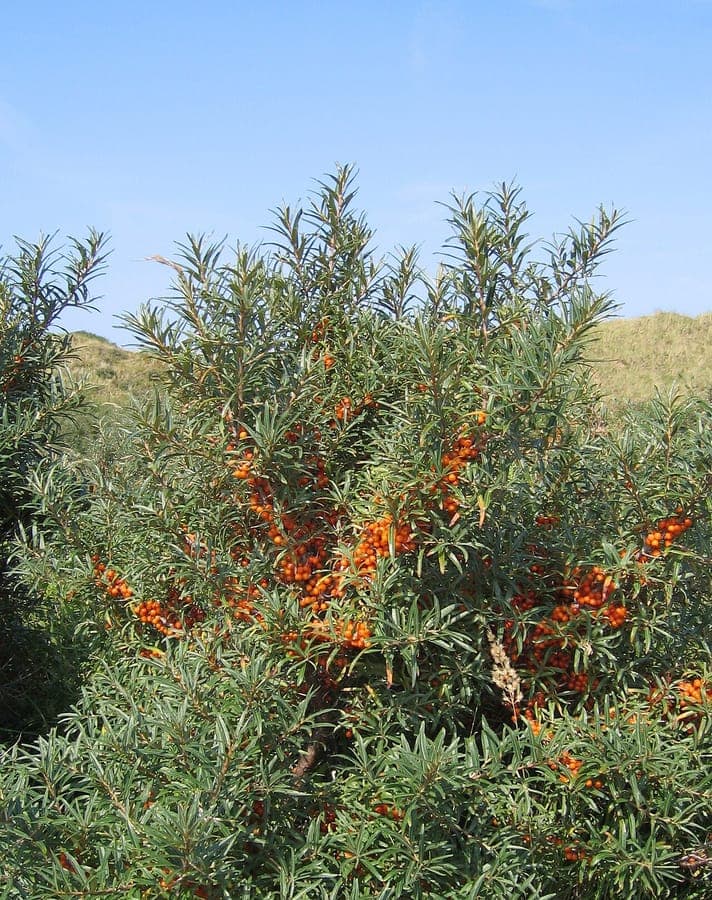
No machine-readable author provided. Svdmolen assumed (based on copyright claims). / CC BY-SA 3.0, via Wikimedia Commons
Sea-buckthorn: complete guide
Hippophae rhamnoides
Want to see Sea-buckthorn: complete guide in your garden?
1 minute, no credit card
Overview
Sea-buckthorn (Hippophae rhamnoides) is a native European shrub famous for its brilliant orange berries that can persist on branches from autumn through winter. This vigorous plant is not only ornamental but also functional: the berries are rich in vitamin C and have been used for centuries in traditional medicine, jam-making, and skincare products.
Growing quickly to 6 meters, sea-buckthorn establishes a mature form within a few years. Because it spreads via root suckers, it can naturally expand across large areas, making it ideal for creating informal hedgerows and wildlife corridors without constant maintenance. It thrives in poor soil where many ornamental shrubs fail.
Appearance and bloom
Sea-buckthorn is instantly recognizable by its narrow, silvery-gray foliage that gleams with a metallic sheen on both sides. The stems are armed with short spines, providing natural defense. Small, inconspicuous yellow flowers appear in early spring (March-April), but don't let their humble appearance fool you - they are magnets for bees and other pollinators.
After pollination, the beloved orange berries develop. These round fruits (about 0.5 cm diameter) densely cover the branches. Ripening in August-September, they can hang until January if birds don't harvest them first. Color intensity ranges from golden-orange to deep orange depending on variety and frost exposure.
Ideal location
Sea-buckthorn is a sun-worshipper, requiring at least 6 hours of direct daily sunlight. More sun means fuller foliage and heavier fruit production. Shaded spots result in sparse growth and minimal berries.
Wind and salt are not obstacles - this shrub actually prefers exposed, windswept sites as it evolved on coastal dunes. This makes it perfect for elevated gardens, coastal properties, and urban environments with poor air quality.
Caution: sea-buckthorn spreads aggressively via root suckers. Plant it at least 2-3 meters from driveways, pipes, and neighboring properties.
Soil
Sea-buckthorn accepts almost any soil but performs best in sandy or clayey ground with pH 6.5-8. It tolerates acidic soils with ease. The real enemy is waterlogging - ensure good drainage.
The shrub thrives in nutrient-poor soils and actually produces better in lean conditions. Rich, fertilized soil can paradoxically reduce fruiting. Plant in marginal soil for best results.
Free design
Want to see Sea-buckthorn: complete guide in your garden? Make a free design now.
Watering
Once established, sea-buckthorn is remarkably drought-tolerant thanks to its deep root system. During the first growing season, water weekly to maintain consistent moisture. After year one, you can practically stop watering.
Only in extreme drought (more than 4 weeks without rain) should you intervene with supplemental watering. A single deep watering (10-15 liters per plant) during hot summers prevents premature berry drop.
Never waterlog the soil - sea-buckthorn despises wet feet.
Pruning
Sea-buckthorn requires no pruning to maintain its natural, attractive form. However, for a more compact shape, prune in March before flowering. Remove older branches at 30 cm height to encourage fresh growth.
Wear gloves - the spines are sharp. Remove dead or damaged wood by cutting entirely to the base, stimulating vigorous new shoots.
To prevent aggressive suckering, remove shoots as they emerge, typically in June-July.
Maintenance calendar
March-April: Flowering; prune before growth season begins.
May-June: Young fruits develop; water regularly in dry periods.
July-August: Berries ripen; color shifts from green to gold.
September-October: Full harvest; berries are juicy and sweet.
November-December: Berries persist on branches; prepare for winter.
January-February: Winter dormancy; no maintenance needed.
Winter hardiness
Sea-buckthorn is exceptionally hardy. In temperate climates (USDA zones 3-9), it survives without protection. The shrub tolerates temperatures down to -35 C with ease. Young first-year plants may appreciate 5-10 cm of organic mulch in October.
Interestingly, light frost actually improves berry flavor, making them sweeter and less bitter.
Companion plants
Sea-buckthorn works beautifully with other hardy shrubs for hedgerows and wildlife corridors:
- Blackthorn: matching native character with white spring flowers
- Willows: early catkin food for wildlife, natural woodland feel
- Rowan: supplemental autumn berries, bright red color
- Hawthorn: classic hedge shrub, white flowers, wildlife food
This combination creates an authentic "wildlife garden" structure that attracts native birds and insects.
Closing
Sea-buckthorn is for gardeners who value substance over fuss. It is tough, undemanding, thrives in poor soil, and rewards you generously with fruit. Whether you make juice, feed wildlife, or simply want a dramatic winter accent, sea-buckthorn delivers. A must-have for sustainable garden design.
Available at garden centers in sizes from 40-60 cm to mature specimens of 1.5 meters.
Learn more about resilient garden design on gardenworld.app.
Want to see Sea-buckthorn: complete guide in your garden? Make a free design now.
Upload a photo, pick a style, and get a photorealistic design with plant list in under a minute.
No credit card required


Similar plants
Canadian buffalo-berry: complete guide
Shepherdia canadensis
Complete guide to Canadian buffalo-berry: location, soil, watering, pruning, and companion plants for this resilient wildlife shrub.
Broadleaf Oleaster: complete guide
Elaeagnus macrophylla Thunb.
Discover the Broadleaf Oleaster, a hardy ornamental shrub with silvery leaves and robust growth. Perfect screening plant for front gardens.
Silver Buffaloberry: complete guide
Shepherdia argentea
Shepherdia argentea: stunning North American shrub with silvery foliage and red berries. Bird magnet for windy, dry gardens.