
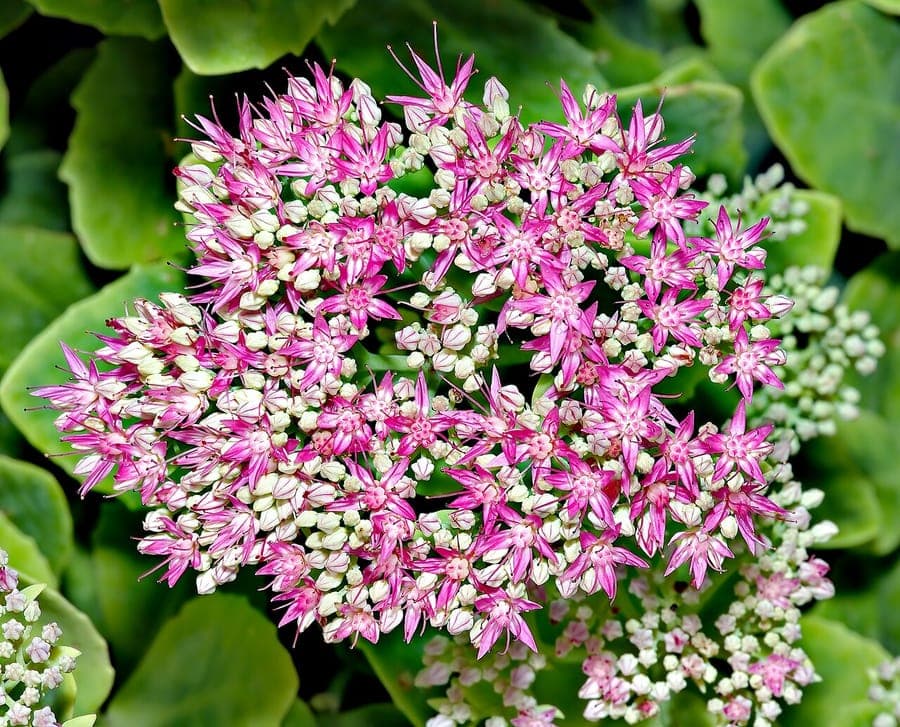
André Karwath aka Aka / CC BY-SA 2.5, via Wikimedia Commons
Stonecrop: complete guide
Sedum spectabile
Want to see Stonecrop: complete guide in your garden?
1 minute, no credit card
Overview
Showy Stonecrop (Sedum spectabile, now also classified as Hylotelephium spectabile) is one of the most valuable perennials for late summer and autumn. When most borders have already passed their peak, stonecrop is just getting started. From August to October, the flat, pink flower heads teem with butterflies, bees, and other pollinators - a spectacle that few other garden plants can match. The name Sedum derives from the Latin sedere (to sit), referring to the way the plant perches on rocks and walls.
Showy Stonecrop is a herbaceous perennial reaching 30 to 60 cm in height that forms compact, upright clumps with thick, succulent leaves. On gardenworld.app you can create a garden design where stonecrop serves as a late-summer attraction - in a border, on a green roof, in a rock garden, or as edging along paths. The plant belongs to the family Crassulaceae (the stonecrop family) and originates from China and Korea. Popular cultivars include 'Herbstfreude' (also known as 'Autumn Joy', pink ageing to coppery brown), 'Brilliant' (bright pink), and 'Matrona' (dark foliage, light pink flowers).
Appearance and bloom cycle
Stonecrop flowers from August to October, producing flat, densely packed flower heads 10 to 15 cm in diameter. The individual florets are star-shaped, 5 to 8 mm across, and appear in dense clusters that gradually shift colour: from green (in bud) through pale pink to deep rose and finally coppery brown in autumn. This colour transition is one of the plant's charms - each phase offers a different beauty.
The leaves are thick, fleshy, oval to spatula-shaped, 3 to 8 cm long, and grey-green to blue-green. In some cultivars such as 'Matrona' and 'Purple Emperor', the foliage is dark purple to near-black. The entire plant has a succulent, rounded appearance that is decorative even before flowering. The dried flower heads in winter are particularly attractive when coated in frost or a dusting of snow - do not cut them back too early.
Ideal location
Stonecrop is a thoroughbred sun-lover. Plant it in the sunniest spot in your garden - at least 6 hours of direct sun per day. In full sun the plant stays compact, sturdy, and upright; in too much shade the stems become floppy and the plant falls open (a common problem in overly shaded positions). A south-facing border, a raised bed, a rock garden, or the edge of a patio are ideal locations.
Stonecrop tolerates heat, drought, wind, and even salt air without difficulty. It is therefore excellent for coastal gardens, urban roof terraces, and heat islands beside paving. The plant is also an outstanding choice for green roofs thanks to its drought tolerance and low growth habit. Space clumps 30 to 40 cm apart.
Soil requirements
Stonecrop makes minimal demands on soil - in fact, it performs better in lean ground than in rich. The ideal soil is well-drained, poor to moderately fertile, and can range from sand to loam. In heavy clay that stays wet in winter, the risk of root rot increases. In that case, improve drainage by working coarse grit or gravel into the top 20 cm.
Avoid rich compost or manure at planting - overly fertile soil leads to lush but floppy foliage and stems that topple over. Soil pH is not critical: stonecrop grows well in acidic to alkaline ground (pH 5.5 to 8.0). On extremely poor, dry ground it even outperforms most competitors, making it a champion of neglected corners.
Watering
Stonecrop is one of the most drought-tolerant perennials available. Its succulent leaves store moisture like a reservoir, enabling it to withstand weeks of drought without so much as drooping a leaf. In the first year after planting, it is sensible to water once a week during prolonged dry spells (more than two weeks) - roughly 3 to 5 litres per plant.
From the second year onward, supplementary watering is virtually never needed. Too much water is actually more damaging than too little: excessive moisture leads to root rot and floppy, collapsing stems. Always water at the base and avoid wetting the foliage. In containers, stonecrop needs slightly more frequent watering, but always allow the soil to dry out thoroughly between waterings. Use a pot with ample drainage holes and preferably a mineral-based compost.
Pruning
Stonecrop requires minimal pruning. The only task is removing the old stems before the new growing season begins. Timing is a matter of taste and strategy. Option one: leave the dried flower heads standing all winter - they are remarkably decorative with frost or snow and provide food and shelter for insects. Option two: cut the stems back to 5 cm above ground in late autumn (November) if you prefer a tidy garden.
The most practical approach is to cut the stems in March, just before the new shoots appear. By then the winter silhouettes have served their purpose and you can simply snip the old stems at ground level with secateurs. The only additional maintenance is dividing clumps every four to five years to maintain vigour.
Free design
Want to see Stonecrop: complete guide in your garden? Make a free design now.
Butterflies and pollinators
Stonecrop is one of the top plants for butterflies and bees in any garden. In late summer, when many other flowers have finished, the flat flower heads of stonecrop serve as one of the last nectar sources for pollinators building reserves for winter. On a warm September day you can find dozens of butterflies simultaneously on a single plant - Red Admirals, Peacocks, Small Tortoiseshells, and Commas jostle for position on the sweet nectar.
Bees - both honey bees and solitary species - also visit the flowers en masse. Hoverflies and small beetles are regular guests too. The combination of a flat flower head (easy landing platform) and abundant nectar makes stonecrop an indispensable link in a pollinator-friendly garden. Plant at least three to five clumps together for the greatest impact.
Maintenance calendar
March: Cut away the old, dried stems at ground level. The new shoots are already visible as fat, round buds at the base.
April–May: The plant grows rapidly into compact, leafy clumps. No action needed - even feeding is unnecessary.
June–July: Flower buds develop as green, broccoli-like heads atop the stems. The plant is already decorative thanks to its succulent foliage.
August–October: Flowering. The heads colour from pale pink to deep rose. Enjoy the butterfly festival. No deadheading required.
November–December: The flower heads age to coppery brown and dry out. Leave them for winter structure or cut them back.
January–February: Dormancy. The plant exists only as a rootstock underground.
Winter hardiness
Sedum spectabile is fully winter-hardy and tolerates temperatures down to approximately -30 °C (USDA zones 3 to 9). Across the British Isles, the Netherlands, Belgium, and the rest of temperate Europe, stonecrop overwinters without any protection. The plant retreats fully underground in winter and reliably re-emerges in spring.
The only winter enemy is excessive wetness: in poorly drained clay soil that floods in winter, the rootstock can rot. Therefore ensure good drainage, especially on heavy ground. Container plants overwinter best in a dry, sheltered spot or with the pot wrapped in bubble wrap - not because of the cold, but to prevent the soil becoming too wet from winter rain.
Cultivars in detail
'Herbstfreude' (Autumn Joy) is the most famous cultivar: robust, 50 to 60 cm tall, with pink heads ageing to coppery brown. 'Brilliant' is slightly more compact (40 cm) with bright pink flowers that hold their colour longer. 'Matrona' stands out for its dark purple foliage and pink stems - an architectural showpiece even without flowers. 'Purple Emperor' pushes the dark foliage even further and is particularly effective as a contrast in a light-toned border.
For small gardens and containers, 'Stardust' (white, compact, 30 cm) is an excellent choice.
Companion plants
Stonecrop is an ideal partner for other drought-tolerant plants. The classic combination is stonecrop with ornamental grasses - Stipa tenuissima, Calamagrostis, or Miscanthus provide an airy contrast to the massive flower heads. Sage (Salvia nemorosa) and lavender (Lavandula angustifolia) are excellent neighbours that flower earlier in the season and then form a green backdrop.
For a late-summer border, combine stonecrop with coneflower (Echinacea purpurea), daylilies (Hemerocallis), black-eyed Susan, and asters. The warm pink and brown tones of stonecrop harmonise beautifully with the yellow and purple shades of these partners. In a rock garden, stonecrop sits well beside thyme, houseleeks (Sempervivum), and other succulents. On a green roof, combine it with grasses, thyme, and other sedum species.
Final thoughts
Stonecrop is the ultimate low-effort plant: it asks for virtually nothing, tolerates drought and poor soil, and rewards you nonetheless with months of ornamental value and an autumn festival of butterflies and bees. Few plants offer so much value for so little effort.
Choose 'Herbstfreude' as an all-round classic, 'Brilliant' for the brightest colour, or 'Matrona' for architectural dark foliage. On gardenworld.app you can create a garden design that combines stonecrop with the right partners for your specific garden. Plant a group of three to five clumps this spring and let the butterflies do the rest.
Want to see Stonecrop: complete guide in your garden? Make a free design now.
Upload a photo, pick a style, and get a photorealistic design with plant list in under a minute.
10,000+ gardens designed already
No credit card required


Similar plants
Woodland sage: complete guide
Salvia nemorosa
Everything about Woodland Sage (Salvia nemorosa): planting, care, pruning and combinations. Expert tips for months of blue-violet flower spikes.
Purple coneflower: complete guide
Echinacea purpurea
Everything about Purple Coneflower (Echinacea purpurea): planting, care, pruning and combinations. Expert tips for a thriving prairie-style garden.
English Lavender: complete guide
Lavandula angustifolia
Everything about English Lavender (Lavandula angustifolia): planting, pruning, care and overwintering. Practical tips for lush purple blooms.