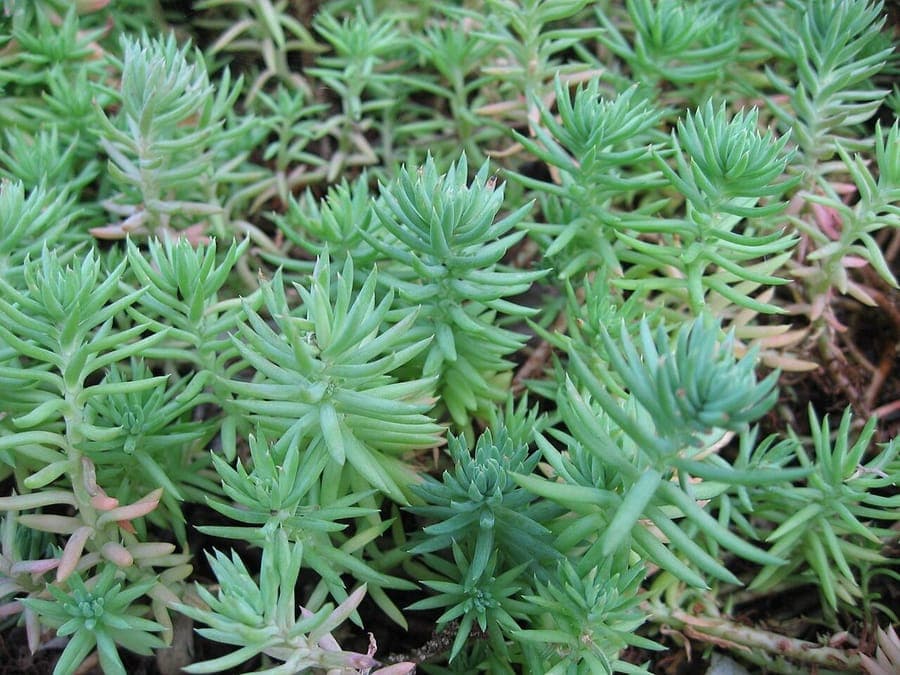
Liné1 / CC BY-SA 3.0, via Wikimedia Commons
Reflexed stonecrop (Sedum rupestre): complete guide
Sedum rupestre
Want to see Reflexed stonecrop (Sedum rupestre): complete guide in your garden?
Full design in HD: €7.99
Look after your Reflexed stonecrop with the GardenWorld app
Identify plants with your camera and get a care calendar with reminders for this plant.


Overview
Reflexed stonecrop (Sedum rupestre) is one of those plants that quietly fills the awkward corners of a garden: the top of a dry wall, the gaps in a gravel path, the shallow soil of a green roof. Look closely and it is a rather handsome thing. The non-flowering shoots resemble tiny spruce twigs, crowded with needle-like, blue-green leaves, and in summer they send up flat heads of bright yellow stars on stems just under 30 cm tall.
Botanists have recently moved the species into its own genus, so recent floras list it as Petrosedum rupestre. You may also find it under the older name Sedum reflexum. Nurseries and garden centres, however, still sell it almost exclusively as Sedum rupestre, and that is the name used here. Other common names include blue stonecrop, Jenny's stonecrop and stone orpine. In the wild it grows across much of Europe, from Scandinavia to Spain, on rocks, sandy slopes and old walls.
Its old English names prick-madam and trip-madam hint at a past life in the kitchen. The young shoots have a fresh, faintly sour taste and were once added to salads and soups. Today it is grown mainly for ornament, and the golden cultivar 'Angelina' is by far the most popular. If you want to see where a tough groundcover like this would earn its keep in your own plot, gardenworld.app can create a garden design that takes account of sun, soil and the difficult spots where little else will grow.
Appearance and bloom cycle
Reflexed stonecrop forms a low, creeping mat 10 to 15 cm high. The stems sprawl along the ground and root wherever they touch soil, so a single plant can cover 40 to 60 cm within a few years. The leaves are cylindrical, pointed and 1 to 2 cm long, arranged in a spiral around the stem, which gives that distinctive conifer-like look. Lower down, older leaves wither and stay on the stems as dry brown or pinkish scales. This is normal.
Leaf colour depends on the form you grow. The wild species is grey-green to blue-green, with a waxy bloom that gives it a frosted appearance. 'Blue Spruce' is a strong steel blue. 'Angelina' has golden to lime-yellow foliage that turns orange-red in winter, especially in a sunny, dry position. There is also a crested form, 'Cristatum', whose stems fuse into odd, fan-shaped crests.
Flowering runs through June and July, sometimes into August. The flower stems rise to 20 to 35 cm, and before the buds open their tips bend downwards, as if nodding. Once the flowers open, the head straightens up. Each flower is a yellow star roughly 1 cm across, with five to seven petals, and they are popular with bees, bumblebees and hoverflies. After flowering, the stems dry out and turn brown.
Ideal location
Full sun is essential. In a bright spot the plant stays compact and colours up beautifully. It will grow in partial shade, but it becomes looser and greener, and 'Angelina' loses much of its golden glow. Deep shade is best avoided.
Think of this stonecrop for places where most plants struggle: the top of a wall, the joints of a dry-stone wall, a rock garden, the edge of a gravel path, a sunny bank or a trough on a south-facing balcony. It is also one of the stalwarts of extensive green roofs with a thin layer of substrate. Because the stems like to spill over edges, it is ideal for softening the hard line of a step, retaining wall or raised bed.
In containers it does best in a wide, shallow pan with a drainage hole. It can be mixed freely with other succulents, as long as they also enjoy sun and dry conditions.
Soil requirements
Reflexed stonecrop is undemanding, with one exception: the soil must drain freely. Poor, sandy, stony or gritty ground is ideal. It copes well with chalk and limestone, yet grows just as happily on slightly acidic sand. Rich soil and generous helpings of compost produce soft, floppy growth and a less robust plant.
On heavy clay, work plenty of coarse sand, grit or lava rock into the top 15 to 20 cm of each planting area. Better still, plant it on a raised spot such as a rockery or a mounded gravel bed so that rainwater runs away quickly. For pots, use a mix of roughly half multipurpose compost and half coarse grit or fine gravel. No feeding is needed.
Free preview
Want to see Reflexed stonecrop (Sedum rupestre): complete guide in your garden? Make a free preview of your design.
Watering
For the first three or four weeks after planting, water whenever the soil has dried out completely so that the roots can establish. After that, a plant in open ground will look after itself, even through a dry summer. The fleshy leaves store enough moisture to get through weeks without rain. In extreme heat the foliage may flush red or look a little limp, but it recovers quickly after a shower.
Overwatering is a far greater danger than drought. Wet roots, particularly in winter, cause the stems to rot and blacken from the inside. In containers, water in summer only when the compost is bone dry, and barely at all in winter. If you can, move pots under the eaves for the colder months.
Pruning and propagation
There is no real pruning to do. After flowering, cut the faded stems back to just above the mat of foliage to keep the plant looking neat. If a mat grows too wide, simply slice or trim away the edges.
Propagation could hardly be easier. Any broken-off shoot a few centimetres long will root within weeks if pushed into damp sand or grit. You can also lift a piece of the mat in spring and replant it elsewhere. In a few years a single pot can become an entire stretch of groundcover. For quick coverage, plant nine to twelve plants per square metre.
If you would like to try it as a culinary herb, pick the young shoot tips in spring and use them sparingly in salads or soups. The species is not regarded as poisonous to people or pets, and the ASPCA lists related stonecrops such as Sedum album as non-toxic. A cat or dog that eats large quantities may still end up with a mildly upset stomach.
Maintenance calendar
March and April: Clear dead leaves and debris from the mat. Plant new specimens or insert cuttings. Pick young shoot tips for the kitchen if you like.
May: Growth is in full swing. Check that weeds are not settling into the mat and remove them carefully.
June and July: Flowering time. Enjoy the yellow heads and the bees that visit them.
August: Cut back the spent flower stems. An excellent moment to take cuttings.
September and October: Still time to plant, so roots can settle before winter. Rake fallen leaves off the mat, because a wet layer of leaves will cause rot.
November to February: Dormant season. Keep pots dry and remove fallen leaves.
Winter hardiness
Reflexed stonecrop is extremely hardy. It survives hard frosts well below -20 °C without protection, and the mat of foliage remains visible all winter. Cold often tints the leaves pink or orange, which adds welcome colour to a bare winter garden.
Wet soil, not cold, is the real threat. On free-draining ground there is nothing to worry about, but on heavy, waterlogged soil parts of the mat may rot away. Never mulch over the plant with leaves or compost in winter, as this traps moisture. In containers, vine weevil grubs can occasionally eat the roots, so if a plant suddenly collapses, take a look just beneath the surface.
Companion plants
Reflexed stonecrop looks best alongside other plants that relish sun and drought. Common houseleek (Sempervivum tectorum), with its tight rosettes, makes a lovely contrast to the fine needles. Wild thyme (Thymus serpyllum) and blue fescue (Festuca glauca) help to build a varied dry tapestry. Thrift (Armeria maritima) brings pink pompoms in late spring, just before the stonecrop turns yellow. A spurge such as Euphorbia myrsinites, with its blue-grey trailing stems, suits the mood perfectly.
'Angelina' shines brightest next to dark tones: dark slate or basalt chippings in a gravel garden, for example, or deep purple foliage on a slightly moister spot nearby. The blue wild form, on the other hand, pairs well with pale grey natural stone.
Final thoughts
Reflexed stonecrop (Sedum rupestre) is a modest, tough groundcover for the sunniest and driest parts of the garden. With its spruce-like foliage, yellow summer flowers and winter colour, it has something to offer all year round, and it asks almost nothing in return. Sun, free-draining soil and no wet feet: that is all it needs.
Plant it in spring or early autumn and you will see the mat knit together in its very first season. The planting calendar on gardenworld.app shows you each month which jobs are waiting in your garden, so taking cuttings and tidying up will never slip your mind.
Frequently asked questions about Reflexed stonecrop
Is Reflexed stonecrop winter hardy?
Reflexed stonecrop is extremely hardy. It survives hard frosts well below -20 °C without protection, and the mat of foliage remains visible all winter.
When and how do you prune Reflexed stonecrop?
There is no real pruning to do. After flowering, cut the faded stems back to just above the mat of foliage to keep the plant looking neat.
How much water does Reflexed stonecrop need?
For the first three or four weeks after planting, water whenever the soil has dried out completely so that the roots can establish. After that, a plant in open ground will look after itself, even through a dry summer.
Where does Reflexed stonecrop grow best?
Full sun is essential. In a bright spot the plant stays compact and colours up beautifully.
What soil does Reflexed stonecrop need?
Reflexed stonecrop is undemanding, with one exception: the soil must drain freely. Poor, sandy, stony or gritty ground is ideal.

See it in your garden
See Reflexed stonecrop in your garden
One photo of your garden and a few questions. You see the result in about a minute.
Try it with a photoIdentify this plant in your own garden. Identify a plant
Similar plants
Houseleek: complete guide
Sempervivum tectorum
Houseleek is the classic succulent for roofs and rock gardens - hardy, drought-tolerant, and maintenance-free. Learn cultivation, propagation, and care.
Breckland thyme: complete guide
Thymus serpyllum
Discover Breckland thyme - a creeping herb with purple flowers, aromatic foliage, and winter hardiness. Ideal for borders, garden edges, and stone gardens.
Blue fescue: complete guide
Festuca glauca
Festuca glauca, or blue fescue, is a low-maintenance ornamental grass with silvery-blue foliage. Perfect for sunny, dry borders and rock gardens.
