
Wikimedia Commons / CC BY-SA 3.0, via Wikimedia Commons
Breckland thyme: complete guide
Thymus serpyllum
Want to see Breckland thyme: complete guide in your garden?
1 minute, no credit card
Overview
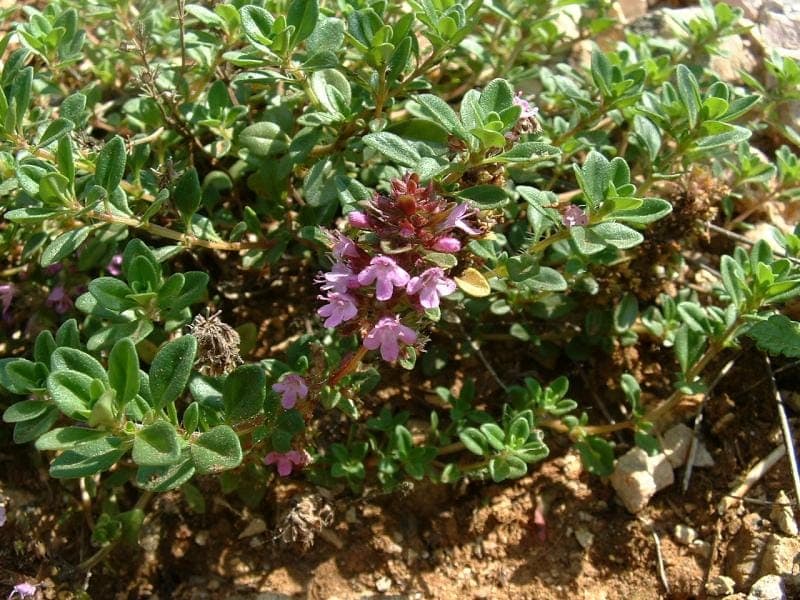
Breckland thyme, also called Creeping thyme or Mother-of-thyme (Thymus serpyllum), is a low, creeping herb from Eastern Europe and Asia. Unlike garden thyme (Thymus vulgaris), this is a refined, delicate ornamental with thin stems and tiny purple to pink flowers. The plant grows as a dense, low mat of 5-15 cm height, perfect for borders, garden cracks, and rocky slopes. Foliage is aromatic - faintly thymol-scented - and beloved by bees.
Appearance and bloom cycle
Leaves are extremely tiny, linear to lance-shaped, about 4-8 mm long, fine green to grey-green. Stems are thin, often purplish-tinged, highly branched, and prostrate. Plant forms dense, undulating mats. Blooming runs June through September. Flowers are small, purple-pink to violet, in short spikes at stem ends. Flower color varies by cultivar: some deeply purple (cv. 'Coccineus'), others rose-pink. Flowers attract bees en masse.
Ideal location
Full sun essential - minimum 6-8 hours direct sunlight. Breckland thyme dislikes deep shade. Wind and air circulation beneficial. Hardy to -25°C (USDA zones 5-6), tolerating heavy snow. Perfect for border edges, between stair treads, as a gentle roof-edge softening, and in rock gardens between larger stones. Also suited for dry meadows and Mediterranean gardens.
Soil requirements
Poor, well-draining soil preferred. Plant accepts even impoverished ground. Mix 50% sand, 30% loam, 20% gravel for optimal results. On heavy clay add sand and gravel liberally. Neutral to slightly acidic pH (6.0-7.5) ideal. Container growing uses standard potting mix amended with extra sand for enhanced drainage.
Watering
Once established, extremely drought-tolerant. During growth year, water regularly until roots establish (May-June). Thereafter minimal water. Breckland thyme tolerates dry periods easily and suffers from overwatering. In extreme heat (3+ weeks without rain), one supplemental watering helps.
Free design
Want to see Breckland thyme: complete guide in your garden? Make a free design now.
Pruning
Moderate pruning encourages dense, compact growth. After flowering in September-October, trim lightly (1/3 of height) to encourage spring regrowth. Old, bare, exhausted plants can be carefully cut hard in March. Handle gently - growth is slow and recovery from heavy pruning is gradual.
Maintenance calendar
March: Optionally trim plant lightly if it looks leggy. Divisions can be separated.
April-May: Growth season begins. Ensure adequate water until root establishment. Foliage achieves full color.
June-September: Flowering period. Minimal water. Plant looks spectacular. Bees visit profusely.
October: Flowering declines. Light post-bloom trim (optional) encourages regrowth.
November-February: Winter dormancy. Plant fully dormant and winter-hardy. No watering.
Winter hardiness
Hardy to -25°C (USDA zones 5-6). Breckland thyme overwinters without protection across the UK, northern France, and Germany. Snow causes no damage. Wet winters can be problematic due to poor drainage - ensure good drainage. Very wet, heavy soils risk rot; sand/gravel ameliorates this.
Aromatic properties
Foliage smells pleasantly thymol-like and can be used for tea, though infrequently. Much stronger aroma than garden thyme. Leaves can be dried for aromatherapy. Attracts bees, bumblebees, and butterflies.
Companion plants
Pair with Sedum, Sempervivum, Armeria, Phlox subulata, and other alpine bloomers. Small-growing grasses (Festuca species) work beautifully as backdrop. For alpine trough culture, ideal with Dianthus and small Saxifraga.
Closing
Breckland thyme is a subtle, refined choice for year-round border interest. Slow foot-by-foot growth reveals complete coverage in 2-3 years. Available at major garden centers. For integration into complete ground schemes, gardenworld.app helps visualize how Breckland thyme plays its role in garden composition. The platform shows how low, flowering groundcover beautifully fills transition zones and edges.
Want to see Breckland thyme: complete guide in your garden? Make a free design now.
Upload a photo, pick a style, and get a photorealistic design with plant list in under a minute.
No credit card required


Similar plants
Apple mint (Mentha x villosa): complete guide
Mentha x villosa
Meet apple mint (Mentha x villosa): a fruity-scented kitchen herb with woolly leaves, perfect for tea and mojitos.
Salvia peyronii: complete guide
Salvia peyronii
Discover Salvia peyronii, a rare Lebanese mountain sage. Growing tips, hardiness, and companion planting for a Mediterranean gravel garden.
Bigleaf mint (Mentha x rotundifolia): complete guide
Mentha x rotundifolia
Discover bigleaf mint: cultivation, care tips, and garden uses. Learn how to grow this aromatic herb with soft, hairy leaves.