
Fredlyfish4 / CC BY-SA 4.0, via Wikimedia Commons
Wool-grass: complete guide
Scirpus cyperinus
Want to see Wool-grass: complete guide in your garden?
1 minute, no credit card
Overview
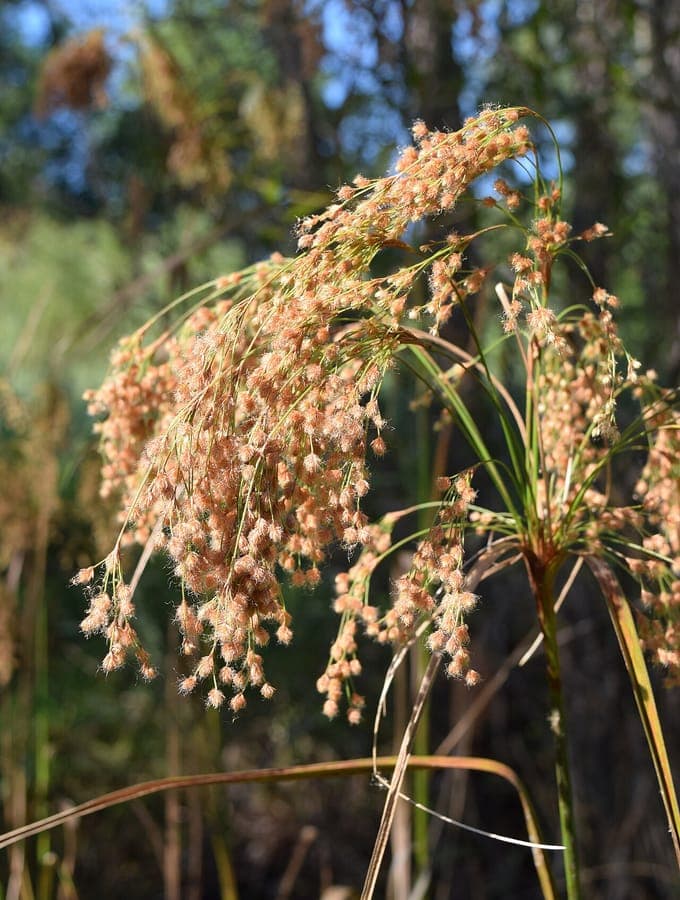
Wool-grass (Scirpus cyperinus), also known as marsh bulrush or teddybear paws, is a captivating North American water plant from the Cyperaceae family (sedges). This plant grows from southeastern Canada to the Mexican Gulf and is known for its characteristic, woolly dark-brown flower heads that look like teddy bear paws - hence the poetic name.
This plant is perfect for marshes, water bird gardens and wet natural gardens where water management is central.
Appearance & bloom
Wool-grass forms dense tufts of slender, upright green grass-like foliage that can reach 60-150 centimeters high. The structure is light and airy, like fine root hairs.
The bloom appears from August to October as very characteristic, spherical clusters of very fine, brownish, soft-hairy, almost woolly florets. These clusters truly resemble teddy bear paws and give the plant its informal, playful name.
After bloom the flower heads transform into seed-bearing globes that retain structure through winter.
Ideal location
Wool-grass grows from full sun to partial shade (at least 4 hours of sunlight). It is highly adaptable to wet soils and can thrive both in shallow water and in marshes.
The plant is suitable for:
- Natural water gardens
- Marsh embankments
- Stream banks
- Rainwater collection zones
- Play situations for children
Soil & water
Wool-grass is very tolerant of watery soils and thrives in both acidic (pH 4.8-7.0) and neutral to weakly alkaline water. It grows in muddy bank soils to shallow standing water (up to about 15 centimeters).
The plant performs well in wetland filtration systems and contributes to water purification through nutrient uptake.
Planting
Plant wool-grass in groups of 3-5 specimens about 25-30 centimeters apart. This creates beautiful, waving texture in marshes.
Sow directly in wet soil or in water tanks. Growth accelerates in warm summers.
Free design
Want to see Wool-grass: complete guide in your garden? Make a free design now.
Watering & water quality
Wool-grass requires permanent moisture - it grows poorly in dry situations. Ideal in natural water areas with regular water supply or in artificial marshes with regular water monitoring.
Water quality: tolerant of widely varying water conditions, from very fresh to slightly brackish.
Maintenance & pruning
In early spring (March), cut away withered stems at soil level. This stimulates new growth. The plant is self-cleaning.
Continuously remove invasive weeds that can impede growth.
Maintenance calendar
March-April: Spring cleanup, cut away withered stems.
May-July: Growth accelerates, regular water as needed.
August-October: Bloom and seed ripeness period.
November-February: Rest, stems are brownish but retain structure.
Winter hardiness
Completely winter-hardy to -30°C in North America and Europe. Regrows each spring from rhizomes. Very reliable plant in temperate climates.
Companion plants & water life
Wool-grass combines beautifully with:
- Reeds (Phragmites australis) - texture contrast
- Marsh blazing star (Liatris ligulistylis) - purple flowers
- Sphagnum (Sphagnum) - ground cover
- Water lily (Nymphaea) - underwater contrast
- Other sedge species
Bird enthusiasts appreciate the plant for nesting opportunities.
Applications
Water purification: The plant takes up nutrients and contributes to water filtration.
Wildlife habitat: Bird nesting site, insect shelter.
Ornamental value: Brilliant bloom and seed ripeness structure.
Erosion control: Rhizomes stabilize banks.
Propagation
Via seeds (direct sowing in muddy soils) or division of rhizomes in spring. Very easy to propagate.
Conclusion
Wool-grass is a characteristic North American water plant with great ornamental value and ecological significance. Its "teddy bear paws" bloom makes it incomparable in marshes and water gardens. With strong winter hardiness and low maintenance needs, it is ideal for sustainable garden plans.
Find specimens at specialized water nurseries. Perfect for professional ecological water garden design.
Want to see Wool-grass: complete guide in your garden? Make a free design now.
Upload a photo, pick a style, and get a photorealistic design with plant list in under a minute.
No credit card required


Similar plants
Flat-stemmed club-rush: complete guide
Bolboschoenus planiculmis
Everything about Bolboschoenus planiculmis: growing conditions, watering, care, and use as a pond margin or wetland plant in garden design.
Great Plains flatsedge: complete guide
Cyperus lupulinus
Everything about Great Plains flatsedge (Cyperus lupulinus): growing conditions, care, garden uses, and ecological value. Tips for pond margins and dry sandy soils.
Golden beak sedge: complete guide
Rhynchospora corymbosa
Everything about golden beak sedge (Rhynchospora corymbosa): a dramatic tropical marginal for pond edges, bog gardens, and wet habitats.