
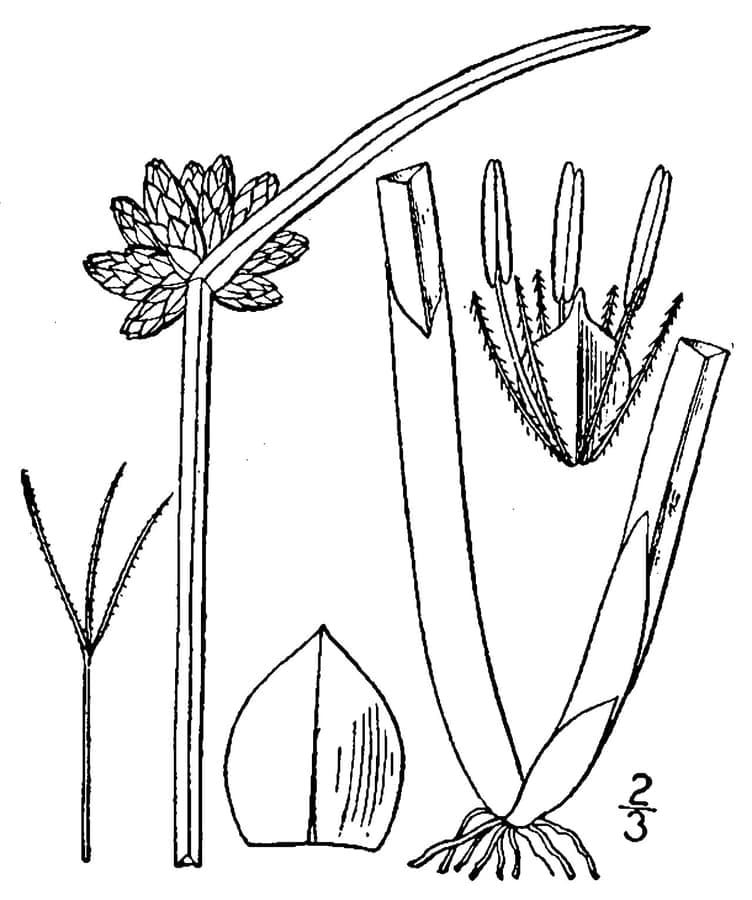
Britton, N.L., and A. Brown. / Public domain, via Wikimedia Commons
Bog Bulrush: complete guide
Schoenoplectiella mucronata
Want to see Bog Bulrush: complete guide in your garden?
1 minute, no credit card
Overview
Bog bulrush (Schoenoplectiella mucronata, formerly Scirpus mucronatus) is an ancient aquatic plant in the sedge family (Cyperaceae). Native to rice paddies, marshy shorelines and shallow pools across Europe, Asia and into Australia, it represents one of the planet's most widespread wetland plants. The species name refers to the sharp mucronate tips on the scale-like glumes surrounding each tiny fruit - a subtle but reliable identification feature for the keen botanist. Botanists reclassified the genus from Scirpus to Schoenoplectiella in 2010 based on molecular evidence, though older literature still uses the former name.
Despite being rarely stocked in ordinary garden centres, bog bulrush is a genuinely valuable addition to any pond margin or constructed wetland, particularly for gardeners seeking an ecologically rich, wildlife-friendly water feature. Visit gardenworld.app for ideas on building a layered pond margin using native aquatic and marginal plants.
Appearance and bloom cycle
Bog bulrush forms compact tufts of sharply triangular, upright stems. That triangular cross-section is characteristic of many sedges in the Cyperaceae family and immediately distinguishes them from round-stemmed common reed or flat-leaved cattail. Stems typically reach 40 to 100 cm in height, are smooth and glossy green, and have a firm, slightly leathery texture. True leaves are largely reduced - the stem itself carries out photosynthesis, giving the plant a clean, linear silhouette that reads well in a naturalistic garden design.
From June through August, small lateral spikelets emerge from partway up the stem. They are dense, rust-brown to ochre clusters of glumes that are botanically interesting without being showy. After flowering, tiny nut-like fruits (achenes) ripen and disperse via water or birds. The plant is perennial; stems die back in autumn while the rhizome overwinters reliably in the pond bed. In favourable conditions established clumps slowly expand sideways via short creeping rhizomes, gradually filling out a planting zone.
Ideal location
Bog bulrush thrives in a sunny to lightly shaded position, at or in standing or slow-moving water. Its natural home is the rice paddy and shallow marsh edge, which tells you everything about its preferences: feet permanently wet, crown in full sun. A water depth of 0 to 30 cm is ideal; up to 50 cm is possible but growth slows noticeably.
In the garden it fits perfectly along a pond edge, in a constructed bog garden or in a large water-filled container. Because it originally evolved in warm rice-growing regions, it appreciates warm summers - but it is well naturalised across temperate Europe and copes with typical northwestern European conditions without difficulty. Planting in full sun also reduces the risk of fungal stem rot, which can occur in persistently cool and shaded wet spots.
Soil
Bog bulrush prefers nutrient-rich, heavy clay or loam with a high organic content. In the wild it colonises the silty, moderately to highly fertile ground of pond and river margins where sediment accumulates. In containers, aquatic plant compost mixed with a measure of garden clay works well. Pure peat or ericaceous compost is best avoided - too acidic and too light, causing stems to grow spindly.
Optimal pH: 6.0 to 7.5. The plant tolerates mild brackishness but grows most vigorously in fresh water. Avoid adding fertiliser directly to the open water; use slow-release aquatic fertiliser tablets pushed into the substrate instead.
Free design
Want to see Bog Bulrush: complete guide in your garden? Make a free design now.
Watering
As a true water plant, bog bulrush needs no supplementary irrigation as long as it is planted in or immediately beside water. In a bog bed or moist pond margin, ensure the soil never dries out completely - even a shallow standing film of water is adequate. Container-grown plants should have a permanently filled saucer, especially during summer.
In drought conditions the stems yellow and go limp, but once water returns the plant typically recovers quickly. For the longest and healthiest growing season, maintain a consistent water level. During very hot spells, top up the container or pond to compensate for evaporation.
Pruning
Bog bulrush needs very little cutting. In autumn, once the stems have browned and died back, cut them down to a few centimetres above the waterline. This keeps the display tidy and stops decomposing plant material from fouling the water. In milder winters you can leave the dead stems standing - they provide shelter for overwintering invertebrates and roosting small birds.
In spring, new shoots emerge from the rhizome. At that point remove any remaining old stems that have stood through winter. If the clump has grown very large, divide it in spring by lifting, splitting with a sharp spade and replanting the healthiest sections.
Maintenance calendar
- January-February: Plant rests. Check water level to ensure the rhizome does not freeze solid.
- March-April: New shoots appear. Remove any remaining dead stems. A good time to divide overcrowded clumps.
- May: Strong growth. Apply a slow-release aquatic plant fertiliser tablet pushed into the substrate if desired.
- June-August: Flowering period. Leave spikelets in place for seed dispersal and bird interest.
- September: Growth slows. Remove floating debris and dead foliage from the water.
- October-November: Cut stems back after the first hard frost. Rhizome overwinters in the pond bed.
- December: Dormancy period. No further action needed.
Winter hardiness
Bog bulrush is hardy in USDA zone 6 and warmer, corresponding to much of temperate Western Europe. The rhizome overwinters easily beneath a protective layer of water; only prolonged solid freezing of the entire pond represents a real risk. Container-grown plants can be moved to a deeper part of the pond or brought into a frost-free space during severe cold spells.
Gardenworld.app has guides for designing a frost-hardy pond margin planting with species that carry over reliably through cold winters. Adding a layer of insulating straw or bubble wrap around outdoor containers also helps when temperatures drop sharply below -10 degrees Celsius.
Companion plants
Bog bulrush combines well with other marginal and aquatic plants sharing similar requirements:
- Cattail (Typha latifolia or narrowleaf T. angustifolia): similar height, striking vertical accent
- Yellow flag iris (Iris pseudacorus): bold yellow flowers May-June, contrasting leaf form
- Marsh cinquefoil (Potentilla palustris): lower marginal, pink flowers in summer
- Water forget-me-not (Myosotis scorpioides): low edging with sky-blue flowers
- Common reed (Phragmites australis): for larger margins, provides windbreak
- Watercress (Nasturtium officinale): in shallow water, also edible
Avoid pairing with highly invasive spreaders such as large-leaved cattail in small ponds unless you are prepared to thin regularly. A mix of plant heights and forms creates the most naturalistic and wildlife-friendly margin.
Closing
Bog bulrush is a modest but ecologically valuable plant that enriches any pond edge or marsh garden. It asks little as long as water is consistently available, and rewards you with a clean, upright green presence from early spring through late autumn. Look for aquatic marginals at specialist water garden centres or native plant nurseries, and ask for the ricefield bulrush or roughseed bulrush by its botanical name if the common name is not recognised. Anyone wanting to explore the full potential of a designed pond margin will find practical planning tools and beautiful garden design inspiration at gardenworld.app.
Want to see Bog Bulrush: complete guide in your garden? Make a free design now.
Upload a photo, pick a style, and get a photorealistic design with plant list in under a minute.
10,000+ gardens designed already
No credit card required


Similar plants
Flat-stemmed club-rush: complete guide
Bolboschoenus planiculmis
Everything about Bolboschoenus planiculmis: growing conditions, watering, care, and use as a pond margin or wetland plant in garden design.
Great Plains flatsedge: complete guide
Cyperus lupulinus
Everything about Great Plains flatsedge (Cyperus lupulinus): growing conditions, care, garden uses, and ecological value. Tips for pond margins and dry sandy soils.
Golden beak sedge: complete guide
Rhynchospora corymbosa
Everything about golden beak sedge (Rhynchospora corymbosa): a dramatic tropical marginal for pond edges, bog gardens, and wet habitats.