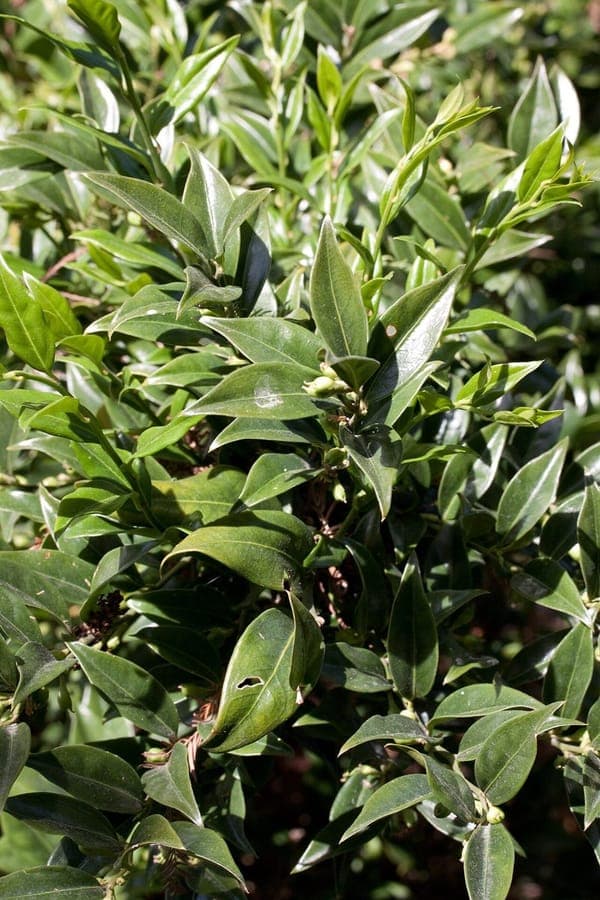
Denis.prévôt / CC BY-SA 3.0, via Wikimedia Commons
Sweet box: complete guide
Sarcococca confusa
Want to see Sweet box: complete guide in your garden?
Full design in HD: €7.99
Look after your Sweet box with the GardenWorld app
Identify plants with your camera and get a care calendar with reminders for this plant.


Overview
Sweet box (Sarcococca confusa) is the shrub you smell in January before you see it. On a grey winter's day a sweet scent of vanilla and honey suddenly hangs around the front door, and if you go looking, you find a modest green shrub with tiny white flowers tucked into the leaf axils. Few plants give so much fragrance at a time when the rest of the garden is asleep.
The species belongs to the box family (Buxaceae) and comes from China. The name confusa, meaning "confused", refers to its uncertain origin: it had been grown in European gardens for a long time before botanists were sure which wild population it came from. You will also see it sold as Christmas box.
Sarcococca confusa is an evergreen, slow-growing shrub reaching 1 to 1.5 metres in height and a similar spread. In a good spot it can reach 2 metres after many years. It forms a dense, rounded mound that spreads slowly by short suckers without ever becoming invasive. That makes it ideal for small town gardens, narrow borders along a house wall and large pots by the front door. On gardenworld.app you can create a garden design that puts a winter-scented shrub like this exactly where you pass it most often in the cold months.
Appearance and bloom cycle
The foliage is the plant's calling card all year round. The leaves are elliptic to lance-shaped, 3 to 6 cm long, dark green and very glossy, with a slightly wavy margin and a pointed tip. They are carried along green, gently arching twigs. The photo at the top shows the typical look: a dense mass of shiny leaves with small flower buds hidden among them.
Flowering usually begins in December and continues until February or early March. The flowers are small and have no showy petals. What you actually see are mostly the creamy-white stamens of the male flowers, with the inconspicuous female flowers just below. What they lack in looks they more than make up for in scent. On a mild, still winter's day you can smell a mature shrub from several metres away. Bees and bumblebees that venture out on warm winter days find a welcome source of pollen and nectar.
After flowering, small round berries form and ripen to glossy black over the year. They often stay on the shrub for months, sometimes until the next flowering. Be aware that, like many members of the box family, the plant contains alkaloids. The berries are considered mildly toxic and can cause stomach upset if eaten, so avoid planting it where small children or dogs are likely to nibble them.
Ideal location
This is where Sarcococca confusa really shines: it is a true shade plant. Partial to full shade is ideal, and once established it copes well with the awkward dry shade beneath trees. In full midday sun the leaves turn yellowish and can scorch, especially in a dry summer. A north- or east-facing spot, on the shady side of a house or under taller shrubs, is perfect.
Since scent is the main attraction, choose a position you pass daily in winter: beside the front door, along the path to the garage or below a window you sometimes open. A sheltered corner helps, because the fragrance lingers there instead of blowing away. The shrub also tolerates urban pollution, which makes it a good choice for courtyards and city gardens. Plant 50 to 70 cm apart for a low informal hedge or as evergreen ground cover in shade.
Soil requirements
Sarcococca grows best in humus-rich soil that is moist but free-draining. When planting, dig plenty of leaf mould or well-rotted compost into the hole, particularly on sandy soil or beneath trees where the ground dries out quickly. On heavy clay, mix coarse grit and compost into the topsoil to avoid standing water.
Soil pH is not critical. It grows happily on slightly acid soil but also tolerates chalky ground well, which sets it apart from many other shade shrubs such as rhododendrons. A 5 cm mulch of leaf mould or fine bark keeps the soil cool and feeds it gradually. Feeding is hardly necessary: a handful of organic shrub fertiliser in March is plenty.
Free preview
Want to see Sweet box: complete guide in your garden? Make a free preview of your design.
Watering
In its first year after planting, Sarcococca needs regular watering. During dry spells give it a thorough soak of 5 to 8 litres once or twice a week, so the roots grow deep. Under trees, where competition for water is fierce, a young plant deserves extra attention.
Once established, the shrub is fairly drought tolerant for a shade plant. Even so, the leaves stay healthier and glossier if the soil does not dry out completely in summer, so give it an occasional deep soak during long heatwaves. In a pot the compost dries out much faster: check every few days in summer and also during dry winter spells, because evergreens lose water in winter too. Always make sure there is a good drainage hole.
Pruning
Sarcococca confusa naturally keeps a neat, dense shape and needs very little pruning. If you do want to tidy it, do so straight after flowering in March or April. Remove damaged or straggly stems, and on older shrubs take out an old stem at the base now and then to rejuvenate the plant. Avoid pruning in late summer and autumn, as you would remove the flower buds for winter.
One thing to watch for is box blight (Calonectria), a fungal disease that can also affect Sarcococca. Look out for brown leaf spots, black streaks on young stems and sudden leaf drop. Remove affected growth immediately, put it in the general waste rather than on the compost heap, and keep the planting airy. Water at the base rather than over the foliage.
Maintenance calendar
January to February: Peak flowering and scent. Enjoy it, and feel free to cut a few sprigs for a fragrant vase indoors.
March to April: Light pruning after flowering if needed. Scatter a handful of organic shrub feed and top up the mulch. A good time to plant.
May to June: Fresh, light green new shoots appear. Water young plants during dry weather.
July to August: Check container plants regularly for drying out. Keep an eye on the foliage for signs of box blight.
September to November: Flower buds for winter are forming, so do not prune. A good time to plant so the roots can settle before frost.
December: The first flowers open. Water pots on frost-free days if the compost is dry. The plant calendar on gardenworld.app sets out all these jobs month by month, tailored to the plants growing in your garden.
Winter hardiness
Sarcococca confusa is fully hardy in most of northern Europe and tolerates temperatures down to around -15 °C without trouble. In Britain, the Low Countries and northern France it survives winter in the open ground without protection. In hard frost combined with bright winter sun and cold wind, some leaves may brown, but the plant recovers in spring.
In exceptionally severe frost the flowers may turn brown while the shrub itself stays unharmed. Container plants are more vulnerable because the root ball freezes faster. Stand the pot against a wall, raise it on pot feet and wrap it in hessian or bubble wrap during prolonged frost.
Companion plants
Sarcococca fits perfectly into a shady winter garden. Combine it with other plants that offer something in the cold season. Christmas roses and Lenten roses (Helleborus niger and Helleborus orientalis) flower at the same time and look lovely at its feet. Skimmia japonica shares the same conditions and adds red buds or berries.
For a carpet of flowers beneath, snowdrops (Galanthus nivalis) and Cyclamen coum are ideal, as both appear in January and February. In summer, ferns such as the male fern (Dryopteris filix-mas) and hostas add greenery and texture. For more winter colour, plant a witch hazel (Hamamelis mollis) behind it; its yellow flowers and spicy scent complete the winter picture.
Final thoughts
Sarcococca confusa is a quiet powerhouse. Glossy green all year, almost no work and few demands on soil or light, and then, in the depths of winter, a fragrance that stops you in your tracks every time. For shady corners where little else wants to grow, it is one of the best choices you can make. Plant it close to the front door and you will have a reason to pause every winter.
Frequently asked questions about Sweet box
Is Sweet box winter hardy?
Sarcococca confusa is fully hardy in most of northern Europe and tolerates temperatures down to around -15 °C without trouble. In Britain, the Low Countries and northern France it survives winter in the open ground without protection.
When and how do you prune Sweet box?
Sarcococca confusa naturally keeps a neat, dense shape and needs very little pruning. If you do want to tidy it, do so straight after flowering in March or April.
How much water does Sweet box need?
In its first year after planting, Sarcococca needs regular watering. During dry spells give it a thorough soak of 5 to 8 litres once or twice a week, so the roots grow deep.
Where does Sweet box grow best?
This is where Sarcococca confusa really shines: it is a true shade plant. Partial to full shade is ideal, and once established it copes well with the awkward dry shade beneath trees.
What soil does Sweet box need?
Sarcococca grows best in humus-rich soil that is moist but free-draining. When planting, dig plenty of leaf mould or well-rotted compost into the hole, particularly on sandy soil or beneath trees where the ground dries out quickly.

See it in your garden
See Sweet box in your garden
One photo of your garden and a few questions. You see the result in about a minute.
Try it with a photoIdentify this plant in your own garden. Identify a plant
Similar plants
Lenten-rose: complete guide
Helleborus orientalis
Learn how to grow and care for Helleborus orientalis. This early-blooming perennial thrives in shady spots and flowers from February to April, adding colour when little else is blooming.
Skimmia japonica: complete guide
Skimmia japonica
Evergreen shrub with red berries and fragrant leaves that remain visible long. Winter hardy to -10C, perfect for shade.
Cyclamen coum: complete guide
Cyclamen coum
Spring cyclamen (Cyclamen coum) is a delicate plant with heart-shaped leaves and pink flowers blooming early.
