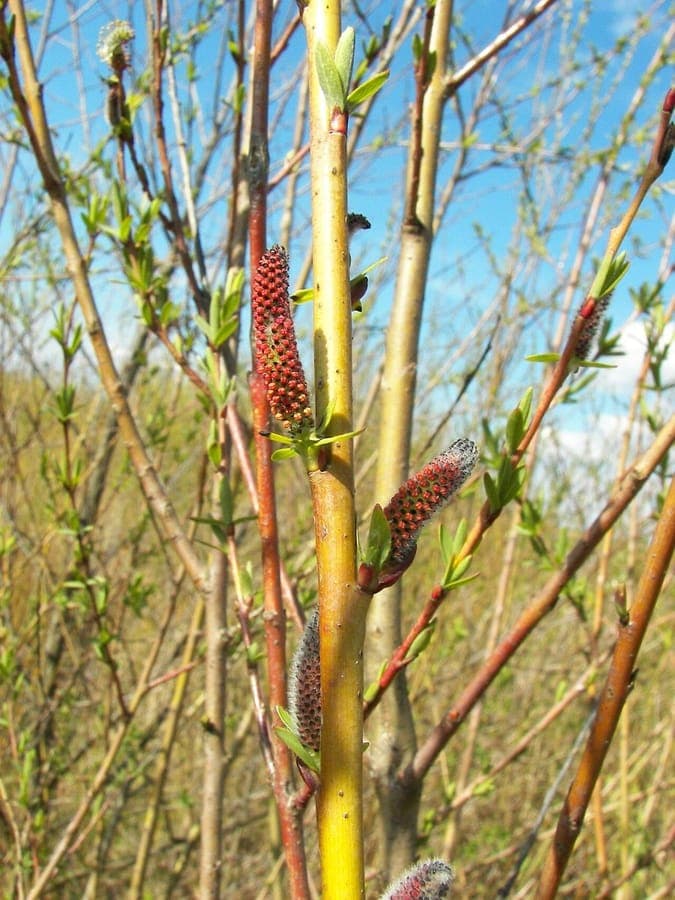
Willow / CC BY-SA 2.5, via Wikimedia Commons
Purple willow (Salix purpurea): complete guide
Salix purpurea
Want to see Purple willow (Salix purpurea): complete guide in your garden?
Full design in HD: €7.99
Look after your Purple willow with the GardenWorld app
Identify plants with your camera and get a care calendar with reminders for this plant.


Overview
The purple willow (Salix purpurea), also known as purple osier, is a shrubby willow that is often overlooked in gardens. That is a pity, because few shrubs are so versatile. It provides catkins for bees in early spring, has fine blue-green foliage, brightens the winter with purple-red stems and supplies supple rods for weaving.
The species belongs to the willow family (Salicaceae) and is native to much of Europe, including parts of Britain. It grows wild along rivers, on gravel banks, in damp dune slacks and in old osier beds. Those beds were once planted for basket making, and the purple willow was valued there because its stems are thin, tough and flexible.
The bark is the reason for its bitter reputation. It contains a lot of salicin and tastes intensely bitter. As a result, rabbits and deer tend to leave it alone more than other willows, a real advantage if you garden on the edge of the countryside.
Left to grow freely, Salix purpurea forms a loose, broad shrub of 3 to 5 metres. Regular cutting back keeps it much smaller. The dwarf form 'Nana', also sold as 'Gracilis', stays at around 1 to 1.5 metres and makes an ideal low hedge with a silvery blue-green haze. The weeping form 'Pendula' is grafted onto a stem and makes a small weeping tree for compact gardens. At gardenworld.app you can have a garden design made in which the purple willow finds its place in a native hedge, at the pond edge or as a living willow structure.
Appearance and flowering
The stems are long, straight and slender, glossy purple-red to olive green or yellowish, depending on the plant and the light. The young, one-year-old shoots have the best colour, which is exactly why it pays to cut the shrub back regularly.
The leaves are narrow, 4 to 10 centimetres long, blue-green with a paler underside and only finely toothed towards the tip. One distinctive feature: on purple willow the leaves and buds are often almost opposite each other, whereas on nearly all other willows they are alternate. Dried leaves turn black.
Purple willow is dioecious, meaning there are separate male and female plants. In March and April, just before or as the leaves emerge, the catkins appear. The male catkins are the most attractive: first reddish-purple from the red anthers, then yellow with pollen and finally almost black. For wild bees, bumblebees and early butterflies they are an important source of food at a time when little else is in flower. Female catkins are grey-green and produce fluffy seed in May.
Ideal position
Grow purple willow in sun or light partial shade. In full sun the stems colour most strongly and the shrub stays denser. In shade it becomes thin and flowers less.
It is ideal for the damp parts of the garden: the edge of a pond, a ditch, a rain garden or a low spot that stays wet in winter. Once established, though, it copes with drier soil better than many willows. That makes it a good choice for a mixed native hedge.
Willow roots seek out water. Do not plant a freely growing purple willow right next to drains, sewers or a lined pond, and keep it a few metres away from foundations. The compact 'Nana' is less vigorous, but even with a hedge of this form it is wise to leave some distance from pipes.
Soil requirements
Salix purpurea is undemanding. It grows on sand, loam and clay, on acidic and chalky soils alike. It grows best on moist, moderately fertile ground. Brief flooding or a wet winter is no problem.
At planting time, loosen the soil well and work some compost into the planting hole. After that, feeding is rarely needed: overly rich soil produces long, soft shoots that colour less well and are more prone to disease. A mulch of leaf mould or wood chips keeps the soil moist, especially on sandy ground.
For a hedge, plant 3 to 4 shrubs per metre; for 'Nana', 3 to 5 per metre, depending on how quickly you want a dense hedge.
Watering
In the first year after planting, water during dry spells, around 10 litres per shrub per week. The same applies to cuttings pushed straight into the ground: they root easily but must not dry out during their first spring.
After that, purple willow in a damp spot hardly needs extra water. On drier soil, just give it an occasional thorough soak during long droughts. Drooping or yellowing leaves in summer are a sign of thirst. A 'Nana' hedge in a dry border needs water rather more often than a freely growing shrub by the water.
Free preview
Want to see Purple willow (Salix purpurea): complete guide in your garden? Make a free preview of your design.
Pruning
Pruning purple willow is not compulsory, but it is the key to the best results. There are three approaches, depending on what you want.
Coppicing for rods and winter colour. Every one to three years, in February or early March, cut the whole shrub back to 10 to 30 centimetres above ground. It responds with vigorous, long, straight shoots in the brightest colour. You can harvest these rods the following winter to make baskets, plant supports or a woven fence.
Pollarding on a small scale. You can also grow purple willow on a short trunk and cut the head back to the same height every winter. This creates a small pollard that suits a narrow border.
A 'Nana' hedge. Trim a hedge of the dwarf form in June and, if necessary, lightly again at the end of August. This keeps it compact and dense. To rejuvenate an old hedge, cut it back to around 20 centimetres in early spring; it regrows quickly.
Whatever the method, remove dead and diseased wood. Use sharp secateurs, as willow stems are tough.
Care calendar
January and February: Harvest rods for weaving. Coppice shrubs and pollard small pollards. Push cuttings of about 25 centimetres straight into moist soil.
March and April: Catkins in flower. Leave the shrub undisturbed while bees are visiting. Apply mulch.
May and June: New shoots grow fast. Trim 'Nana' hedges in June. Water young plants in dry weather.
July and August: Check for aphids, rust and willow leaf beetles. Give hedges a light second trim if needed.
September to November: Leaves turn yellow and fall. A good time to plant new shrubs and hedges.
December: The purple-red stems are at their best. Plan your pruning for the year ahead.
The plant calendar at gardenworld.app gives a month-by-month overview of the jobs for your purple willow and the rest of your garden.
Hardiness
Purple willow is a native plant and completely hardy. It tolerates frosts well below -30 °C and never needs protection in Britain. Even a late frost on the catkins does the shrub itself no harm.
Pests and diseases are usually minor. Rust, leaf spots and willow leaf beetles can damage the foliage, especially in wet summers, but the shrub recovers quickly after cutting back. Thanks to its bitter bark, it suffers less from rabbits and deer than other willows.
Purple willow is not genuinely poisonous, but the bark is rich in salicin. Children or dogs that chew a stem mainly get a bitter taste. Cats are more sensitive to salicylates, so do not let them gnaw bark or leaves. Pollen from male plants can trigger hay fever in sensitive people in spring; if that is a concern, choose a female plant.
Companion plants
Purple willow fits perfectly into a natural, damp garden. Combine it in a mixed hedge with red-barked dogwood (Cornus alba) and common dogwood (Cornus sanguinea). Together they create a winter display of purple, red and orange stems.
Along the pond edge, yellow flag (Iris pseudacorus), purple loosestrife (Lythrum salicaria) and meadowsweet (Filipendula ulmaria) are ideal. They flower after the willow and provide nectar from May into September. Pendulous sedge and bistort fill the partly shaded corners.
A low 'Nana' hedge is an attractive, natural alternative to box around a vegetable garden or herbaceous border. The fine blue-green leaves go well with grasses, lavender and silver-leaved plants such as Stachys.
Final thoughts
The purple willow is an underrated native shrub that gives a lot for little work. It feeds early bees, colours the winter with purple stems, grows in wet spots where other shrubs give up and supplies weaving material every year.
Cut it back regularly for the best stems and give it a spot with enough moisture. Whether you choose a free-growing shrub by the pond, a low 'Nana' hedge or a living willow fence, Salix purpurea brings a piece of natural riverside landscape into your garden.
Frequently asked questions about Purple willow
Is Purple willow winter hardy?
Purple willow is a native plant and completely hardy. It tolerates frosts well below -30 °C and never needs protection in Britain.
When and how do you prune Purple willow?
Pruning purple willow is not compulsory, but it is the key to the best results. There are three approaches, depending on what you want.
How much water does Purple willow need?
In the first year after planting, water during dry spells, around 10 litres per shrub per week. The same applies to cuttings pushed straight into the ground: they root easily but must not dry out during their first spring.
What soil does Purple willow need?
Salix purpurea is undemanding. It grows on sand, loam and clay, on acidic and chalky soils alike.

See it in your garden
See Purple willow in your garden
One photo of your garden and a few questions. You see the result in about a minute.
Try it with a photoIdentify this plant in your own garden. Identify a plant
Similar plants
Siberian Dogwood: complete guide
Cornus alba
Learn how to grow and care for Cornus alba (Siberian Dogwood) in your garden. Ideal conditions, pruning, winter color and companion plants explained.
Common dogwood: complete guide
Cornus sanguinea
Discover how to grow and care for Cornus sanguinea. A hardy shrub with white flowers, red stems, and year-round garden interest.
Iris pseudacorus: complete guide
Iris pseudacorus L.
Yellow flag iris brings golden beauty to water edges with bold yellow blooms and elegant height. Learn care for wetlands and water gardens.
