
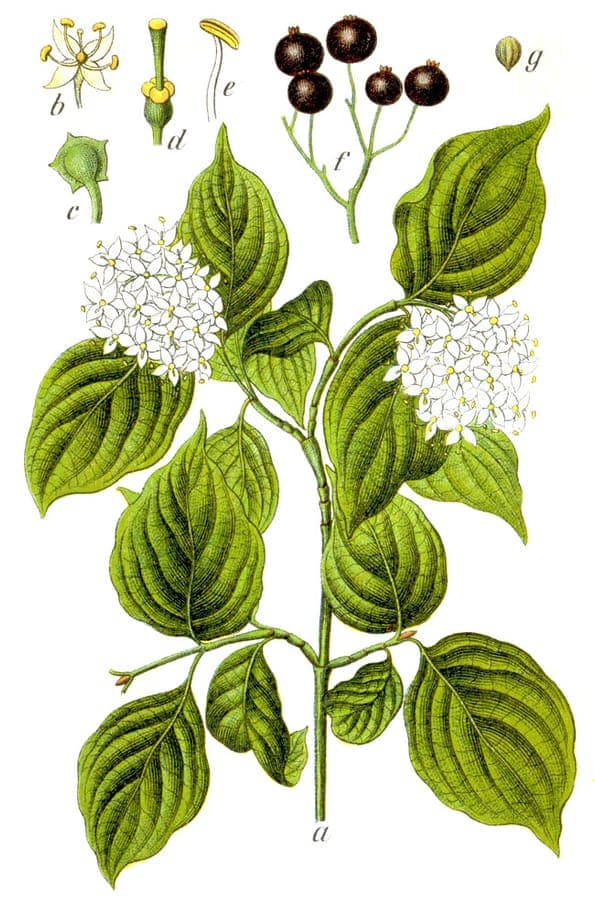
Johann Georg Sturm (Painter: Jacob Sturm) / Public domain, via Wikimedia Commons
Common dogwood: complete guide
Cornus sanguinea
Want to see Common dogwood: complete guide in your garden?
1 minute, no credit card
Overview
Cornus sanguinea, commonly known as common dogwood, is a tough, deciduous shrub native to much of central and western Europe, including the UK and parts of northern France. It grows 1.5 to 3 meters tall with a spread of around 1.5 meters, forming a loose, upright thicket. This member of the Cornaceae family is often overlooked in ornamental gardens, but it's a powerhouse in wildlife support and seasonal structure. From May to June, it produces clusters of small white flowers, followed by dark purple berries that birds love. The real showstopper comes in winter, when the young stems turn a striking blood-red - hence the name 'sanguinea'. On gardenworld.app, we're seeing a resurgence of this shrub in native planting schemes, especially in layered borders and natural hedgerows.
Appearance & bloom cycle
Common dogwood features simple, oval leaves with a pointed tip, arranged oppositely along the stems. In summer, the foliage is a rich green, turning golden-yellow to reddish in autumn. The flowers appear in flat-topped cymes from late May into June. Though not particularly showy, they're highly attractive to pollinators like hoverflies, bees, and beetles. By late summer, pea-sized blackish-purple fruits develop - mildly toxic to humans but a valuable food source for thrushes, blackbirds, and warblers. Winter reveals the plant's true charm: bare, slender stems glow bright red, especially when grown in full sun. This color is most intense on new growth, making pruning essential for visual impact.
Ideal location
Common dogwood thrives in light shade to partial sun, but for the best stem color, plant it in a spot that receives at least 6 hours of direct sunlight daily (light factor 6/10). Full sun enhances the red pigmentation in young shoots. It tolerates a range of exposures, including north-facing sites, as long as the soil isn't waterlogged. It's ideal for woodland edges, informal hedges, or as a backdrop in mixed borders. Consider using gardenworld.app to visualise how this shrub fits into your garden's light and spacing requirements, especially when planning for winter interest.
Soil requirements
This shrub is adaptable but prefers well-drained, neutral to slightly alkaline soil with a pH between 7.0 and 7.5. It grows well in loam, clay-loam, or chalky soils. Avoid highly acidic conditions (below pH 6.5), which can cause poor growth and chlorotic leaves. While it handles heavy soils, prolonged waterlogging leads to root rot. In sandy soils, amend with compost to improve moisture retention. A top-dressing of well-rotted manure in spring supports healthy growth.
Free design
Want to see Common dogwood: complete guide in your garden? Make a free design now.
Watering
Young plants need consistent moisture during their first two growing seasons. Water deeply once a week during dry spells, ensuring the root zone is saturated. Established shrubs are drought-tolerant but perform better with moderate moisture. Mulching with wood chips or leaf mould helps retain soil moisture and suppress weeds. Avoid overhead watering to prevent fungal leaf spots.
Pruning
To maximise stem color, prune hard every late winter (late February to early March). Cut all stems back to 15–20 cm above ground level. This encourages vigorous new growth, which produces the brightest red stems. Without pruning, the plant becomes leggy and the older stems turn dull brown. Pruning also rejuvenates older specimens. Use clean, sharp secateurs and remove any dead or crossing branches. Pruned stems can be used in winter floral arrangements or piled as insect habitat.
Maintenance calendar
- Jan: Inspect for winter damage; remove broken stems.
- Feb: Prepare tools for pruning; check plant structure.
- Mar: Hard prune; apply compost around the base.
- Apr: Monitor for aphids or mildew; water if dry.
- May: Flowers emerge; watch for pollinator activity.
- Jun: Peak bloom; avoid pruning now.
- Jul: Check for pests; maintain mulch layer.
- Aug: Water during extended droughts.
- Sep: Replenish mulch; plant new specimens.
- Oct: Leaves begin to change; enjoy autumn tints.
- Nov: Berries may still be present; stems turn red after leaf drop.
- Dec: Full winter display; stems glow in low winter sun.
Winter hardiness
Common dogwood is fully hardy to USDA zone 4 (-30°C). It withstands harsh winters without protection and even looks striking under snow. No winter cover or wrapping is needed, even in exposed sites.
Companion plants
Pair common dogwood with other native shrubs like hawthorn, elder, or guelder rose for a natural hedge. Underplant with native perennials such as wood anemone, foxglove, or primrose. For structural contrast, use ferns, hostas, or carex. In a mixed border, combine with Cornus alba 'Sibirica' for a red-stem contrast, or with white-stemmed birches for winter texture. It also works well behind ornamental grasses that die back in winter, revealing the dogwood's stems.
Closing
Common dogwood is a low-maintenance, ecologically rich shrub that earns its place in any garden. With proper pruning, it delivers vibrant winter color, supports wildlife, and adds structure across all seasons. It's perfect for wildlife gardens, cottage borders, or as a screen. You'll find it at garden centres like B&Q, Wyevale, or local independents, usually as bare-root plants in winter or potted specimens in spring. Plant in the right spot - sun for color, decent drainage - and it will thrive for decades. Use gardenworld.app to plan your planting layout and see how this understated shrub can become a seasonal highlight.
Want to see Common dogwood: complete guide in your garden? Make a free design now.
Upload a photo, pick a style, and get a photorealistic design with plant list in under a minute.
No credit card required


Similar plants
Toughleaf Dogwood: complete guide
Cornus asperifolia
Toughleaf dogwood is a suckering, thicket-forming shrub native to the southeastern US, ideal for wildlife hedges on damp, low-lying ground.
Silky dogwood (Cornus obliqua): complete guide
Cornus obliqua
Silky dogwood: cultivation, care tips, and garden uses. White flowers, colorful berries, and stunning fall foliage.
Roughleaf dogwood: complete guide
Cornus drummondii
Everything you need to know about Cornus drummondii: siting, soil, pruning, winter hardiness and companion plants for a naturalistic garden.