
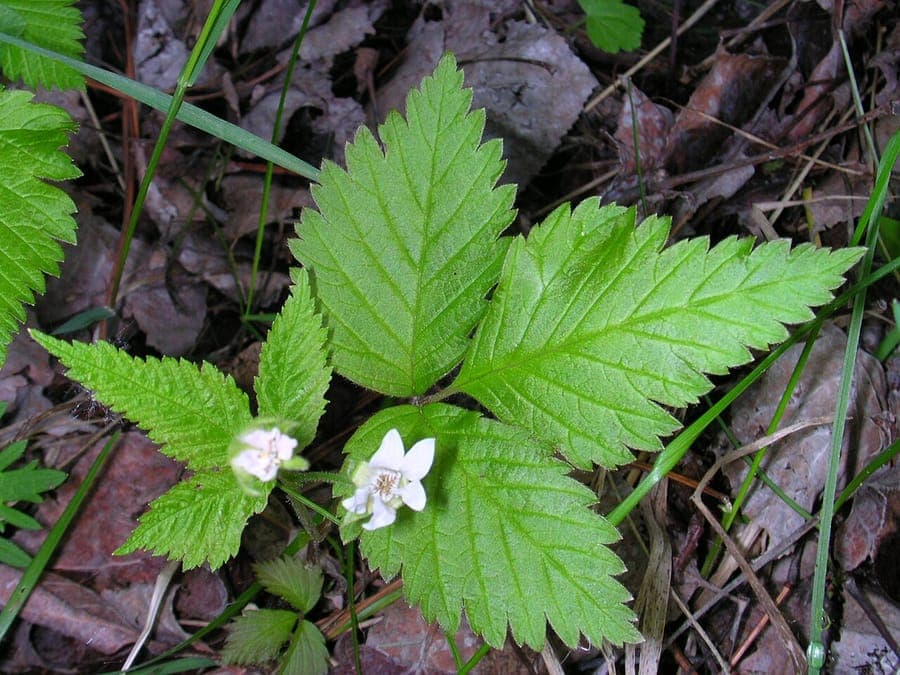
Superior National Forest / CC BY 2.0, via Wikimedia Commons
Dwarf raspberry (Rubus pubescens): complete guide
Rubus pubescens
Want to see Dwarf raspberry (Rubus pubescens): complete guide in your garden?
1 minute, no credit card
Overview
Rubus pubescens, commonly called dwarf raspberry, creeping red raspberry, or Canadian raspberry, is a low herbaceous bramble from subarctic North America to the northeastern United States. This species barely reaches 30-50 cm height, distinguishing it from most raspberries. The name "pubescens" refers to the downy hairs on stems and leaves, giving it a unique tactile texture. An excellent choice for natural woodland gardens and moisture-tolerant plantings in cool climates.
Appearance and bloom
Reaches only 30-50 cm, spreads via shallow rhizomes to 1 metre wide. Leaves are trifoliate, distinctly serrated, covered with soft hairs giving a velvety appearance. Flowers are crimson to deep pink, small and abundant, appear May-June in dense clusters. Fruits ripen July-August into red aggregate berries about 1 cm long - sweet and edible, highly prized by birds and woodland inhabitants.
Ideal location
Grows in half-shade to full shade, ideal along forest edges and beneath tall trees. Tolerant of marshes, moist meadows, and mountainous terrain. These are woodland plants feeling at home in cool, moist environments. In warm, dry Mediterranean-style gardens it fails. Full sun only acceptable in very cool climates.
Soil
Thrives in acidic, moist to wet soils (pH 4-6). Silt-clay mixtures with high organic content ideal. Sandy loams dry too quickly. Add 40% peat moss or coir to planting holes for optimal establishment. Drainage can be moderate - slight waterlogging tolerated and even stimulates growth.
Free design
Want to see Dwarf raspberry (Rubus pubescens): complete guide in your garden? Make a free design now.
Watering
Highest moisture requirement of all Rubus species. Water regularly, at least weekly during growing season. In dry summers water 2x weekly. Mature plants tolerate 2-3 week dry periods poorly - wilting occurs. For optimal fruit production: consistently moist maintenance.
Pruning
Minimal pruning required. Remove dead material in March only. Every 2-3 years, light thinning of overgrown colonies by removing older rhizomes. No formal shaping needed. Allow natural growth to predominate.
Maintenance calendar
March: Dead-wood inspection, light thinning. April-May: Monitor flowering and moisture. June-July: Fruit formation and ripening. August: Harvest ripe berries (optional). September-October: Allow seeds to drop naturally. November-February: Subarctic dormancy routine.
Winter hardiness
Rubus pubescens withstands temperatures to -30 to -35C (USDA zones 2-3). Excellent for cool-climate and Scandinavian gardens. Above-ground parts may blacken after extreme cold, but underground systems always recover. Snow cover protective and beneficial.
Companion plants
Perfect beneath birch, willow, and conifers in natural woodland plantings. Combine with ferns, trilliums, and other forest-floor herbaceous plants. Suitable for bird habitat alongside Cornus, Sambucus, and Viburnum. Creates continuity with native subarctic flora for ecosystem-authentic gardens. Wildlife greatly values this composition.
Closing
Dwarf raspberry is essential for cool-climate gardens and natural woodland plantings. With its characteristic downy texture, red berries, and moisture tolerance, it is ideal for creating authentic forest-ecosystem gardens. Not for dry Mediterranean settings, but indispensable for Northern European and mountain gardeners.
Want to see Dwarf raspberry (Rubus pubescens): complete guide in your garden? Make a free design now.
Upload a photo, pick a style, and get a photorealistic design with plant list in under a minute.
No credit card required


Similar plants
Running blackberry (Rubus hispidus): complete guide
Rubus hispidus
Discover running blackberry from eastern North America. A low trailing berry-bearer with hispid stems, thrives in swampy and acid soils - perfect for ecological understory planting.
Strawberry-leaf raspberry (Rubus pedatus): complete guide
Rubus pedatus
Discover strawberry-leaf raspberry from the Himalayas and northwestern North America. A low creeping groundcover with distinctive five-leafed foliage and colour-changing berries.
Pacific blackberry (Rubus ursinus): complete guide
Rubus ursinus
Discover Pacific blackberry from western North America. A vigorous trailer with large white flowers, black berries, and coarse foliage - perfect for wild coastal and mountain gardens.