
Wikimedia Commons / Public domain, via Wikimedia Commons
Running blackberry (Rubus hispidus): complete guide
Rubus hispidus
Want to see Running blackberry (Rubus hispidus): complete guide in your garden?
1 minute, no credit card
Overview
Rubus hispidus, commonly called running blackberry, swamp blackberry, or hispid dewberry, is a low-growing herbaceous bramble from eastern Canada and the northeastern United States. Unlike tall brambles, this species trails along the ground on hairy, creeping stems (hispidus = hairy), making it unique for growers seeking ground-cover effects in wet, acidic soils. Bird and small mammal wildlife value the protective cover and persistent winter berries highly.
Appearance and bloom
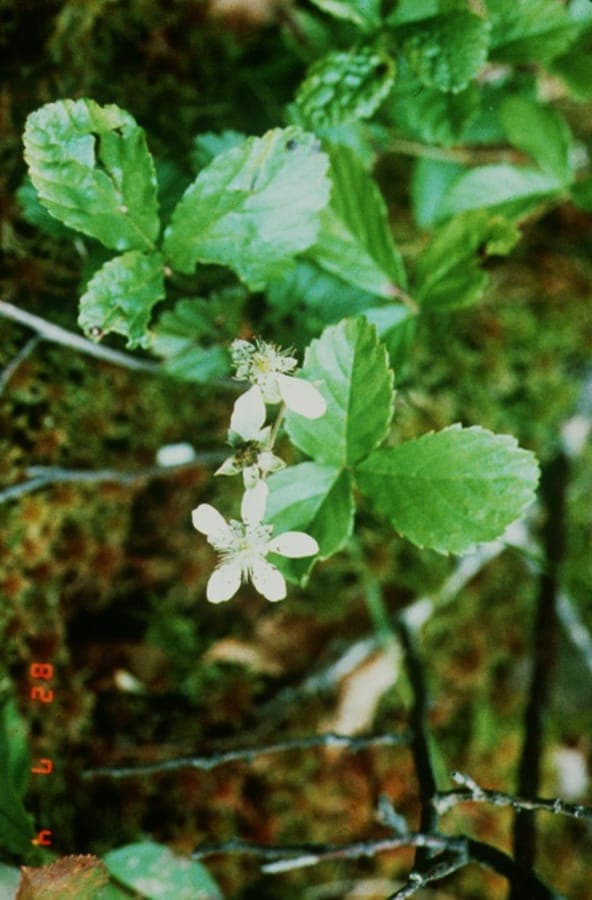
Reaches only 30-60 cm height but spreads via shallow, bristly runners to 1 metre wide. Leaves are notably small, roundish, dark green above. Flowers are white to pale pink, approximately 1 cm wide, appearing May-June in loose clusters. Fruits ripen July-August into black drupes about 1 cm long - edible but sharp and astringent, valued more for wildlife than human consumption.
Ideal location
This species flourishes in half-shade to full shade, but blooms best with 3-4 hours diffuse sunlight. Ideal along forest edges, in wet areas, near water channels, and in understory layers beneath tall trees. Excellent for boggy garden corners where other plants fail. Avoid completely dry sandy soils.
Soil
Prefers acidic, moist to wet soils (pH 4.5-6). This preference is actually unusual - most garden plants dislike such conditions! Sedge marshes, brackish woodland floors, peaty forest soils are ideal. Organic matter (peat moss, leaf mould, decomposed wood) is crucial. In fast-draining gravel gardens, this plant will disappoint.
Free design
Want to see Running blackberry (Rubus hispidus): complete guide in your garden? Make a free design now.
Watering
Ordinarily requires no supplemental watering. Groundwater 20-30 cm deep is optimal. In dry seasons, weekly watering 1x helps, but drought does not kill - merely reduces vigour. In very wet soils, the plant thrives without drainage works whatsoever.
Pruning
Essentially pruning-free. Remove dead material in March only. In very dense colonies, thin runners every 2-3 years. No formal shaping needed. Herbaceous growing tips naturally collapse in autumn winds.
Maintenance calendar
March: Dead-wood inspection, clearance. April-May: Monitor flowering, no intervention. June-July: Observe fruiting. August-September: Monitor ripeness. October-February: Rest period, wildlife observation.
Winter hardiness
Rubus hispidus withstands temperatures to -25 to -30C (USDA zones 3-4). Excellent for cool-climate and Scandinavian gardens. Above-ground parts may blacken after extreme frost, but underground systems recover fully.
Companion plants
Perfect as underplanting beneath sassafras, birch, and conifers in natural woodland plantings. Combines well with other low forest plants: trillium, bog rosemary, and ferns. Provides bird habitat alongside low willow species. Forest birds use it for nesting and winter shelter.
Closing
Running blackberry is an unexpected star for moisture-tolerant and ecological gardens. This North American species offers something entirely different: a hairy, ground-hugging shrub that embraces boggy conditions. For those valuing ecological function and native bird support, this is essential.
Want to see Running blackberry (Rubus hispidus): complete guide in your garden? Make a free design now.
Upload a photo, pick a style, and get a photorealistic design with plant list in under a minute.
No credit card required


Similar plants
Strawberry-leaf raspberry (Rubus pedatus): complete guide
Rubus pedatus
Discover strawberry-leaf raspberry from the Himalayas and northwestern North America. A low creeping groundcover with distinctive five-leafed foliage and colour-changing berries.
Dwarf raspberry (Rubus pubescens): complete guide
Rubus pubescens
Discover dwarf raspberry from subarctic North America. A low herbaceous ground cover with red fruits and downy foliage - hardy to -30C, thrives in wet woodlands.
Pacific blackberry (Rubus ursinus): complete guide
Rubus ursinus
Discover Pacific blackberry from western North America. A vigorous trailer with large white flowers, black berries, and coarse foliage - perfect for wild coastal and mountain gardens.