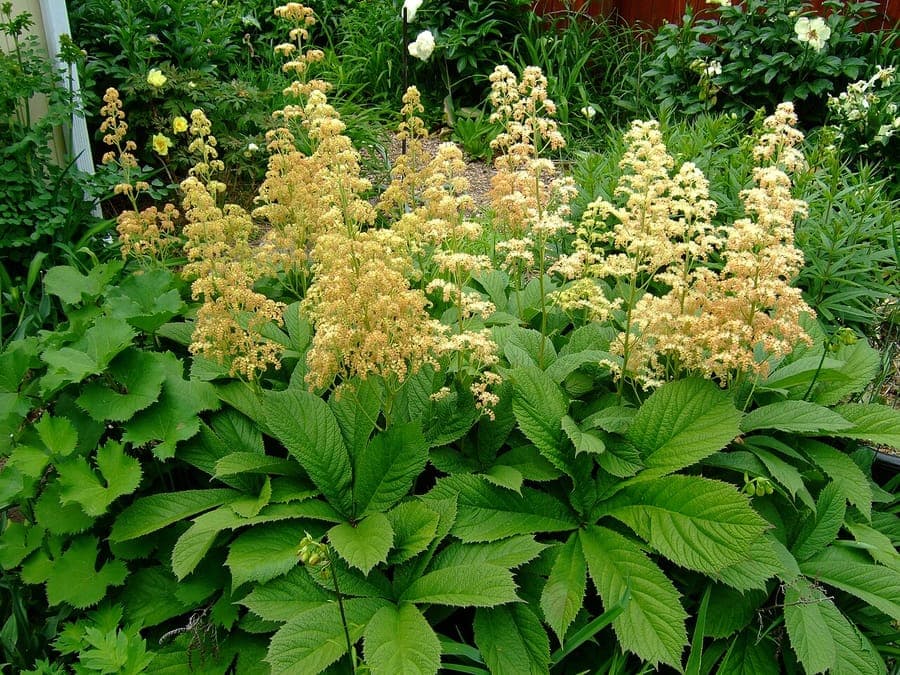
James Steakley / CC BY-SA 3.0, via Wikimedia Commons
Rodgersia pinnata: featherleaf rodgersia guide
Rodgersia pinnata
Want to see Rodgersia pinnata: featherleaf rodgersia guide in your garden?
Full design in HD: €7.99
Look after your Rodgersia pinnata with the GardenWorld app
Identify plants with your camera and get a care calendar with reminders for this plant.


Overview
Rodgersia pinnata is one of the finest foliage plants for a moist, partly shaded garden. Often called featherleaf rodgersia, it forms a broad clump of large, divided leaves that recall those of a horse chestnut, with deeply impressed veins and a glossy surface. In summer, plumes of tiny star-shaped flowers rise above the foliage in pink, red, cream or white, depending on the form or cultivar.
The species comes from south-western China, from Yunnan and Sichuan, where it grows in damp woodland, along stream banks and on wet mountain slopes. That explains its liking for cool, moist soil and shelter from strong sun. In flower Rodgersia pinnata reaches 90 to 120 cm, and the clump slowly spreads by short rhizomes to 75 to 90 cm. Well-known cultivars include 'Superba', with pink plumes and bronze young leaves, 'Elegans', with creamy pink flowers, and 'Chocolate Wing', whose spring foliage is chocolate brown. Flower colour can vary a little from year to year and from site to site, and often fades to cream or salmon pink as the plumes age, as in the photo.
If you want to see where such a large foliage plant would look best, on gardenworld.app you can create a garden design that takes shade, moisture and the space in your plot into account. As far as is known, Rodgersia pinnata is not toxic to people or pets.
Appearance and bloom cycle
Each leaf has five to nine oblong leaflets 10 to 20 cm long, some radiating from a single point and others arranged in pairs along a short central stalk. That arrangement is what gives the species its name, pinnata, meaning feathered. The edges are finely toothed and the surface is strongly textured by the sunken veins. In spring the young leaves are often tinted bronze or reddish brown; through summer they turn deep green, and in autumn some forms colour bronze to reddish again.
Flowering takes place in July and August. The plumes stand upright on sturdy stems and consist of hundreds of small flowers with no true petals; the colour comes from the sepals. After flowering the seed heads remain and often turn deep red to rusty brown, giving a fine effect well into autumn. Bees and hoverflies visit the flowers.
Ideal location
Partial shade is ideal: a spot with morning sun and afternoon shade, or dappled light beneath tall trees. In full sun the leaves can scorch and develop brown edges unless the soil is genuinely wet all the time, as at a pond margin. In deep shade the plant will grow but flowers less.
Choose a sheltered position too. Strong wind tears the large leaves and dries them out. Good places include a pond or stream bank, a moist shady border, the edge of a woodland planting or the north side of a wall or hedge. Plant 75 to 90 cm apart so each clump can spread its leaves fully. Three plants together form an impressive group within a few years.
Soil requirements
The soil should be humus-rich, deep and consistently moist. Rodgersia pinnata does best in moist loam, clay soil enriched with plenty of organic matter, or wet ground beside water. A slightly acidic to neutral pH is preferred, although slightly alkaline soil is tolerated.
On light sandy soil, work generous amounts of compost, leaf mould or well-rotted manure into the top 30 cm before planting. Each spring, spread a 5 cm mulch of compost or leaf mould. This keeps the soil cool and moist and feeds the plant gradually. Chemical fertiliser is not needed.
Free preview
Want to see Rodgersia pinnata: featherleaf rodgersia guide in your garden? Make a free preview of your design.
Watering
A rodgersia must never dry out. After planting, water regularly for the first few months. Established plants also need extra water in dry spells unless they grow at the edge of a pond or stream. In an ordinary border, give a generous soaking two or three times a week during prolonged drought, preferably in the morning.
Brown leaf edges in summer are almost always a sign of too little water, too much sun or both. Leaves that droop on a hot afternoon often recover by evening; if they are still limp in the morning, water straight away. No extra water is needed in winter.
Pruning
Rodgersia pinnata needs hardly any pruning. Leave the seed heads in place for as long as they look good; they add a warm red note in late summer and autumn. In late autumn, when the foliage dies back, cut the leaves and old stems down to just above the ground. Alternatively, leave the dead leaves as protection until spring.
Every four or five years, when the clump becomes too large or loses vigour in the centre, divide it in early spring. Cut away sections of rhizome with at least one bud each and replant them at once in moist, humus-rich soil.
Slugs usually leave the fairly tough leaves alone, but they can damage young shoots. Check regularly in April and May.
Maintenance calendar
March: Remove dead leaves. Spread a mulch of compost or leaf mould. A good time to plant or divide.
April–May: The bronze young leaves unfurl. Protect them from late frost and check for slugs.
June: The foliage is fully grown. Water in dry weather.
July–August: Flowering time. Keep the soil moist, especially in warm weather.
September–October: The seed heads turn red. Leave them for ornamental value.
November: Cut back leaves and stems, or leave them as protection.
December–February: Winter rest. No care needed.
To keep track of these jobs month by month, the planting calendar on gardenworld.app reminds you what needs doing and when.
Winter hardiness
Rodgersia pinnata is very hardy. The rhizomes withstand hard frost down to about -20 °C and below, and the plant needs no winter protection anywhere in the British Isles or the Low Countries.
The only real risk is late frost in April or May. The young leaves emerge early and are tender; a single frosty night can scorch them. The plant will produce new leaves afterwards, but the season gets off to a less attractive start. Cover the young shoots with fleece when frost is forecast, or choose a spot that is not in a frost pocket.
Companion plants
Rodgersia pinnata is an excellent partner for other plants of moist, shady places. Hostas such as Hosta sieboldiana provide a fine contrast in shape with their broad, blue-grey leaves. Ostrich fern (Matteuccia struthiopteris) fills the gaps between the large leaves with light, finely cut fronds.
Astilbe (Astilbe japonica) flowers with similar plumes and the same colour range but is smaller, so it fits nicely at the front of the border. Japanese primrose (Primula japonica) flowers in late spring, while the rodgersia is still unfurling, and also loves wet soil. Ligularia dentata adds orange flowers in late summer and a warm accent beside the dark rodgersia foliage.
Final thoughts
Rodgersia pinnata gives a shady garden structure and presence. Its large, divided leaves are decorative from spring to autumn, the plumes bring colour in summer, and the red seed heads extend the season into autumn. Above all it asks for moist, humus-rich soil and protection from fierce midday sun.
If you have a pond edge, a damp corner or a cool shady border, this rodgersia is a lasting asset. Plant it in spring, keep the soil moist and give it room, and it will grow into a lush clump that shapes the look of your garden for years.
Frequently asked questions about Rodgersia pinnata
Is Rodgersia pinnata winter hardy?
Rodgersia pinnata is very hardy. The rhizomes withstand hard frost down to about -20 °C and below, and the plant needs no winter protection anywhere in the British Isles or the Low Countries.
When and how do you prune Rodgersia pinnata?
Rodgersia pinnata needs hardly any pruning. Leave the seed heads in place for as long as they look good; they add a warm red note in late summer and autumn.
How much water does Rodgersia pinnata need?
A rodgersia must never dry out. After planting, water regularly for the first few months.
Where does Rodgersia pinnata grow best?
Partial shade is ideal: a spot with morning sun and afternoon shade, or dappled light beneath tall trees. In full sun the leaves can scorch and develop brown edges unless the soil is genuinely wet all the time, as at a pond margin.
What soil does Rodgersia pinnata need?
The soil should be humus-rich, deep and consistently moist. Rodgersia pinnata does best in moist loam, clay soil enriched with plenty of organic matter, or wet ground beside water.

See it in your garden
See Rodgersia pinnata in your garden
One photo of your garden and a few questions. You see the result in about a minute.
Try it with a photoIdentify this plant in your own garden. Identify a plant
Similar plants
Hosta sieboldiana: complete guide
Hosta sieboldiana
Hosta sieboldiana growing guide: large blue-green shade plant from Japan. Complete care tips, placement and maintenance for shady gardens and woodland areas.
Ostrich Fern: complete guide
Matteuccia struthiopteris
The ostrich fern (Matteuccia struthiopteris) is an elegant moisture-loving fern with distinctive feathery fronds. Learn care tips, ideal locations, and propagation methods.
Japanese astilbe: complete guide
Astilbe japonica
Japanese astilbe brings elegant feathery flowers and fine foliage to shaded gardens. Perfect border perennial for moist soils and cool settings.
