A. Barra / CC BY 3.0, via Wikimedia Commons
Fingerleaf Rodgersia: complete guide
Rodgersia aesculifolia
Want to see Fingerleaf Rodgersia: complete guide in your garden?
Full design in HD: €7.99
Look after your Fingerleaf Rodgersia with the GardenWorld app
Identify plants with your camera and get a care calendar with reminders for this plant.


Overview
Rodgersia aesculifolia is one of those perennials you keep looking at even when it is not in flower. Its leaves are a near copy of horse chestnut foliage: five to seven large, toothed leaflets radiating like fingers from a single point, which is exactly where the species name comes from (aesculifolia means "with leaves like Aesculus"). In Britain it is sold as fingerleaf rodgersia or chestnut-leaved rodgersia. The plant is native to the mountain forests and damp ravines of central and western China, where it grows beside streams and in dappled shade beneath trees.
In the garden this rodgersia is an architectural foliage plant for spots where many others struggle: moist, partly shaded corners, the margin of a pond or a strip along a ditch. It slowly forms broad clumps from thick, creeping rhizomes and will stay in the same place for decades without needing to be divided. In summer, tall plumes of creamy white to soft pink flowers rise above the leaves and later fade to a rusty red.
Rodgersia aesculifolia belongs to the saxifrage family (Saxifragaceae), alongside astilbe and darmera. If you want to build a shade border around bold leaf shapes, this plant brings instant structure. At gardenworld.app you can have a garden design made in which rodgersia, ferns and hostas come together in a calm, green shade garden that stays interesting all season.
Appearance and bloom cycle
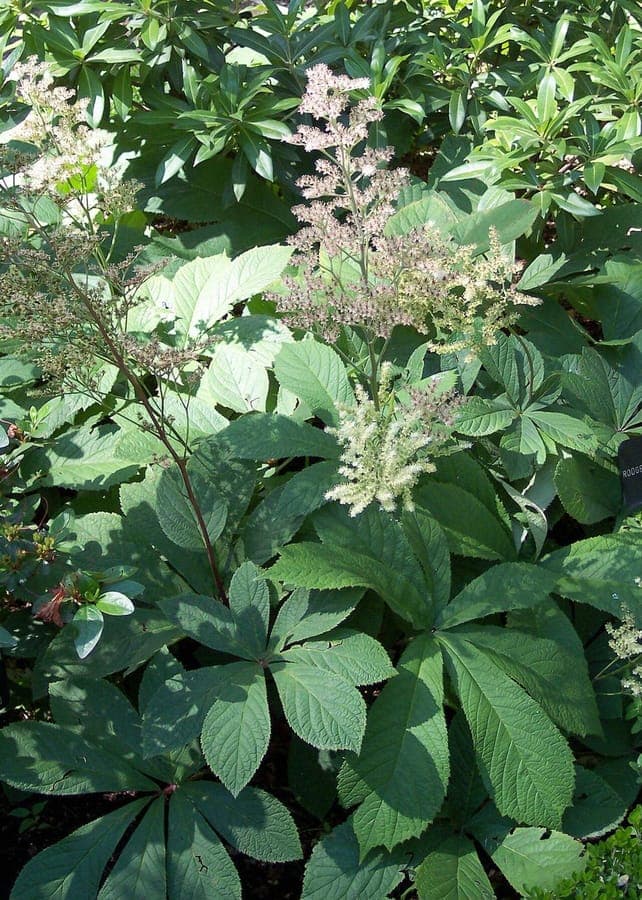
The foliage is what sets it apart. Each leaf sits on a long, hairy stalk and usually consists of five to seven leaflets, each 15 to 25 cm long. As they unfurl in April the leaves are bronze to reddish brown and slightly crinkled; through May they turn a deep, faintly glossy green with prominent veining. The leaf stalks and the veins on the underside carry brownish hairs, giving the plant a slightly rough, robust look. In autumn the leaves can take on bronze and coppery tones before dying back.
The foliage forms a mound 60 to 90 cm tall and eventually 90 cm to 1 m across. In June and July sturdy, reddish brown flower stems rise well above it, reaching 1.2 m and sometimes 1.5 m. The plumes are loosely branched and carry hundreds of small, star-shaped flowers without true petals; the colour comes from the sepals. They are creamy white when they open and gradually turn pink to rusty red. Even after flowering the plumes stay attractive, because the seed capsules colour reddish brown and remain decorative well into autumn.
The photo shows the typical picture: broad, palmately compound leaves in the shade, topped by airy plumes in white and old rose. Insects visit the flowers, but this is first and foremost a foliage plant.
Ideal location
Part shade is ideal. In the wild, Rodgersia aesculifolia grows under a light tree canopy, catching morning sun and sheltered during the hottest part of the day. In the garden, a spot on the east or north side of a building, or beneath tall trees with a raised canopy, works perfectly. Full sun is possible, but only where the soil stays reliably moist, for example at the edge of a pond. In a dry, sunny spot the leaves scorch and develop brown edges.
The plant also tolerates deep shade, though it flowers less freely there. Choose a sheltered position if you can: the large leaves tear and snap in strong gusts, especially in exposed places. A sheltered corner between shrubs or a spot behind a hedge is therefore better than an open lawn edge. Allow a spacing of 80 cm to 1 m, since the clumps broaden over the years.
Soil requirements
The soil should be humus-rich, deep and consistently moist. Rodgersia roots with thick rhizomes in the upper layer and likes ground that smells of woodland floor: rich in leaf mould and compost, slightly acidic to neutral (pH 5.5 to 7). A clay or loamy soil that does not dry out in summer is perfect. Sandy soil can work too, provided you dig in plenty of compost or well-rotted manure at planting time and mulch every year.
The plant copes reasonably well with winter wet, but not with compacted, airless soil for long periods. A pond margin or stream bank is fine, as long as the rhizomes themselves are not permanently submerged. Plant the rhizomes shallowly, with the tips just below the surface, and firm the soil well.
Free preview
Want to see Fingerleaf Rodgersia: complete guide in your garden? Make a free preview of your design.
Watering
Water is the key to handsome foliage. In the first year after planting, water generously twice a week during dry spells, around 10 litres per plant. Established plants also need extra water in a dry summer, because the big leaves lose a lot of moisture. If the leaves hang limp in the afternoon, that is a clear signal. Water in the morning or evening, directly onto the soil.
A mulch of 5 to 8 cm of leaf mould, bark chips or shredded leaves holds in moisture and feeds the soil at the same time. There is no need to water in winter. Rodgersia can be grown in a large container, but then it will need water almost daily in summer; a saucer with a little standing water helps.
Pruning
Real pruning is not needed. After flowering you can leave the plumes for their reddish brown seed heads or cut them off if you prefer a cleaner foliage display. In autumn the leaves die back; leave them in place until the first hard frost, as they protect the rhizomes. Cut away the old foliage in late winter or early spring, before the new shoots appear.
During summer, remove damaged or scorched leaves at the base to keep the clump looking fresh. Division is only necessary if you want more plants: in March or April use a sharp spade to slice off a piece of rhizome with at least one bud, and replant it straight away.
Maintenance calendar
March–April: Cut away old, dead foliage. Spread a mulch of compost or leaf mould. This is also the best time to plant or divide.
April–May: The bronze leaves unfurl. Protect them from slugs and snails, which love the young shoots. Use ferric phosphate pellets if needed or check by torchlight in the evening.
June–July: Flowering time. Water during dry spells and keep the soil moist. Remove brown, scorched leaves.
August–September: The seed capsules turn reddish brown. Keep watering in dry weather.
October–November: The foliage colours and dies back. Leave it as winter cover or add a few extra leaves on top.
December–February: Dormant period. No maintenance needed. If you want to know exactly when to do each job, the planting calendar on gardenworld.app gives you seasonal reminders.
Winter hardiness
Rodgersia aesculifolia is fully hardy throughout the UK and north-western Europe, tolerating frost down to about -25 °C (USDA zone 5). The rhizomes sit in the ground and are well protected by the dead foliage and a layer of mulch. The real risk is late spring frost: the young bronze leaves emerge fairly early and can be frosted on a cold April night. The plant usually recovers, but the leaves will be smaller and less perfect that season. Throw a sheet of horticultural fleece over the emerging shoots when a frost is forecast.
In a container the plant is more vulnerable, because the roots are less insulated. Move the pot against a wall in winter and wrap it in hessian or bubble wrap.
As far as is known, the plant is not toxic to people, dogs or cats. It is not regarded as invasive anywhere in Europe and spreads only slowly through its rhizomes.
Companion plants
Rodgersia aesculifolia looks its best among other plants for moist shade. Hostas such as Hosta sieboldiana provide a fine contrast with their broad, undivided leaves. Ferns like the shuttlecock fern (Matteuccia struthiopteris) and the royal fern add fine, airy textures. Astilbe (Astilbe japonica) flowers at the same time and echoes the plume shape on a smaller scale in stronger colours.
For early summer colour, candelabra primulas such as Primula japonica enjoy the same damp soil. Ligularia (Ligularia dentata) brings warm orange flowers next to the dark foliage in August. Ornamental grasses such as Hakonechloa and shade-loving sedges fill the foreground. Avoid pairing it with drought lovers like lavender or sage: their needs are the opposite of a rodgersia's.
Final thoughts
Rodgersia aesculifolia is a plant for gardeners who love foliage. With its chestnut-like leaves, bronze spring growth and tall plumes it brings calm and structure to any damp, shady corner. Give it humus-rich soil, enough water and a spot out of the fierce afternoon sun, and it will shine for years with very little effort. Plant one this spring beside a pond or beneath a tree, and you will have a focal point that gets better every year.
Frequently asked questions about Fingerleaf Rodgersia
Is Fingerleaf Rodgersia winter hardy?
Rodgersia aesculifolia is fully hardy throughout the UK and north-western Europe, tolerating frost down to about -25 °C (USDA zone 5). The rhizomes sit in the ground and are well protected by the dead foliage and a layer of mulch.
When and how do you prune Fingerleaf Rodgersia?
Real pruning is not needed. After flowering you can leave the plumes for their reddish brown seed heads or cut them off if you prefer a cleaner foliage display.
How much water does Fingerleaf Rodgersia need?
Water is the key to handsome foliage. In the first year after planting, water generously twice a week during dry spells, around 10 litres per plant.
Where does Fingerleaf Rodgersia grow best?
Part shade is ideal. In the wild, Rodgersia aesculifolia grows under a light tree canopy, catching morning sun and sheltered during the hottest part of the day.
What soil does Fingerleaf Rodgersia need?
The soil should be humus-rich, deep and consistently moist. Rodgersia roots with thick rhizomes in the upper layer and likes ground that smells of woodland floor: rich in leaf mould and compost, slightly acidic to neutral (pH 5.5 to 7).

See it in your garden
See Fingerleaf Rodgersia in your garden
One photo of your garden and a few questions. You see the result in about a minute.
Try it with a photoIdentify this plant in your own garden. Identify a plant
Similar plants
Hosta sieboldiana: complete guide
Hosta sieboldiana
Hosta sieboldiana growing guide: large blue-green shade plant from Japan. Complete care tips, placement and maintenance for shady gardens and woodland areas.
Ostrich Fern: complete guide
Matteuccia struthiopteris
The ostrich fern (Matteuccia struthiopteris) is an elegant moisture-loving fern with distinctive feathery fronds. Learn care tips, ideal locations, and propagation methods.
Japanese astilbe: complete guide
Astilbe japonica
Japanese astilbe brings elegant feathery flowers and fine foliage to shaded gardens. Perfect border perennial for moist soils and cool settings.
