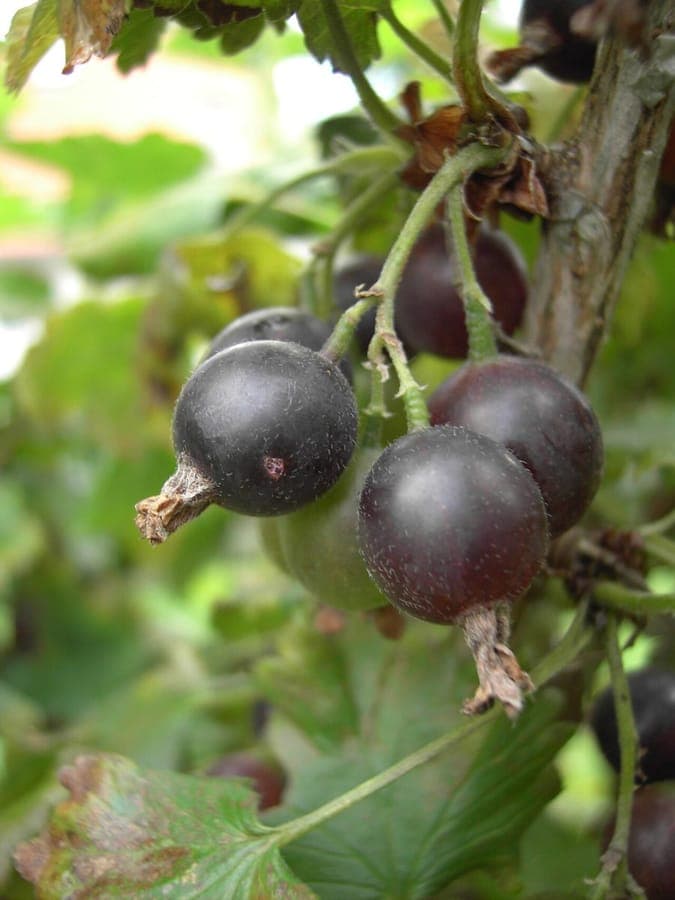
User:Zualio / CC BY 2.5, via Wikimedia Commons
Jostaberry: complete guide to planting, pruning and harvest
Ribes × nidigrolaria
Want to see Jostaberry: complete guide to planting, pruning and harvest in your garden?
Full design in HD: €7.99
Look after your Jostaberry with the GardenWorld app
Identify plants with your camera and get a care calendar with reminders for this plant.


Overview
The jostaberry (Ribes × nidigrolaria) is a cross between the blackcurrant and the gooseberry, with a third species, Ribes divaricatum, also in its family tree. It was bred in Cologne in the 1970s by Rudolf Bauer, who was after a berry with the flavour of a blackcurrant, the size of a gooseberry and no thorns. The name combines the German words Johannisbeere and Stachelbeere. The first variety, 'Josta', is still sold in nearly every garden centre.
What makes the jostaberry so well suited to an allotment or fruit garden is its toughness. The bush is vigorous, thornless, very hardy and largely resistant to the problems that plague blackcurrants and gooseberries, such as American gooseberry mildew and big bud mite. It grows into a substantial shrub 1.5 to 2 metres tall and as wide, and after a few years easily yields 4 to 6 kilos of fruit per plant. Children can pick it themselves without getting scratched.
Besides 'Josta' you will also find 'Jogranda', with larger berries in looser clusters, and the slightly more compact 'Jostine'.
Appearance, flowers and fruit
The jostaberry forms an upright bush that later spreads widely, with sturdy, smooth branches. The leaves resemble those of the blackcurrant, three- to five-lobed, fresh green and glossy, but have hardly any scent. In autumn they turn yellowish and fall; in mild winters some leaves hang on for a long time.
In April small, bell-shaped flowers appear in greenish and reddish-purple shades. They are easy to overlook, but bumblebees and bees adore them, which also earns the jostaberry a place in a wildlife-friendly garden.
The berries ripen in July. They are 1.5 to 2 cm across, round, first green, then reddish-purple and finally almost black with a matt sheen. The flavour sits between the two parents: the spiciness of blackcurrant, but milder, with the fresh acidity and firm skin of a gooseberry. The berries are rich in vitamin C and are not toxic to people or pets.
Ideal location
Plant the jostaberry in full sun or light shade. The more sun, the sweeter the berries and the heavier the crop, although four to six hours of sun a day still gives a decent harvest. As the bush grows large, allow at least 2 metres between plants, and the same distance from paths and hedges.
The jostaberry also works well as an informal fruiting hedge along the edge of a vegetable plot; in that case space the plants 1.5 metres apart. Avoid frost pockets where cold air collects: the bush itself is hardy, but late frost during flowering can reduce the crop.
Soil requirements
The jostaberry is not fussy and grows on sand, loam and even clay, as long as the ground does not stay waterlogged. Ideal is a humus-rich, moisture-retentive soil with a pH between 6 and 7. Work a few spadefuls of well-rotted compost into the planting hole.
Bare-root plants are best planted between November and March, during frost-free spells. Container plants can go in all year, but in summer they will need plenty of water. Set the bush slightly deeper than it stood in the pot, which encourages new shoots from the base. A mulch of compost, grass clippings or leaf mould keeps the shallow roots cool and moist and suppresses weeds.
Watering
Currant bushes have shallow roots and cope badly with long dry spells. In the first year after planting, give a good can of water, about 10 litres per bush, once or twice a week in dry weather. Established plants need water mainly from May to July, while the berries swell. If they dry out, the berries stay small or drop.
Water at the base rather than over the leaves, so fungal diseases get less of a chance. The mulch does the rest by greatly reducing evaporation. After harvest you can ease off.
Free preview
Want to see Jostaberry: complete guide to planting, pruning and harvest in your garden? Make a free preview of your design.
Pruning
Prune the jostaberry in winter, between December and February. The fruit is borne mainly on one-year-old shoots and on short spurs on two- and three-year-old wood. The aim is an open bush with eight to ten main stems of different ages.
Each year, cut the two or three oldest stems, four years or older and recognisable by their dark, rough bark, right down near the ground. Leave the same number of strong young shoots to replace them. Also remove branches that hang low over the soil, cross or grow inwards. Long, floppy shoots can be shortened by a third. An unpruned jostaberry quickly turns into an impenetrable thicket with small berries.
Pollination and harvest
The jostaberry is self-fertile, so a single bush will crop. Even so, two different varieties side by side, or a jostaberry near a blackcurrant, often give slightly better fruit set. Bees and bumblebees do the pollinating.
Harvest starts in July and runs for several weeks, as the berries do not all ripen at once. Pick in a few rounds, taking berries that are fully dark and give slightly. For jam and jelly you can pick a little earlier, when the pectin content is higher. Birds, blackbirds in particular, like the fruit at least as much as you do: a net over the bush as soon as the first berries colour will save much of the crop. Fresh berries keep for a few days in the fridge and freeze well.
Maintenance calendar
December to February: Winter pruning. Plant new bushes during frost-free spells.
March: Spread compost or an organic fruit fertiliser around the bush and renew the mulch.
April: Flowering. Protect with fleece if frost threatens.
May to June: Water during dry spells. Keep the base free of weeds.
July: Harvest in several rounds. Net against birds.
August to September: Thin out a few overcrowded young shoots if needed. In autumn, take 20 cm hardwood cuttings to raise new plants.
October to November: Leaf fall. A good time to plant bare-root and container plants.
For an overview of every fruit job by month, tailored to your own garden, see the planting calendar on gardenworld.app.
Winter hardiness
Ribes × nidigrolaria is exceptionally hardy. It tolerates temperatures down to at least -20 °C, and according to some nurseries much lower, so it never needs winter protection in Britain or the Low Countries. Only the flowers are vulnerable to late frost in April. A welcome bonus is that the jostaberry resists white pine blister rust, which sometimes affects blackcurrants. It is not invasive and does not naturalise in Europe.
Companion plants
In the fruit garden the jostaberry sits happily beside its parents, the blackcurrant (Ribes nigrum) and the gooseberry (Ribes uva-crispa), giving you three flavours within arm's reach. Raspberries (Rubus idaeus) extend the harvest, and strawberries (Fragaria × ananassa) suit the sunny bed in front. Comfrey (Symphytum officinale) at the edge of the fruit garden draws in bumblebees and provides leaves for mulching or liquid feed. Keep turf and vigorous perennial weeds away from the base of the bush.
Final thoughts
The jostaberry is one of the easiest fruit bushes you can plant: thornless, vigorous, disease-resistant and productive year after year. Give it sun, some space, a mulch and an annual prune, and every summer you will pick kilos of dark berries for jam, crumbles and juice. Planning a new fruit corner? Have a garden design made on gardenworld.app and give your berries the spot they deserve.
Frequently asked questions about Jostaberry
Is Jostaberry winter hardy?
Ribes × nidigrolaria is exceptionally hardy. It tolerates temperatures down to at least -20 °C, and according to some nurseries much lower, so it never needs winter protection in Britain or the Low Countries.
When and how do you prune Jostaberry?
Prune the jostaberry in winter, between December and February. The fruit is borne mainly on one-year-old shoots and on short spurs on two- and three-year-old wood.
How much water does Jostaberry need?
Currant bushes have shallow roots and cope badly with long dry spells. In the first year after planting, give a good can of water, about 10 litres per bush, once or twice a week in dry weather.
Where does Jostaberry grow best?
Plant the jostaberry in full sun or light shade. The more sun, the sweeter the berries and the heavier the crop, although four to six hours of sun a day still gives a decent harvest.
What soil does Jostaberry need?
The jostaberry is not fussy and grows on sand, loam and even clay, as long as the ground does not stay waterlogged. Ideal is a humus-rich, moisture-retentive soil with a pH between 6 and 7.

See it in your garden
See Jostaberry in your garden
One photo of your garden and a few questions. You see the result in about a minute.
Try it with a photoIdentify this plant in your own garden. Identify a plant
Similar plants
Black currant: complete guide
Ribes nigrum
Grow black currants: this productive shrub reaches 2m and delivers vitamin-rich berry harvests in July-August, producing 5-8kg per mature plant.
European gooseberry: complete guide
Ribes uva-crispa
Everything you need to grow, maintain and harvest European gooseberries in your garden. Perfect for tart fruit lovers and sustainable garden designs on gardenworld.app.
Raspberry: complete guide
Rubus idaeus
Grow raspberries like a pro: ideal conditions, pruning, harvesting, and care from March to December. Perfect for UK, US, and Canadian gardens.
