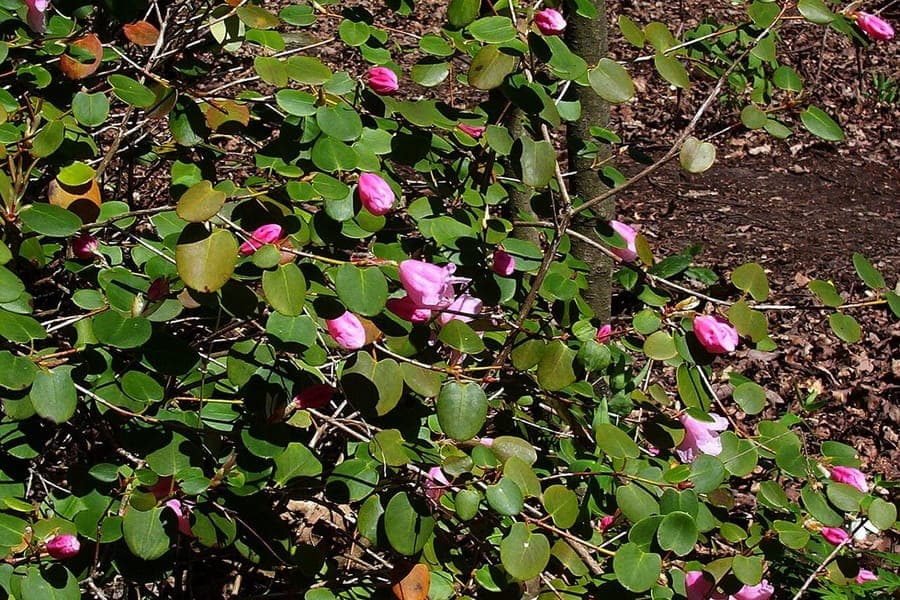
peganum from Henfield, England / CC BY-SA 2.0, via Wikimedia Commons
Williams rhododendron (Rhododendron williamsianum): guide
Rhododendron williamsianum
Want to see Williams rhododendron (Rhododendron williamsianum): guide in your garden?
Full design in HD: €7.99
Look after your Williams rhododendron with the GardenWorld app
Identify plants with your camera and get a care calendar with reminders for this plant.


Overview
Rhododendron williamsianum is a rhododendron you can recognise by its leaves long before it flowers. They are almost perfectly round to heart-shaped, only 2 to 4 cm across, and give the shrub a soft, almost playful look that most rhododendrons lack. Over time it builds a low, spreading dome about 1 to 1.5 metres tall and often wider than that. In April it hangs with pink bell-shaped flowers, and in May the new leaves unfold in a striking shade of bronze.
The Williams rhododendron comes from western Sichuan in China, where it grows on mountain slopes in open woodland and scrub. Ernest Wilson introduced it to Western gardens in the early twentieth century, and the name honours John Charles Williams of Caerhays in Cornwall, one of the great British rhododendron growers. It soon proved a remarkable parent: a long list of compact garden rhododendrons with rounded leaves and bell flowers descend from Rhododendron williamsianum. If you spot a low rhododendron with round leaves at a garden centre, it may well be one of those offspring, such as 'Bow Bells', 'Humming Bird' or 'Gartendirektor Glocker'.
It suits a shady border, the edge of a woodland garden, a sheltered spot near a terrace or a large container. On gardenworld.app you can have a garden design created that places this low dome among ferns, hostas and other plants for dappled shade.
A word of caution: like all rhododendrons, Rhododendron williamsianum is poisonous. Leaves, flowers, nectar and twigs contain grayanotoxins. In people these can cause nausea, vomiting, drooling, dizziness, a slow heartbeat and low blood pressure. Dogs, cats, rabbits, guinea pigs, horses, goats and sheep can also become seriously ill. Keep the shrub out of reach of grazing animals and small pets, and dispose of clippings where they cannot get at them.
Appearance and bloom cycle
The rounded foliage is this rhododendron's calling card. Leaves are fresh to dark green above and bluish grey beneath. New leaves emerge in May in bronze to coppery red before turning green after a few weeks. The photograph shows those rounded leaves clearly, together with pink buds just starting to open. The shoots are slender and closely packed, so the plant forms a dense dome that stays clothed in leaves right down to the ground.
Flowering usually comes in April, sometimes late March after a mild winter. The flowers are open bells 4 to 5 cm long, hanging in twos or threes at the tips of the shoots. They range from soft to deep pink, sometimes with a pale bloom, and are darker in bud than when fully open. A mature plant in full flower is dotted all over with these bells, a far lighter effect than the dense trusses of the big hardy hybrids. Bumblebees are the main visitors.
One thing worth knowing: young plants can take a few years to flower freely. Be patient, because once established the species sets buds reliably every year.
Ideal location
Rhododendron williamsianum prefers light shade. The ideal spot is beneath tall, widely spaced trees, with filtered light and protection from fierce midday sun. Morning sun is welcome, as it dries the leaves after rain and encourages bud formation. In full sun on a hot site the foliage scorches, while in deep shade the plant grows thin and flowers poorly.
Shelter matters too. The early flowers and new shoots are vulnerable to late frosts, and an open, draughty position makes that damage worse. Avoid places where early morning sun strikes frozen flowers straight after a frosty night, as rapid thawing does the most harm. A spot on the west or north-west side of a hedge or building often works well. Give it room to spread, planting at least 1.2 to 1.5 metres from other shrubs.
Soil requirements
Like every rhododendron, this species needs acid soil with a pH between 4.5 and 5.5. On chalky or neutral soil the leaves soon yellow between the veins. If in doubt, use a raised bed or a large container filled with ericaceous compost.
The ideal soil is humus-rich, open, moisture-retentive yet free-draining. Mix peat-free ericaceous compost with composted bark, leaf mould and a little sharp sand. The roots are fine and shallow, so do not plant too deeply: the top of the root ball should sit level with the soil surface. A 5 cm mulch of leaf mould or pine bark keeps the soil cool and moist, and in a woodland setting fallen leaves will top it up naturally.
Free preview
Want to see Williams rhododendron (Rhododendron williamsianum): guide in your garden? Make a free preview of your design.
Watering
Water regularly after planting and never let the root ball dry out during the first year. Established plants mainly need water during dry summers, especially in July and August when next spring's flower buds are forming. A shrub left dry at that time may drop buds or flower less the following year.
Rainwater is best, since hard tap water slowly raises the pH. Waterlogging is as harmful as drought, so make sure excess water can drain away. Check container plants every couple of days in summer, and give them an occasional drink in dry, frost-free spells during winter, because evergreen leaves keep losing moisture.
Pruning
Rhododendron williamsianum rarely needs pruning. It naturally forms a neat dome. After flowering, carefully snap off the spent blooms just above the new shoots, so the plant does not waste energy on seed and looks tidy.
If you need to correct the shape or shorten a long branch, do it straight after flowering in May. Prune later and you will remove next year's buds. Old, leggy plants can be renewed gradually over several years by cutting a few older stems hard each spring, but the species does not take kindly to severe pruning all at once. Wear gloves and put clippings in the green waste bin.
Maintenance calendar
March: Keep an eye on the forecast and cover buds with horticultural fleece if a late frost threatens. Give a light feed of ericaceous fertiliser.
April: Flowering time. Protect blooms on frosty nights and water if spring is dry.
May: Remove faded flowers. Bronze new leaves appear. Prune if necessary.
June–August: Bud formation. Keep the soil moist with rainwater and top up the mulch.
September–October: The best planting window. Leave fallen leaves as a natural mulch.
November–February: Dormant period. Protect container plants in hard frost and water occasionally in dry weather.
Winter hardiness
The plant itself is reasonably hardy. The Royal Horticultural Society rates it H5, which means hardy to roughly -15 °C, and an established shrub in a sheltered position can take somewhat lower temperatures. In most of Britain and the Low Countries, Rhododendron williamsianum comes through a normal winter in open ground without trouble.
The real risk comes in spring. Because the plant flowers and leafs out early, an April frost can brown the flowers and soft new growth. The shrub survives, but that season's flowers or shoots may be lost. A layer of fleece on cold nights is a simple remedy. In winter, move container plants against a wall and wrap the pot during prolonged freezing weather.
Companion plants
Rhododendron williamsianum belongs in a shady, woodland-style border. A Japanese maple (Acer palmatum) provides light shade and autumn colour above the low dome. The red young fronds of the autumn fern (Dryopteris erythrosora) echo the bronze new growth of the rhododendron beautifully. Hosta sieboldiana, with its large blue-grey leaves, makes a striking contrast with the small round foliage.
For winter and early spring colour, plant Christmas roses (Helleborus niger) at its feet. A star magnolia (Magnolia stellata) flowers around the same time and appreciates a similar sheltered spot. Avoid vigorous ground covers that would compete with the shallow roots.
Final thoughts
Rhododendron williamsianum is a rhododendron with real character: round leaves, bronze new shoots and pink bells on a low dome. Give it acid, humus-rich soil, light shade, shelter from late frost and rainwater in dry summers, and it will stay handsome for decades with very little pruning.
Do bear in mind its toxicity to people and animals. Want to see how it would sit with ferns, hostas and a maple in your own garden? Use gardenworld.app to have a garden design made and plan the perfect spot where those pink bells can shine every spring.
Frequently asked questions about Williams rhododendron
Is Williams rhododendron winter hardy?
The plant itself is reasonably hardy. The Royal Horticultural Society rates it H5, which means hardy to roughly -15 °C, and an established shrub in a sheltered position can take somewhat lower temperatures.
When and how do you prune Williams rhododendron?
Rhododendron williamsianum rarely needs pruning. It naturally forms a neat dome.
How much water does Williams rhododendron need?
Water regularly after planting and never let the root ball dry out during the first year. Established plants mainly need water during dry summers, especially in July and August when next spring's flower buds are forming.
Where does Williams rhododendron grow best?
Rhododendron williamsianum prefers light shade. The ideal spot is beneath tall, widely spaced trees, with filtered light and protection from fierce midday sun.
What soil does Williams rhododendron need?
Like every rhododendron, this species needs acid soil with a pH between 4.5 and 5.5. On chalky or neutral soil the leaves soon yellow between the veins.

See it in your garden
See Williams rhododendron in your garden
One photo of your garden and a few questions. You see the result in about a minute.
Try it with a photoIdentify this plant in your own garden. Identify a plant
Similar plants
Japanese Maple: complete guide
Acer palmatum
Everything about Japanese Maple (Acer palmatum): planting, pruning, cultivars and autumn colour. Expert tips for a spectacular ornamental tree in your garden.
Autumn fern: complete guide
Dryopteris erythrosora
A semi-evergreen fern with copper-red young fronds perfect for shady gardens. Ideal for ground cover applications. Very low maintenance and sustainable.
Christmas-rose: complete guide
Helleborus niger
The Christmas-rose (Helleborus niger) is an elegant winter-flowering perennial blooming from December to April. Perfect for shady borders and woodland gardens.
