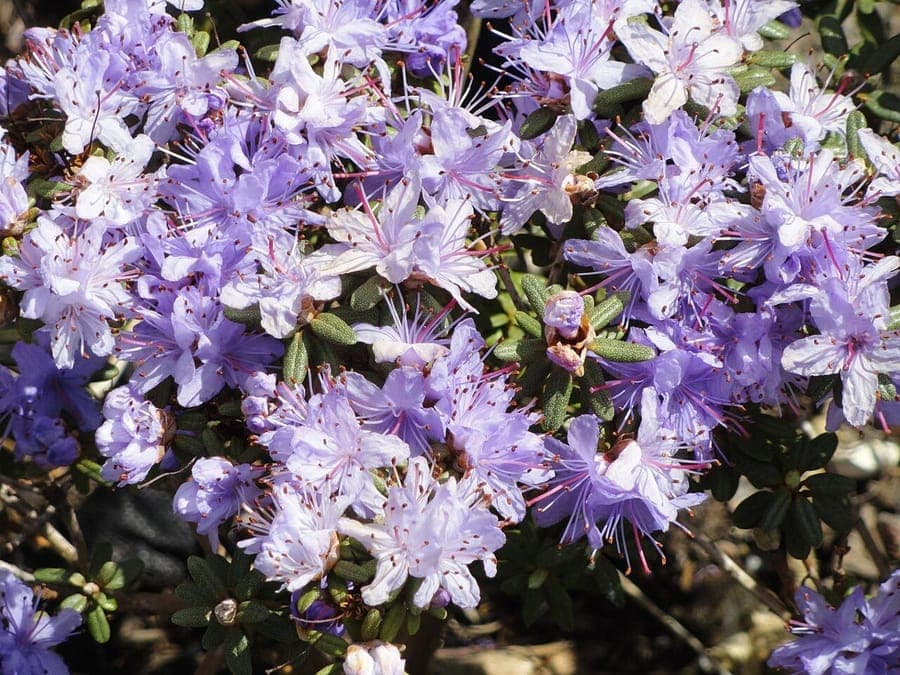
Daderot / CC0, via Wikimedia Commons
Cloudland rhododendron (Rhododendron impeditum): growing guide
Rhododendron impeditum
Want to see Cloudland rhododendron (Rhododendron impeditum): growing guide in your garden?
Full design in HD: €7.99
Look after your Cloudland rhododendron with the GardenWorld app
Identify plants with your camera and get a care calendar with reminders for this plant.


Overview
Rhododendron impeditum, often sold as the cloudland rhododendron, is about as far removed from the classic woodland rhododendron as the genus gets. Instead of a towering evergreen with leathery leaves the size of a hand, you get a low, tightly packed mound that rarely tops 30 to 60 cm, even after many years. It comes from the high mountains of south-west China, mainly Yunnan and Sichuan, where it grows between 3,000 and 4,500 metres on open, windswept slopes among boulders, grasses and other dwarf shrubs. That background tells you most of what you need to know: it shrugs off cold and wind, but it dislikes lime, heat and waterlogged roots.
The reason gardeners love it is the spring display. In April and May the tiny leaves vanish beneath hundreds of violet-blue to lilac flowers, turning the whole plant into a cushion of colour. It suits a rock garden, the front of a raised bed, a heather garden or a wide container on a patio. On gardenworld.app you can have a garden design drawn up that gives a dwarf shrub like this a proper place among rocks, heathers and other acid-loving plants.
One point to be clear about from the start: like every rhododendron, this species is poisonous. All parts, especially the leaves and nectar, contain grayanotoxins. In people, eating the plant can cause nausea, vomiting, excess salivation, dizziness, a slow heart rate and low blood pressure. It is also toxic to dogs, cats, rabbits, horses, goats and sheep, and grazing animals are most at risk if they get hold of clippings. Keep it away from paddocks and hutches, and never tip prunings where livestock can reach them.
Appearance and bloom cycle
Up close, the foliage is what makes this plant so refined. Each leaf is only 5 to 15 mm long, oval to elliptic, matt grey-green to bluish green above and rusty brown beneath. Both surfaces carry minute scales, a feature shared by the alpine rhododendrons of the Lapponicum group to which Rhododendron impeditum belongs. The twigs are densely packed, and together they make a firm, slightly irregular mound that will happily spill over the edge of a stone.
Flowering usually runs from mid-April to mid-May, depending on the spring. The blooms are funnel-shaped, roughly 1 to 1.5 cm across, and sit in clusters of one to four at the tips of the shoots. Colour ranges from violet-blue through lilac to mauve, with long, prominent stamens tipped in dark anthers. Bumblebees and early solitary bees visit the flowers readily.
Alongside the wild species you will find selections and hybrids with Rhododendron impeditum as a parent, such as the compact violet-blue 'Moerheim' and 'Blue Tit', a slightly taller cross. Check the label carefully, because not every small blue rhododendron on sale is this species.
Ideal location
In the wild this plant grows in full light but in cool, moist mountain air. In British and northern European gardens that translates to morning or late afternoon sun with light shade during the hottest part of the day. In cooler, damper regions it will cope with full sun, provided the roots stay cool and moist. Against a hot south-facing wall in a city garden, the foliage scorches easily.
Deep shade under trees is no better: the plant becomes thin and open, and flowering suffers. An open rock garden with a few larger stones to break the midday sun, a partly shaded edge of a heather bed or a spot on the east side of the house all work well. In a container it makes a rewarding patio plant. Choose a wide, fairly shallow pot of at least 30 cm across so the shallow roots can spread.
Soil requirements
Like all rhododendrons, Rhododendron impeditum needs acid soil, ideally with a pH between 4.5 and 5.5. On chalky or neutral ground the leaves turn yellow between the veins, a sign of iron deficiency, and the plant gradually declines. If your garden sits on chalk or limy clay, grow it in a raised bed or a large container filled with ericaceous compost instead.
The perfect soil is open, rich in organic matter and yet free-draining. A blend of peat-free ericaceous compost, composted bark, leaf mould and a generous handful of grit works very well. The root system is fine and shallow, so never plant deeper than the plant sat in its pot. The top of the root ball should be level with the soil surface, or even a centimetre above it. A mulch of 3 to 5 cm of pine bark or pine needles keeps the roots cool and helps maintain acidity.
Free preview
Want to see Cloudland rhododendron (Rhododendron impeditum): growing guide in your garden? Make a free preview of your design.
Watering
Shallow roots mean the plant feels drought quickly. In the first year after planting, water weekly during dry spells so the root ball never dries out. Established plants still need help in long dry periods, particularly in July and August when next year's flower buds are forming.
Use rainwater whenever you can. Tap water in many areas is hard and will slowly raise the pH around the roots. At the same time, this species hates sitting wet: in a pot without drainage holes or in a hollow of heavy clay, the roots rot quickly. Check containers every two or three days in summer. In winter, give pots an occasional drink during dry, frost-free weather, because evergreens continue to lose moisture through their leaves.
Pruning
Rhododendron impeditum needs very little pruning. It naturally keeps a compact, cushion-like shape. If you have the time, gently snap off the faded flower clusters after blooming. It looks tidier and stops the plant putting energy into seed, though with such small flowers it is not essential.
If you want to keep a plant tighter or remove a wayward shoot, trim straight after flowering, in May or early June. Pruning any later removes next year's flower buds, which are set during summer. This species does not respond well to hard cutting into old wood. Wear gloves when pruning and put the clippings in your green waste bin, not anywhere animals graze.
Maintenance calendar
March: Check containers for dryness. Scatter a small handful of ericaceous fertiliser around established plants.
April–May: Flowering time. Water during dry spring spells and enjoy the violet-blue display.
June: Remove faded flower clusters and give a light trim if needed. Top up the mulch.
July–August: Buds form for next year. Keep the soil evenly moist with rainwater, especially in hot weather.
September–October: A good planting window. The soil is still warm and roots establish well in autumn.
November–February: Dormant season. Protect pots from prolonged hard frost and water lightly on dry, frost-free days.
Winter hardiness
For a rhododendron, Rhododendron impeditum is exceptionally hardy. The Royal Horticultural Society rates it H6, meaning hardy to around -20 °C, and the American Rhododendron Society quotes figures close to -25 °C. In most of Britain and the Low Countries it survives any normal winter in open ground without protection.
The weak point is not cold as such but the combination of frozen soil and bright sun. On a cold, sunny day with an east wind, the leaves lose water while the roots cannot replace it, which leads to browned leaf edges. A position sheltered from the harshest winter morning sun helps. Container plants are more vulnerable because the whole root ball can freeze solid. Move them against a wall and wrap the pot in hessian or bubble wrap during a prolonged cold spell.
Companion plants
Rhododendron impeditum looks best among other plants that enjoy acid, humus-rich soil. Heather (Calluna vulgaris) takes over the colour in summer and autumn once the rhododendron has finished, keeping the bed interesting for months. Pieris japonica and Skimmia japonica add taller evergreen structure and early flowers. For a true mountain feel in a rock garden, a dwarf pine such as Pinus mugo makes an excellent backdrop.
Between the stones you can tuck small alpines with similar needs, such as the stemless gentian (Gentiana acaulis), whose deep blue trumpets pick up the violet-blue tone of the rhododendron beautifully. Avoid lime-loving plants such as lavender in the same bed, as their needs are the exact opposite.
Final thoughts
Rhododendron impeditum proves that a rhododendron does not need to be large to make an impression. Give it acid, free-draining soil, rainwater in dry summers and a spot out of scorching afternoon sun, and you will have an evergreen cushion that turns violet-blue every spring for many years, with almost no pruning and little worry about winter.
Do keep its toxicity to people and animals in mind, and choose the spot carefully if you have small children, rabbits or grazing animals. Not sure where it would look best? Use gardenworld.app to have a garden design made and see how this little blue cushion works alongside heathers, gentians and your own rock garden.
Frequently asked questions about Cloudland rhododendron
Is Cloudland rhododendron winter hardy?
For a rhododendron, Rhododendron impeditum is exceptionally hardy. The Royal Horticultural Society rates it H6, meaning hardy to around -20 °C, and the American Rhododendron Society quotes figures close to -25 °C.
When and how do you prune Cloudland rhododendron?
Rhododendron impeditum needs very little pruning. It naturally keeps a compact, cushion-like shape.
How much water does Cloudland rhododendron need?
Shallow roots mean the plant feels drought quickly. In the first year after planting, water weekly during dry spells so the root ball never dries out.
Where does Cloudland rhododendron grow best?
In the wild this plant grows in full light but in cool, moist mountain air. In British and northern European gardens that translates to morning or late afternoon sun with light shade during the hottest part of the day.
What soil does Cloudland rhododendron need?
Like all rhododendrons, Rhododendron impeditum needs acid soil, ideally with a pH between 4.5 and 5.5. On chalky or neutral ground the leaves turn yellow between the veins, a sign of iron deficiency, and the plant gradually declines.

See it in your garden
See Cloudland rhododendron in your garden
One photo of your garden and a few questions. You see the result in about a minute.
Try it with a photoIdentify this plant in your own garden. Identify a plant
Similar plants
Japanese pieris: complete guide
Pieris japonica
Complete care guide for Japanese pieris (Pieris japonica): ideal location, soil, watering, pruning and companion plants. Perfect for shaded, acidic gardens.
Heather: complete guide
Calluna vulgaris
Discover how to grow and care for Calluna vulgaris: ideal soil, pruning tips, companion plants and winter care. Perfect for UK and US gardens.
Gentiana acaulis: complete guide
Gentiana acaulis
Stemless gentian offers spectacular deep-blue trumpet flowers close to the ground. An alpine jewel for rock gardens and shaded borders.
