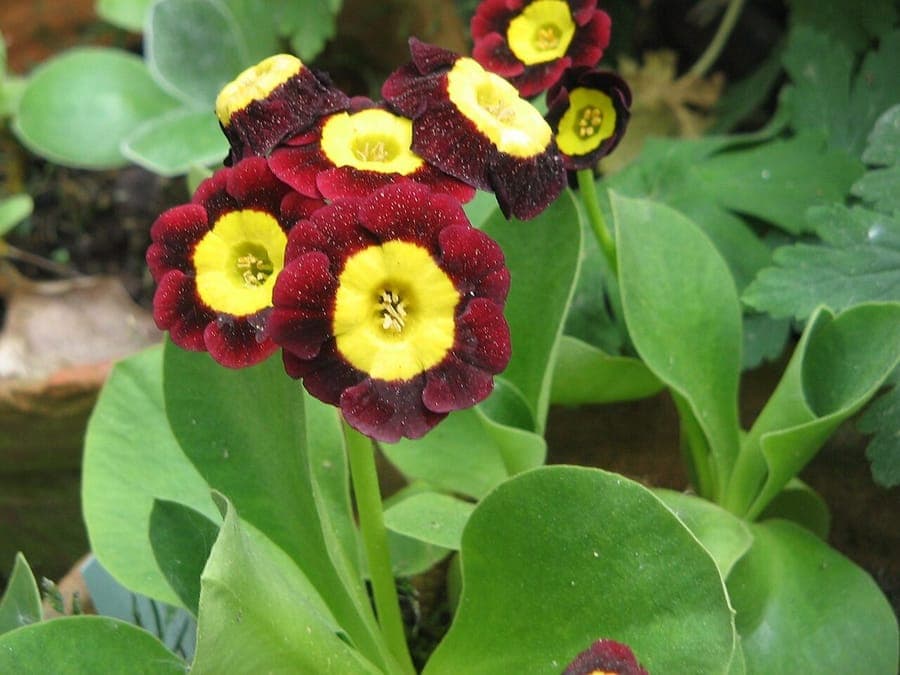
Meneerke bloem / CC BY-SA 3.0, via Wikimedia Commons
Garden auricula: complete guide
Primula × pubescens
Want to see Garden auricula: complete guide in your garden?
Full design in HD: €7.99
Look after your Garden auricula with the GardenWorld app
Identify plants with your camera and get a care calendar with reminders for this plant.


Overview
The garden auricula (Primula × pubescens) has one of the longest pedigrees of any cultivated flower in Europe. It began life in the Alps, where the yellow mountain auricula (Primula auricula) and the rosy Primula hirsuta grew side by side on rocky ledges and crossed naturally. By the late sixteenth century, these wild hybrids had found their way into gardens in Vienna, Flanders and England. Flemish weavers and Huguenot refugees turned them into a passion, and by the eighteenth century the finest plants were displayed like jewels on tiered shelves known as auricula theatres.
Today the name Primula × pubescens covers hundreds of named cultivars, which growers sort into three broad groups. Border auriculas are the toughest and live happily outdoors in a rock garden or at the front of a bed. Alpine auriculas have a clean gold or cream centre with no white dusting. Show auriculas carry a thick coating of farina, a mealy white powder, on their flowers and sometimes their leaves, and they are best grown under cover because rain washes the powder away.
The plant stays small: a rosette 10 to 15 cm across with flower stems 15 to 20 cm tall. That makes it ideal for any size of garden, including a balcony or an old stone trough. On gardenworld.app you can have a garden design made that gives auriculas a permanent home in a rockery, along a shady terrace or in a collection of pots by the front door. Once you start, it is hard to stop at one: 'Blue Velvet', 'Old Irish Blue', 'Mrs. Nora' and the almost black 'Neat and Tidy' are much-loved classics.
Appearance and bloom cycle
The garden auricula forms a firm, slightly fleshy rosette of leaves. Each leaf is obovate to spoon-shaped, 5 to 10 cm long, pale to greyish green and often finely hairy along the margin. Some cultivars have a silvery, waxy bloom on the foliage, which keeps them attractive long after flowering. The rosette sits on a short, woody rootstock that gradually rises above soil level as the plant ages.
In April and May sturdy stems appear, each carrying a head of five to fifteen flowers. The individual blooms are 2 to 3 cm wide, flat-faced and marked with a clearly defined eye. The colour range is remarkable: crimson, claret, purple, violet blue, pink, yellow, bronze, brown and near black. Many flowers have a velvety sheen and a soft, sweet scent you only notice up close. They offer early nectar and pollen to bumblebees and other spring pollinators.
Some cultivars produce a second, lighter flush in autumn, particularly after a cool, damp late summer. This does no harm, although it can slightly reduce the spring display.
Ideal location
Although its ancestors grow in the mountains, Primula × pubescens dislikes heat. It wants good light but not fierce midday sun. A spot with morning sun and shade from early afternoon is perfect: the east side of a house, a rockery in the dappled shade of a low shrub, or a patio table that falls into shade after lunch.
Good air movement matters, as rosettes rot more readily in stuffy corners, so avoid planting them among tall, dense perennials. Pots are easy to move around: a little closer to the light in spring, then somewhere cool and shaded for the summer. Show auriculas with farina belong under a roof, in a cold frame or in an open-sided greenhouse where rain and splashing cannot spoil the powder. Border auriculas can simply stay outside all year.
Soil requirements
The secret is a soil that holds moisture yet never becomes waterlogged. Outdoors, work a mix of garden soil, leaf mould and coarse grit or fine gravel into a rockery or raised bed, roughly in equal parts. On heavy clay, build a raised bed at least 20 cm high, otherwise winter water will sit around the neck of the plant.
For containers, use two parts good multipurpose compost to one part perlite or fine grit. A top dressing of grit keeps the crown dry and helps prevent rot. A neutral to slightly alkaline pH between 6.5 and 7.5 suits it well. Feed sparingly: a little organic fertiliser or a half-strength liquid feed in March and again after repotting is plenty. Too much nitrogen gives large, soft leaves and fewer flowers.
Free preview
Want to see Garden auricula: complete guide in your garden? Make a free preview of your design.
Watering
During the growing season, from March to June, keep the compost lightly moist. Water pots once the top centimetre feels dry, and pour around the edge of the pot rather than into the heart of the rosette. Water lodging in the crown is one of the most common causes of rot.
In summer the plant takes a rest. Water less, but never let pots dry out completely. In winter, plants kept under cover need very little: a small drink every two or three weeks is usually enough. In open ground, nature supplies the water; your job is mainly to make sure the surplus can drain away.
Pruning and dividing
Garden auriculas need no pruning in the usual sense, but a little tidying keeps them healthy. Cut spent flower stems off at the base unless you want to collect seed. In autumn and early spring, remove yellowing and dead lower leaves, which quickly become a refuge for fungi and slugs.
After a few years the rootstock lifts out of the soil and the plant produces offsets. That is the moment to divide or repot, ideally between late June and mid-August. Lift the plant or tip it out of its pot, shake off the old compost and check the roots for vine weevil grubs, the auricula's worst enemy. Gently pull away the offsets with some root attached and pot them into small pots of gritty mix. Trim the old, bare section of rootstock from the parent and replant it a little deeper. This keeps a collection young and vigorous.
Maintenance calendar
January–February: Dormant period. Check pots for soggy compost and clear away dead leaves. Keep show auriculas dry and well ventilated.
March: New growth starts. Give a light spring feed and refresh the top dressing of grit.
April–May: Peak flowering. Keep the compost lightly moist, protect buds from slugs and remove faded stems.
June: The summer rest begins. Move pots into shade and reduce watering.
July–August: The best time to repot, divide and pot up offsets. Inspect the roots for vine weevil grubs.
September–October: Young plants settle in. Clear dead foliage and give a half-strength feed if a second flush appears.
November–December: Move potted plants under cover or into a cold frame and keep watering to a minimum.
Winter hardiness
Primula × pubescens is fully hardy in Britain and across north-western Europe. Border auriculas cope with frosts down to around -20 °C without protection, and alpine auriculas also survive hard winters as long as their roots stay reasonably dry. Cold is not the problem; wet is. Repeated freezing and thawing in sodden soil is what rots the crown.
In winter it is best to stand pots under a roof overhang, against a wall or in a ventilated cold frame. There is no need to bring them indoors, and warmth actually does harm, because the plant needs a cold rest to flower well. In severe frost, group pots together and wrap the containers.
A word on toxicity: primulas contain saponins. The sap can mildly irritate sensitive skin, and dogs or cats that chew the plant may suffer a minor upset stomach. Wear gloves if you have sensitive skin and are handling lots of plants.
Companion plants
Garden auriculas look their best alongside other small alpines. In a stone trough or rock garden, pair them with the true mountain auricula (Primula auricula), Primula marginata with its toothed, powdered leaves, and silvery encrusted saxifrages such as Saxifraga paniculata. Common houseleek (Sempervivum tectorum) adds structure and enjoys the sunnier, drier edges.
In a partly shaded border, small ferns, low geraniums and the Cheddar pink (Dianthus gratianopolitanus) make good neighbours, as long as they do not smother the rosettes. For an early spring picture, add small bulbs such as crocuses or grape hyacinths. Grown in pots on shelves or steps, auriculas shine in plain terracotta, where each colour can stand on its own.
Final thoughts
The garden auricula is a plant for people who love detail. A single bloom, with its velvety colour and crisply drawn eye, rewards you afresh every spring. Give Primula × pubescens gritty soil, a cool spot out of the harsh midday sun and dry feet in winter, and it is surprisingly easy. Divide it every few years and your collection grows almost by itself.
The plant calendar on gardenworld.app shows month by month what your auriculas and the rest of your garden need, from the spring feed to summer repotting. Start with two or three cultivars in pots by the front door and you will soon understand why this little primula has captivated collectors for four centuries.
Frequently asked questions about Garden auricula
Is Garden auricula winter hardy?
Primula × pubescens is fully hardy in Britain and across north-western Europe. Border auriculas cope with frosts down to around -20 °C without protection, and alpine auriculas also survive hard winters as long as their roots stay reasonably dry.
When and how do you prune Garden auricula?
Garden auriculas need no pruning in the usual sense, but a little tidying keeps them healthy. Cut spent flower stems off at the base unless you want to collect seed.
How much water does Garden auricula need?
During the growing season, from March to June, keep the compost lightly moist. Water pots once the top centimetre feels dry, and pour around the edge of the pot rather than into the heart of the rosette.
Where does Garden auricula grow best?
Although its ancestors grow in the mountains, Primula × pubescens dislikes heat. It wants good light but not fierce midday sun.
What soil does Garden auricula need?
The secret is a soil that holds moisture yet never becomes waterlogged. Outdoors, work a mix of garden soil, leaf mould and coarse grit or fine gravel into a rockery or raised bed, roughly in equal parts.

See it in your garden
See Garden auricula in your garden
One photo of your garden and a few questions. You see the result in about a minute.
Try it with a photoIdentify this plant in your own garden. Identify a plant
Similar plants
Auricula: complete guide
Primula auricula
Everything you need to know about Primula auricula: ideal placement, care requirements, hardiness, and companion plants. Perfect for rock gardens and containers.
Primula marginata: complete guide
Primula marginata
Learn how to grow Primula marginata: ideal location, soil, watering, and companion plants. Perfect for rock gardens and borders. 150-160 chars.
Lifelong saxifrage: complete guide
Saxifraga paniculata
Complete care guide for lifelong saxifrage (Saxifraga paniculata): white flowers, silvery rosettes, alpine rockeries, and hardiness to USDA zone 2. Long-lived.
