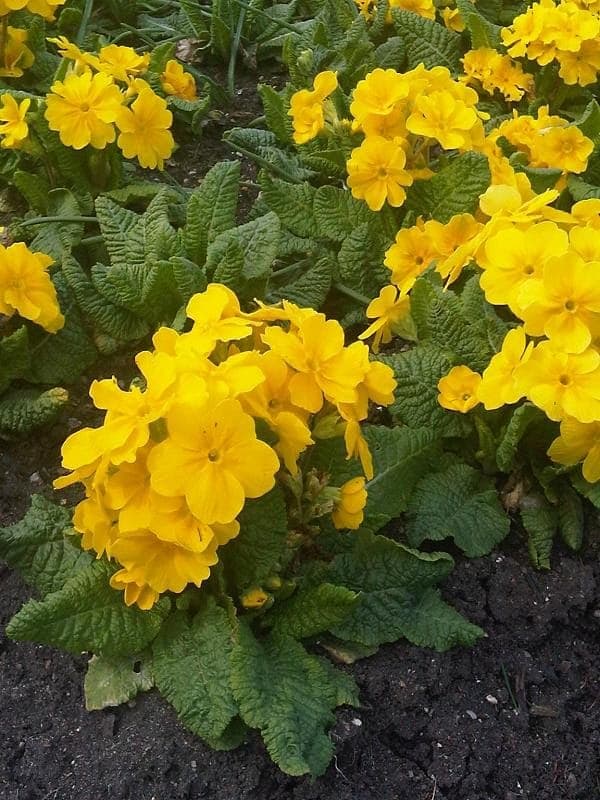
Emőke Dénes / CC BY-SA 4.0, via Wikimedia Commons
Polyanthus (Primula × polyantha): growing guide
Primula × polyantha
Want to see Polyanthus (Primula × polyantha): growing guide in your garden?
Full design in HD: €7.99
Look after your Polyanthus with the GardenWorld app
Identify plants with your camera and get a care calendar with reminders for this plant.


Overview
Primula × polyantha, the polyanthus, is one of the cheeriest spring flowers there is. From February its brightly coloured pots fill markets and garden centres, and in March and April they brighten beds, borders and window boxes. It is a hybrid between the primrose (Primula vulgaris) and the cowslip (Primula veris), possibly with some input from the oxlip (Primula elatior). English gardeners were already growing polyanthus in the seventeenth century.
The difference from the ordinary primrose is easy to spot. In Primula × polyantha the flowers do not rise individually from the centre of the plant but sit together in a cluster at the top of a sturdy stem 15 to 30 cm tall. The flowers are larger than those of the cowslip and come in almost every colour: yellow, white, pink, red, orange, purple and blue, usually with a yellow eye.
Many people treat polyanthus as throwaway bedding, which is a shame. It is a true perennial that comes back year after year in the right spot. On gardenworld.app you can have a garden design made that gives polyanthus a permanent home beneath shrubs and among spring bulbs.
Appearance and bloom cycle
The plant forms a low rosette of oblong, crinkled leaves 10 to 25 cm long, fresh green with a slightly rough upper surface. The leaves lie half flat and build up into a dense clump. The photo shows the crinkled foliage clearly, with the yellow flower clusters above.
In the garden it flowers from March to May, and in mild winters sometimes from February. Each stem carries five to fifteen flowers 2.5 to 4 cm across. Some varieties have a light, sweet scent inherited from the cowslip. Well-known groups include the gold-laced polyanthus, with dark red or near-black flowers edged in gold, and the large-flowered Pacific Giants, which are spectacular but less long-lived in the garden.
Seed capsules form after flowering. Seedlings rarely match the parent's colour but sometimes produce surprising combinations. Through summer the rosette stays green, provided the soil does not dry out.
Ideal location
Polyanthus likes partial shade. In spring, while trees and shrubs are still bare, it gets plenty of light, and in summer it enjoys the shade of the leaves above. A spot beneath deciduous shrubs, at the front of a border or on the north or east side of the house is ideal.
Full sun is fine in spring, for example in a window box or bedding scheme, but in summer the plants dry out and often disappear. If you want to keep them after flowering, move them to a cooler place. Avoid spots where the soil becomes bone dry in summer, such as right against a south-facing wall.
Soil requirements
The ideal soil is humus-rich and moisture-retentive yet well drained. Ordinary garden soil with some compost worked in is usually perfect. Clay is no problem as long as water does not stand on it. On poor, sandy soil, add a few handfuls of compost or leaf mould to each planting hole, or the ground will dry out too quickly in summer.
A pH from slightly acidic to slightly alkaline, roughly 6 to 7.5, suits it. Plant at the same depth as in the pot, with the crown just above soil level, spacing plants 20 to 25 cm apart. A thin layer of leaf compost around the plants keeps the soil cool.
Watering
Newly planted polyanthus needs regular water for the first few weeks, especially in a dry March or April. Water as soon as the top few centimetres feel dry, aiming at the soil rather than the flowers. Plants in pots and window boxes dry out faster, so check them every few days.
In summer, moisture is the key to survival. An established plant in partial shade usually copes, but during prolonged drought give it a good soak once a week. Limp, drooping leaves are a warning sign. It must not be too wet either: standing water rots the crown.
Feeding is hardly necessary. A layer of compost in autumn or a little organic fertiliser after flowering is enough.
Free preview
Want to see Polyanthus (Primula × polyantha): growing guide in your garden? Make a free preview of your design.
Pruning
No real pruning is needed. Cut spent flower stems off at the base to keep the plant tidy and sometimes encourage a few late flowers. Remove yellow or rotting leaves, especially in wet spells, to prevent grey mould.
After two or three years a clump often becomes congested and flowers less. That is the time to divide it, straight after flowering in May or June, or in September. Lift the clump, pull or cut it into pieces with a few rosettes and roots each, and replant them straight away in a moist spot. Water in well. This gives you new plants of exactly the same colour at no cost.
Maintenance calendar
February-March: Plant new polyanthus whenever the ground is not frozen. Window boxes can be planted early.
March-May: Full bloom. Remove spent stems and keep the soil moist. Watch out for slugs.
May-June: Divide congested clumps straight after flowering. Move plants from window boxes to a partly shaded spot in the garden.
July-August: Water during dry spells. Look out for red spider mite in hot weather.
September-October: A good time to divide or plant. Spread a layer of compost.
November-January: Rest. In mild winters the first flowers may appear.
For a monthly overview of jobs in the garden, use the plant calendar on gardenworld.app.
Winter hardiness
Primula × polyantha is reliably hardy in Britain and tolerates frost down to about -15 °C, sometimes lower in free-draining soil. Plants in the ground rarely need protection. Plants bought early in the year straight from a heated greenhouse are more tender, so bring them in or cover them with fleece during hard frosts in March.
Wet winters are a bigger threat than cold. On poorly drained soil the crown can rot. Move pots against a wall and out of the rain over winter.
Watch for two pests. Vine weevil grubs feed on the roots in autumn and winter; a plant that suddenly wilts and comes away when tugged is often a victim. Nematodes against vine weevil work well in autumn or spring. Slugs chew leaves and flowers in spring.
On toxicity: primulas contain saponins. Eating them causes at most mild stomach upsets such as vomiting in cats and dogs. In sensitive people the leaves can irritate the skin, though much less than the indoor poison primrose (Primula obconica). Wear gloves if you have sensitive skin.
Companion plants
Polyanthus is ideal for combining with other spring flowers. Grape hyacinths (Muscari armeniacum) and forget-me-nots (Myosotis sylvatica) make a fresh contrast with yellow or orange polyanthus. Dwarf daffodils and tulips add height above them.
Beneath shrubs they pair perfectly with the Lenten rose (Helleborus orientalis), which flowers at the same time and enjoys the same partial shade. Lungwort (Pulmonaria saccharata) and Siberian bugloss (Brunnera macrophylla) take over after flowering with handsome foliage. Daisies (Bellis perennis) and violas are classic partners in window boxes.
Final thoughts
Primula × polyantha is much more than a disposable plant for the windowsill. In partial shade with humus-rich, moisture-retentive soil it returns every spring with clusters of colourful flowers, and by dividing it you soon have a whole drift. Plant it beneath shrubs, among spring bulbs or in a window box, keep the soil moist in summer and keep an eye out for slugs and vine weevil. Then every gardening year begins with a celebration of colour.
Frequently asked questions about Polyanthus
Is Polyanthus winter hardy?
Primula × polyantha is reliably hardy in Britain and tolerates frost down to about -15 °C, sometimes lower in free-draining soil. Plants in the ground rarely need protection.
When and how do you prune Polyanthus?
No real pruning is needed. Cut spent flower stems off at the base to keep the plant tidy and sometimes encourage a few late flowers.
How much water does Polyanthus need?
Newly planted polyanthus needs regular water for the first few weeks, especially in a dry March or April. Water as soon as the top few centimetres feel dry, aiming at the soil rather than the flowers.
Where does Polyanthus grow best?
Polyanthus likes partial shade. In spring, while trees and shrubs are still bare, it gets plenty of light, and in summer it enjoys the shade of the leaves above.
What soil does Polyanthus need?
The ideal soil is humus-rich and moisture-retentive yet well drained. Ordinary garden soil with some compost worked in is usually perfect.

See it in your garden
See Polyanthus in your garden
One photo of your garden and a few questions. You see the result in about a minute.
Try it with a photoIdentify this plant in your own garden. Identify a plant
Similar plants
Primrose: complete guide
Primula vulgaris
Learn how to grow Primula vulgaris successfully in your garden. Covers light, soil, watering, pruning and month-by-month care tips.
Lenten-rose: complete guide
Helleborus orientalis
Learn how to grow and care for Helleborus orientalis. This early-blooming perennial thrives in shady spots and flowers from February to April, adding colour when little else is blooming.
Common grape-hyacinth: complete guide
Muscari armeniacum
Muscari armeniacum blooms in early spring with dense clusters of blue, grape-like flowers. Hardy, low-maintenance, and bee-friendly, it's perfect for borders, lawns, and naturalized plantings.
