
Mealy cowslip: complete guide
Primula pulverulenta
Want to see Mealy cowslip: complete guide in your garden?
1 minute, no credit card
Overview
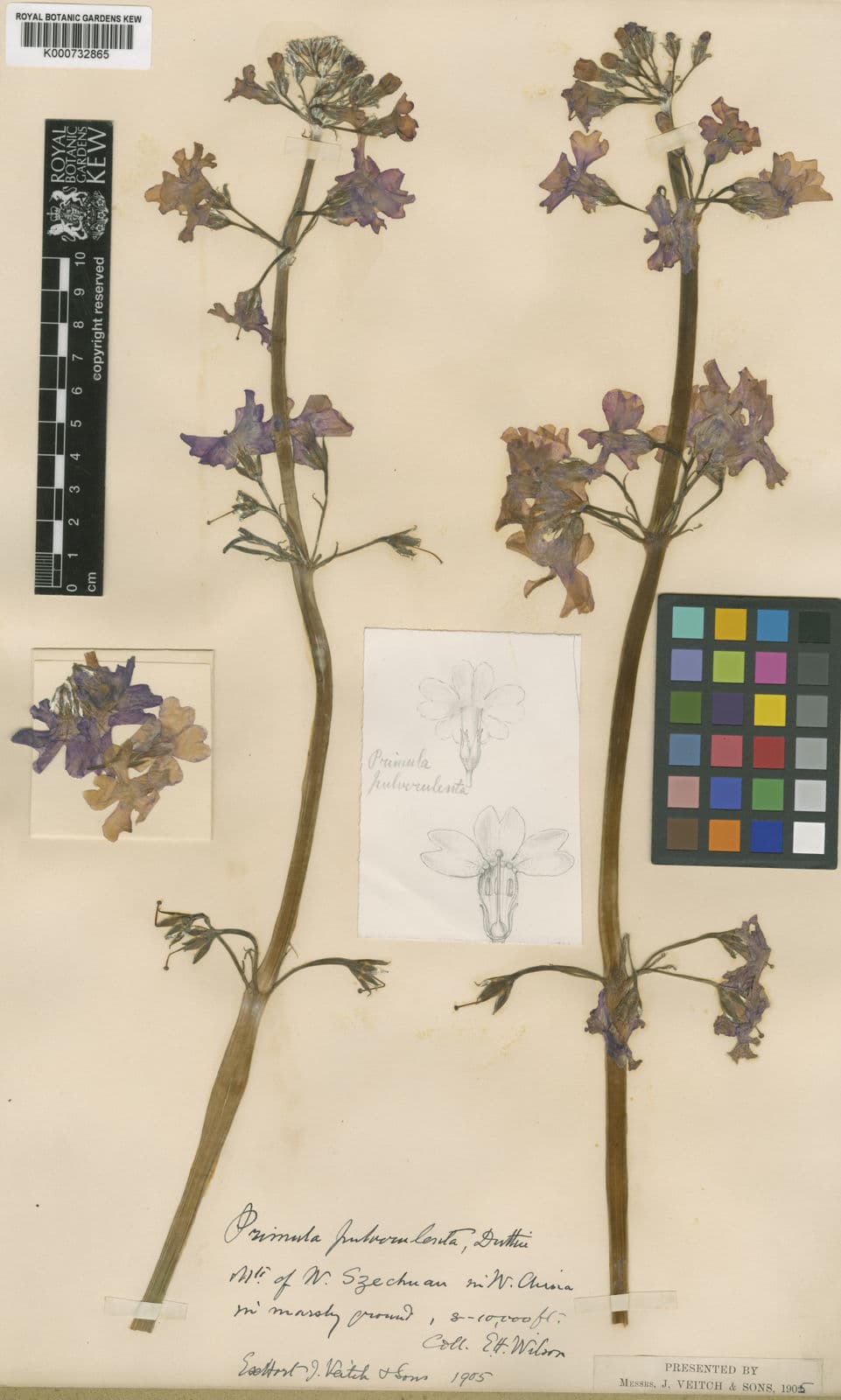
The Mealy cowslip (Primula pulverulenta) is a remarkable flowering plant with characteristic candelabra flowers in red, purple, and pink tones. This plant, native to Sichuan in China, grows to 24-36 inches tall and distinguishes itself with impressive, candelabra-shaped flower spikes. The Mealy cowslip is ideal for moisture-loving spots in shade, such as beside ponds and streams, where it grows robustly.
Flowers appear in July and August in 4-6 horizontal tiers (whorls), each containing 10-20 small flowers. This candelabra effect is unique and very decorative. Flowers are red, purple, or pink, often with a yellow or white "eye" at the center. Leaves are mostly basal and can reach 12 inches long.
Appearance and bloom period
The Mealy cowslip first forms a rosette of slightly hairy leaves, deeply grooved, with serrated edges. The leaves are dark green with a surface that feels somewhat powdery - hence the "mealy" name. In the second year (as it's technically a biennial), the flower stem appears.
The flower stem is sturdy and reaches 24-36 inches tall. Flowers grow in distinct tiers (whorls) around the stem, each about 0.4-0.6 inches in diameter. The flowering period runs July through October, peaking in August. After flowering, seeds form which can be collected.
The standard form has red to purple flowers, though pink forms also occur. No special cultivars are known for this species.
Ideal location
The Mealy cowslip grows best in shady to partially shaded spots. It can tolerate full shade (less than 4 hours sun) but can also grow in partial shade (4-6 hours sun). Full sun is unsuitable - this causes leaf scorch in hot climates.
The plant prefers cool, moist conditions. Don't plant against south or west-facing walls where heat accumulates. East or north-facing walls are ideal.
Soil requirements
The Mealy cowslip doesn't need normal garden soil - it prefers moist soil. Plant in moisture-rich, humus-rich soils, preferably pH 6.0-7.0 (slightly acidic to neutral). It can also grow in neutral and slightly alkaline soils.
More important is moisture retention. Add lots of compost or peat. For moisture-loving soils: a mixture of 50% peat, 30% compost, and 20% sand is ideal. For normal soils, add 40% compost. Well-composted leaf mold is excellent.
Watering
The Mealy cowslip loves moisture. During the growing season (April to September), water so soil is always lightly moist. The plant must never dry out. Water regularly, daily in hot periods.
Equally important: the plant cannot tolerate stagnant water. Don't plant in pure clay; ensure good drainage by adding sand. A balance between moisture retention and drainage is crucial.
In winter, when the plant is dormant, you can reduce watering, but soil shouldn't completely dry out.
Pruning and harvest
The Mealy cowslip requires minimal pruning. After flowering (October/November), you can cut the flower stem. If you want to save seed, leave several flower spikes until they've set seed. Harvest seed in September/October and press it dry.
Remove withered leaves. That's all that's needed.
Maintenance calendar
April-May: Planting time. Water thoroughly. Check for slugs/snails. June: Fertilizer application (compost around the plant). Regular watering. July-October: Enjoy the blooms. Water properly. Note color variations for seed collection. November-March: Plant goes dormant. Minimal watering. Prepare for winter.
Winter hardiness
The Mealy cowslip is hardy to about 5°F (USDA zones 6-7), reasonably suitable for most of Europe. In very cold winters (below -4°F), frost damage may occur. If snow is present, this naturally protects.
In very cold regions, apply dry leaf mold around the plant in November/December.
Free design
Want to see Mealy cowslip: complete guide in your garden? Make a free design now.
Companion plants
The Mealy cowslip works well with other moisture-loving plants: Astilbe, Hostas, Rodgersia, Aquilegia, ferns. Also beautiful beside Primula japonica (another large candelabra primrose) or other primula species.
Plant in groups of 3-5 for maximum effect. They can also be sown in streamside settings.
Cultivars and varieties
Beyond the standard red to purple form, the well-known 'Bartley Strain' offers soft shell-pink flowers and has received the Royal Horticultural Society's Award of Garden Merit. This selection is slightly more compact than the wild form and is valued for its gentle color palette, which pairs beautifully with blue and white spring bloomers. Barnhaven hybrids, developed from crosses between Primula pulverulenta and related candelabra primroses, offer an even broader color range from salmon pink to deep crimson.
Pests and diseases
The Mealy cowslip is relatively robust, though several problems can occur. Slugs and snails pose the greatest threat, especially to young plants in spring; scatter grit or use organic slug pellets around plants. Powdery mildew can develop when roots are too dry combined with damp foliage; ensure consistent soil moisture and good air circulation.
Leaf spot disease (caused by fungi such as Ramularia) can appear in wet summers; remove affected leaves promptly and avoid overhead watering. Vine weevil larvae can damage roots, particularly in container culture; check the root ball regularly when repotting.
Additional pond-edge combinations
Beyond Astilbe and Hostas, the Mealy cowslip pairs beautifully with Iris sibirica, Ligularia, and Rodgersia podophylla for a richly planted pond-edge design. In a woodland-edge setting, the plant combines well with ferns like Matteuccia struthiopteris (ostrich fern) and with Trollius (globeflower) for an extended flowering season from April through August.
For gardeners assembling a complete moisture-loving border design, gardenworld.app's plant database offers additional combination suggestions based on bloom time, height, and color pairing.
Fertilizing
While the Mealy cowslip has modest nutritional needs, light feeding in early spring (March) supports vigorous flowering. Work a layer of fresh compost into the root zone or use an organic, slow-release fertilizer with a balanced NPK ratio. Avoid nitrogen-heavy synthetic fertilizers, which stimulate excessive leaf growth at the expense of flower formation.
A second, lighter application after the first flush of bloom in July can extend flowering into September or even October. In container culture, nutrients leach out faster due to frequent watering; a diluted liquid fertilizer every 3-4 weeks during the growing season (April-August) works well here. Stop fertilizing from September onward so the plant can prepare properly for winter dormancy.
For new plantings in spring, it's advisable to withhold extra fertilizer for the first month; the plant needs this time primarily to establish roots in its new location.
Propagation
The plant self-seeds in moist conditions. You can collect seed and sow it in May/June in moist seed compost. Sow lightly (seed needs light to germinate). Wait until February before sowing - this provides a stratification period.
Conclusion
The Mealy cowslip is a special plant for moist, shady corners. The candelabra flowers are unique and highly decorative. With good moisture care, it will grow for years. For more tips on moisture-loving plants and water garden plantings, see our comprehensive guide on GardenWorld. You can also subscribe to premium gardening tips.
Want to see Mealy cowslip: complete guide in your garden? Make a free design now.
Upload a photo, pick a style, and get a photorealistic design with plant list in under a minute.
10,000+ gardens designed already
No credit card required


Similar plants
Primula incana: complete guide to silvery alpine primrose
Primula incana
Silvery primrose (Primula incana), a delicate alpine flower with white blooms and powdered grey-green leaves. Growing, care, and cultivation guide.
Cliff dwarf-primrose: complete guide
Androsace laevigata
Full guide to growing Androsace laevigata, a rare Pacific Northwest alpine cushion plant. Planting, care, and garden design tips explained.
Pyrenean snowbell: complete guide
Soldanella villosa
Complete guide to Pyrenean snowbell: moist acid soil, shade requirements, early spring blooms, winter hardiness and the best alpine companions.