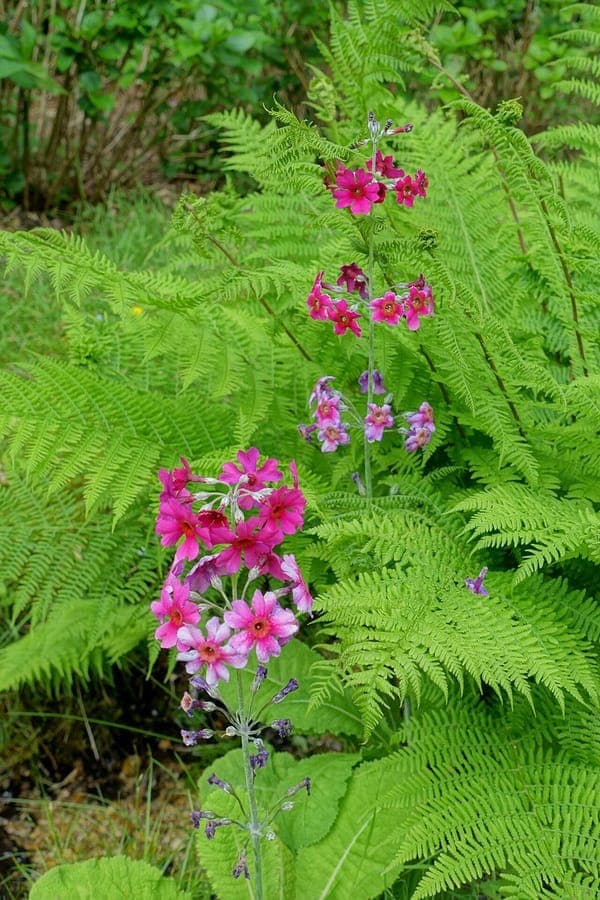
Daderot / CC0, via Wikimedia Commons
Primula beesiana: complete guide to Bees' primrose
Primula beesiana
Want to see Primula beesiana: complete guide to Bees' primrose in your garden?
Full design in HD: €7.99
Look after your Primula beesiana with the GardenWorld app
Identify plants with your camera and get a care calendar with reminders for this plant.


Overview
Primula beesiana, often sold as Bees' primrose, is one of the classic candelabra primulas and a superb perennial for any damp corner of the garden. Most primroses stay close to the ground, but this one rises well above its rosette of fresh green leaves. In early summer it sends up sturdy stems around half a metre tall, with the flowers arranged in neat tiers, one whorl above the next, like the branches of a candelabrum. Planted in drifts along a pond or stream, it creates a sheet of magenta and rose that catches the eye from across the garden.
The species comes from the mountains of Yunnan and Sichuan in south-west China, where it grows in wet meadows and along streams at high altitude. The plant hunter George Forrest collected it in the early twentieth century for Arthur Bulley's nursery, Bees Ltd, which explains the name.
If you would like to see how a planting for wet ground might work in your own plot, you can have a garden design made on gardenworld.app that places candelabra primulas, ferns and hostas together in a natural waterside scheme. Expect the plant to reach 45 to 60 cm in height and 30 to 40 cm in spread. In a spot it likes, it self-seeds freely, so a small group soon becomes a colony.
Appearance and bloom cycle
In spring a rosette of long, obovate leaves appears, each 15 to 25 cm long. They are slightly crinkled, finely toothed and mid-green with a pale midrib. From late May, one or more stout flower stems push up from the centre of the rosette.
Each stem carries two to eight whorls, each with eight to sixteen flowers. Individual blooms are about 2 cm across, flat-faced and a rich magenta-pink to rosy purple, with a bright yellow or orange eye. The lowest tier opens first and the display climbs one storey at a time, so a single plant stays in flower for three to five weeks, usually from late May into July. Buds and stems are dusted with a whitish meal known as farina, which gives the plant a faint silvery sheen.
After flowering, rounded seed capsules form and split open in late summer. Leave them and dozens of seedlings will appear around the parent the following year. In autumn the leaves die back and the plant overwinters as a tight bud at or just below soil level. Primula beesiana hybridises readily with the yellow-flowered Primula bulleyana, and the resulting seedlings, sold as Primula × bulleesiana, come in warm shades of salmon, orange, pink and apricot.
Ideal location
Partial shade suits this primula best. A position with morning sun and shelter from the hottest part of the day is ideal, such as the eastern side of a pond or the dappled shade of a tree with a light canopy. Full sun is only acceptable where the soil stays permanently wet, for example on a bank where the roots can always reach water. In a dry, sunny border the leaves scorch and flowering is poor.
A sheltered position helps, because the tall flower stems can topple in strong wind or heavy rain. Along a stream or pond you can plant a broad band, spacing plants about 30 cm apart, so that after a few years the self-sown seedlings form a continuous ribbon of colour.
Soil requirements
With this plant, soil is everything. It needs a humus-rich ground that is always moist to wet and never dries out in summer. The crown should not sit under water for long periods, but the surrounding soil can be boggy. A bog bed, a damp ditch or a pond margin are perfect.
Slightly acidic to neutral soil, with a pH between 5.5 and 7, is preferred. On chalky ground the plant will grow, but its leaves tend to yellow. Before planting, dig a generous layer of well-rotted compost, leaf mould or fine bark into the top 25 cm. This holds moisture and creates an open structure in which the fine roots can spread easily. Heavy clay is fine as long as it does not bake hard and crack in summer.
Watering
Water is the key to success. Beside a pond or in a bog garden there is little to do, but in an ordinary border you will need to water generously during dry spells, ideally two or three times a week with 5 to 10 litres per square metre. Rainwater is best, especially if your tap water is hard.
A 5 cm mulch of leaf mould or compost around the plants reduces evaporation and keeps the roots cool. If the leaves remain limp into the evening or develop brown edges, the soil is too dry and needs a thorough soaking at once. In a container the compost dries quickly, so water daily in summer and keep a saucer of water underneath. In winter, plants in open ground need no extra watering.
Free preview
Want to see Primula beesiana: complete guide to Bees' primrose in your garden? Make a free preview of your design.
Pruning
There is no real pruning to do. Cut the flower stems back to the foliage after flowering if you do not want seedlings or would like the plant to conserve energy. If you are happy for it to spread, leave a few stems until the capsules have turned brown and shed their seed. You can also collect the seed and sow it fresh in a tray of moist compost; primula seed germinates best after a cold spell.
In autumn, leave the dead foliage in place as natural protection and clear it away in early spring before the new rosette emerges. Every three or four years older clumps flower less freely. Divide them straight after flowering or in early spring into pieces with a few buds and healthy roots each, and replant in fresh, humus-rich soil.
Maintenance calendar
March–April: Remove old leaves and spread compost or leaf mould around the clumps. Divide tired plants if needed. Watch for slugs, which love the young foliage.
May: Flower stems are growing. Keep the soil wet and top up the mulch. Plant new pot-grown specimens.
June–July: Peak flowering. Water generously in dry weather. Remove spent stems or leave them for seed.
August–September: Collect ripe seed and sow immediately. Move young seedlings to their final positions. Keep watering in dry spells.
October–November: The foliage dies back. Leave it as cover and mark the position so you do not dig into the crowns over winter.
December–February: Dormant period. Seed trays can stay outside in the cold to encourage germination.
For a handy month-by-month reminder of these jobs, the plant calendar on gardenworld.app shows what needs doing in a damp border throughout the year.
Winter hardiness
Primula beesiana is reliably hardy and tolerates temperatures down to around -20 °C. The RHS rates it H6, so it overwinters outdoors without protection across Britain, the Low Countries and most of Germany. Because it dies back to a bud at ground level, frost rarely harms it.
Cold, wet winters with standing water around the crown are a greater risk, as they can cause rot. If water lingers in a hollow after rain or snowmelt, plant on a slight mound. Container-grown plants are more vulnerable: move pots against a wall in winter and wrap them in hessian or bubble wrap during hard frost.
The plant can suffer from grey mould in prolonged damp weather, and from root aphids and vine weevil larvae, which feed on the roots of primulas. Remove affected parts promptly. If you have pets, bear in mind that primulas contain compounds that can cause stomach upsets in cats and dogs if they chew a lot of them, and the sap may irritate sensitive skin. Wear gloves when dividing if this affects you.
Companion plants
Candelabra primulas look their best alongside other moisture lovers. Large-leaved perennials such as the blue-grey Hosta sieboldiana and Ligularia dentata, with its rounded dark leaves, make a calm backdrop for the vivid flowers. Ferns such as the shuttlecock fern (Matteuccia struthiopteris) add a feathery texture and fill the gaps when the primulas fade after flowering.
For continuous colour at the water's edge, start with marsh marigold (Caltha palustris) for yellow in April, follow with Primula beesiana in June, and add Siberian iris (Iris sibirica) for its blue blooms. Feel free to mix in the yellow Primula bulleyana or the white forms of Primula japonica: together they create a colourful carpet that changes slightly every year thanks to natural crosses.
Final thoughts
Primula beesiana is a rewarding plant for anyone with a damp patch in the garden. Its tiers of magenta flowers bring the feel of a mountain meadow to early summer, and it asks for little more than partial shade and soil that never dries out. Let it self-seed and you will have more plants every year for the same effort.
Plant a group along a pond or in a bog bed, surround it with ferns and bold foliage, and enjoy a piece of the Chinese mountains in your own garden.
Frequently asked questions about Primula beesiana
Is Primula beesiana winter hardy?
Primula beesiana is reliably hardy and tolerates temperatures down to around -20 °C. The RHS rates it H6, so it overwinters outdoors without protection across Britain, the Low Countries and most of Germany.
When and how do you prune Primula beesiana?
There is no real pruning to do. Cut the flower stems back to the foliage after flowering if you do not want seedlings or would like the plant to conserve energy.
How much water does Primula beesiana need?
Water is the key to success. Beside a pond or in a bog garden there is little to do, but in an ordinary border you will need to water generously during dry spells, ideally two or three times a week with 5 to 10 litres per square metre.
Where does Primula beesiana grow best?
Partial shade suits this primula best. A position with morning sun and shelter from the hottest part of the day is ideal, such as the eastern side of a pond or the dappled shade of a tree with a light canopy.
What soil does Primula beesiana need?
With this plant, soil is everything. It needs a humus-rich ground that is always moist to wet and never dries out in summer.

See it in your garden
See Primula beesiana in your garden
One photo of your garden and a few questions. You see the result in about a minute.
Try it with a photoIdentify this plant in your own garden. Identify a plant
Similar plants
Hosta sieboldiana: complete guide
Hosta sieboldiana
Hosta sieboldiana growing guide: large blue-green shade plant from Japan. Complete care tips, placement and maintenance for shady gardens and woodland areas.
Iris sibirica: complete guide
Iris sibirica
Discover elegant Iris sibirica with fine blue flowers. Perfect for moist soils, 60-80cm tall. Excellent in groups and as a cut flower.
Ligularia (Ligularia dentata): complete growing guide
Ligularia dentata
Learn how to grow ligularia, the dramatic shade-lover with bold foliage. Complete guide for success in moist shade with large golden flowers and structural impact.
