
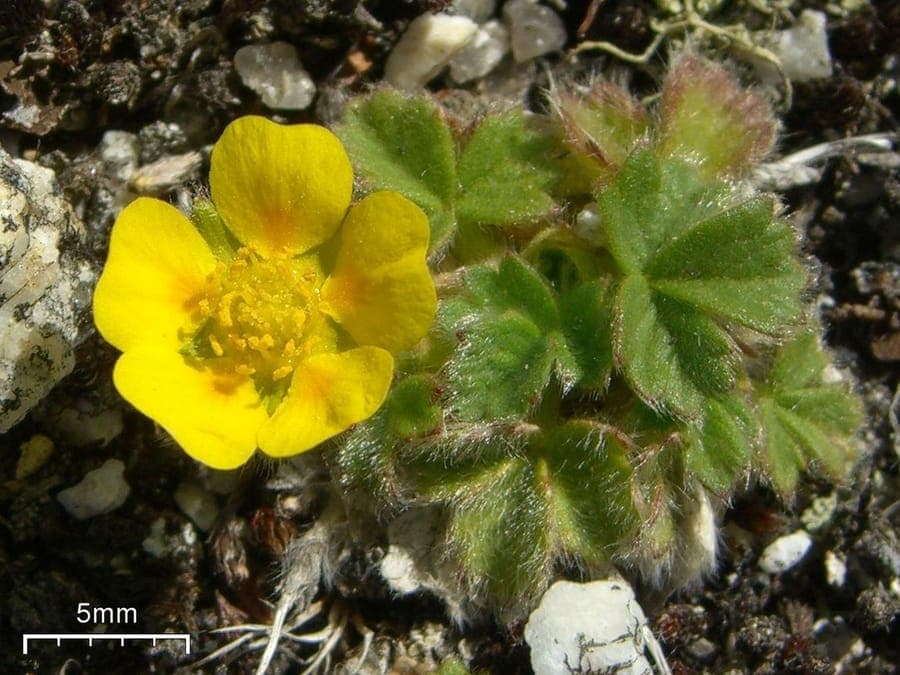
Jason Hollinger / CC BY 2.0, via Wikimedia Commons
Villous cinquefoil: complete guide
Potentilla villosa
Want to see Villous cinquefoil: complete guide in your garden?
1 minute, no credit card
Overview
Potentilla villosa, known in English as villous cinquefoil or northern cinquefoil, is a low-growing herbaceous perennial in the rose family (Rosaceae). It was described in 1814 by Friedrich Adam Wilhelm Pallas and Francis Pursh; the epithet villosa - meaning "with shaggy soft hairs" - refers to the dense silky indumentum that covers the leaves and stems. In French it is called potentille villeuse, in German filziges Fingerkraut.
This species has an intriguingly restricted native range: it grows naturally in Alaska, British Columbia, Oregon and Washington along the North Pacific coast, and also on the Kamchatka Peninsula in far eastern Russia. This circumpacific distribution pattern points to a strongly alpine or subarctic character. In the wild it inhabits rocky slopes, coastal cliffs and alpine meadows at elevations where cold temperatures, thin soils and strong winds are normal conditions.
As a garden plant, villous cinquefoil is especially valuable in rock gardens, alpine troughs and living green roofs. The design gallery at gardenworld.app features a range of ideas that show how compact alpine perennials can be combined into cohesive, low-maintenance planting schemes.
Appearance and bloom cycle
Potentilla villosa forms compact leaf rosettes of pinnately compound leaves, each typically carrying three to five leaflets. The leaflets are wedge-shaped to oval, 2 to 4 cm long, coarsely toothed at the margin, and clothed on the underside in a thick layer of soft, whitish hairs. The upper surface is green and hairy as well, though less densely so. This indumentum gives the foliage a distinctively silvery or silky sheen - a quality that makes the plant ornamentally attractive even when it is not in flower.
Flowers appear from June to August, with the exact timing depending on elevation and local climate. They are butter-yellow, five-petalled and 1 to 2 cm across, with broad heart-shaped petals typical of the rose family. Each flower is carried individually on a slender stem above the rosette. The blooms produce nectar that attracts small bees, hoverflies and solitary bees.
After flowering, small achenes form and are wind-dispersed. The overall picture - silver foliage combined with fresh yellow flowers - makes this a charming plant for small gardens and alpine compositions.
Ideal location
Villous cinquefoil grows best in full sun to partial shade. In its natural habitat it occupies open rocky slopes, alpine meadows and coastal cliffs that receive full sun for much of the day. In the garden it performs best with at least four to six hours of direct sun daily.
Warm and well-ventilated is better than cool and enclosed. The plant tolerates cold superbly but dislikes warm, humid conditions that promote fungal disease. A rock garden, the base of a dry stone wall, a well-drained raised bank or a scree bed are all ideal situations. It also works well in wide, shallow containers on a sunny balcony or patio, provided drainage is excellent.
In larger gardens it can serve as a ground cover on sunny, sloping ground where the soil is too poor or too steep for conventional planting. It stabilises the soil without demanding much attention.
Soil
Potentilla villosa strongly prefers lean, stony or sandy soils with excellent drainage. It comes from bare mountain rocks and arctic-alpine grasslands - far from fertile conditions. Rich, heavily amended soil stimulates leafy growth and weakens the flowering response.
A pH of 5.5 to 7.0 suits the plant. In heavy clay, work in large quantities of coarse grit or horticultural sand before planting. In a rock garden, use a gritty compost mix or blend equal parts potting compost with perlite. A top-dressing of fine gravel or stone chips around the crown keeps the base dry and improves drainage in the root zone.
Avoid any situation where water stands after rain. The roots are susceptible to rot, especially in wet winters with poorly draining soil. Good drainage is the single most important factor in keeping this plant healthy through a north-west European winter.
Free design
Want to see Villous cinquefoil: complete guide in your garden? Make a free design now.
Watering
As a true mountain plant, Potentilla villosa is well adapted to dry spells interrupted by occasional heavy rain. In garden cultivation this translates to generous but infrequent watering: water thoroughly, then wait until the soil has dried out before watering again.
During the first few weeks after planting, water regularly to help the plant establish. Once established, in the growing season, two or three waterings per week during dry weather is enough - and far less in wet periods. During prolonged dry spells (more than three weeks without significant rainfall) give the plant a deep watering, but never let it sit in moisture.
In winter, watering should be minimal. Drought during dormancy is far less damaging than persistent wet conditions. If your region experiences heavy winter rainfall, consider raising the plant in a better-drained bed or placing a cloche over it during the wettest months.
Pruning
Pruning needs are modest. At the end of winter or in early spring, remove dried flower stems and any damaged leaves from the previous season. Cutting back to just above the rosette encourages fresh, tidy foliage and a more compact habit.
During the season, removing spent flowers as they fade can extend the blooming period. With small alpine plants this is quickly done. Avoid heavy autumn pruning: the leaf rosettes provide a degree of natural frost protection to the crown through winter.
If you want the plant to branch more densely, you can lightly trim the longest stems in mid-summer. This is not essential since the plant has a naturally neat and compact form.
Maintenance calendar
March-April: remove dead stems from the previous season once hard frost has passed. Apply a thin layer of fine grit as a top-dressing mulch.
May-June: full growth begins. Water once a week in dry weather. Feeding is rarely needed; if desired, use a very low dose of a high-potassium, low-nitrogen fertiliser.
July-August: flowering period. Remove spent blooms regularly to extend flowering. Water only during extreme dry spells.
September-October: flowering ends. Allow the plant to ripen naturally; do not remove rosettes too early.
November-February: dormancy. Minimal to no watering. In very cold regions, protect the crown with a light covering of dry leaves or conifer needles.
Winter hardiness
Potentilla villosa is exceptionally cold-hardy. It is adapted to the harsh conditions of Alaska and Kamchatka, where temperatures can drop well below -20 degrees Celsius. It is comfortably hardy to USDA zone 3 (minimum temperatures of -40 to -37 degrees Celsius) and will overwinter without problems in the UK, Belgium and the Netherlands (typically zone 7 to 8).
In a western European garden, the risk is not cold but the combination of cold and wet soil. Good drainage is the key safeguard. In unusually wet winters a layer of coarse grit or conifer needle mulch around the crown helps keep the roots adequately dry.
For container-grown plants, move the pot to a sheltered outdoor spot rather than indoors. This plant benefits from a cold period; it needs some exposure to winter temperatures to flower well the following season. Look for it at specialist alpine nurseries and rock garden specialists, or check the perennial sections at garden centres in spring.
Companion plants
Potentilla villosa combines beautifully with other alpine and rock garden plants that share its preference for lean, well-drained soils. Aubrieta deltoidea provides a vivid purple contrast in spring. Saxifraga species enjoy the same stony conditions and flower at similar times. Dianthus alpinus and Thymus serpyllum are excellent neighbours that complete the ground cover and attract pollinators.
For colour contrast, pair it with Veronica prostrata, Phlox subulata or Sedum acre. The silvery-grey foliage of the Potentilla acts as a calming buffer between brighter-coloured alpine plants. Small bulbs such as Muscari or Crocus naturalise well in the same dry, sunny conditions and provide early-season colour before the Potentilla comes into full flower.
Gardenworld.app can help you design a complete rock garden or alpine planting plan, taking into account spacing, height and a considered colour palette so that your garden looks its best across the seasons.
Closing
Potentilla villosa is an understated but genuinely charming perennial for gardeners who appreciate low-growing, tough alpine plants. The silky, silver-haired foliage and bright yellow flowers give the plant visual appeal all summer without demanding much attention. It is outstandingly cold-hardy, tolerant of dry spells and largely free from pests and diseases when grown on the right site.
If you want to incorporate this plant into a broader garden design or explore which companion plants best suit your specific conditions, gardenworld.app offers personalised planting plans with realistic visual previews so you can see exactly how your finished garden will look.
Want to see Villous cinquefoil: complete guide in your garden? Make a free design now.
Upload a photo, pick a style, and get a photorealistic design with plant list in under a minute.
10,000+ gardens designed already
No credit card required


Similar plants
Siberian crab apple: complete guide
Malus x robusta
Complete guide to the Siberian crab apple (Malus x robusta): location, soil, pruning, winter hardiness and the best companion plants for your garden.
Chinese flowering crabapple (Malus x spectabilis): complete guide
Malus x spectabilis
Meet the Chinese flowering crabapple (Malus x spectabilis): a classic spring bloomer with carmine buds and pink blossom.
Potentilla crassinervia: complete guide
Potentilla crassinervia
Potentilla crassinervia, the Corsican cinquefoil, grows wild on Corsica and Sardinia's peaks. Discover how to grow this hardy alpine rock garden gem.