
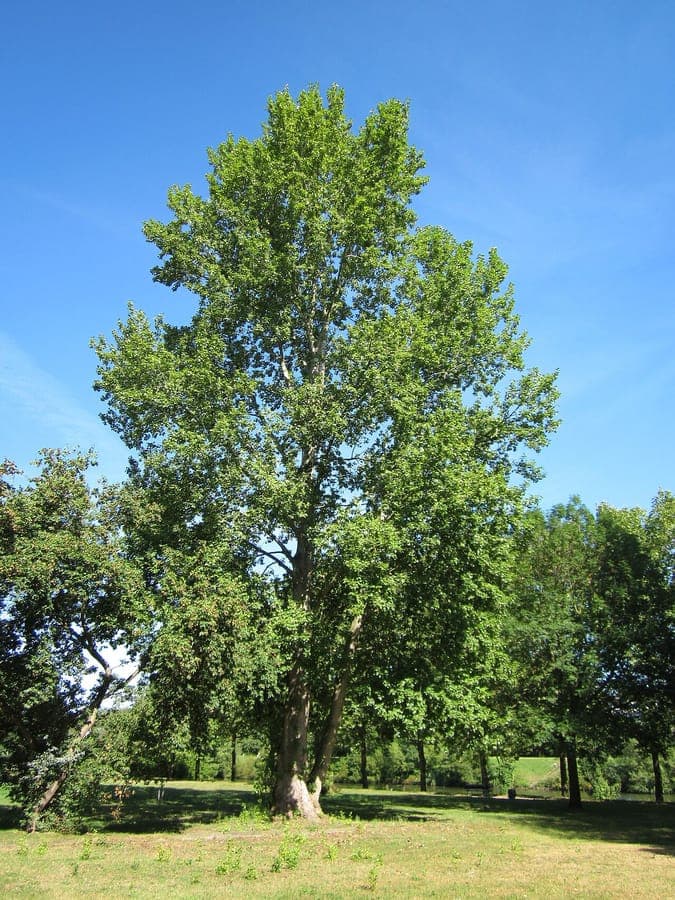
AnRo0002 / CC0, via Wikimedia Commons
Grey poplar: complete guide
Populus x canescens
Want to see Grey poplar: complete guide in your garden?
1 minute, no credit card
Overview
The grey poplar (Populus x canescens) is a naturally occurring hybrid between the white poplar (Populus alba) and the aspen (Populus tremula). It is native to a broad swathe of Europe stretching from the Netherlands and France across to Central Asia, and has been a familiar part of the European landscape for thousands of years. The botanical name canescens means 'becoming grey' in Latin, a direct reference to the distinctive silver-grey colouring of the leaf undersides that is the tree's most recognisable feature.
As a garden or landscape tree, the grey poplar occupies a specific niche: it is for large spaces, open fields, farm boundaries, wide riverbank plantings and coastal shelter belts. In those settings it excels, combining exceptional speed of growth with remarkable tolerance of wind, wet soil and cold. For gardeners planning a large-scale planting or wanting to screen a property quickly with a tree that has genuine character, the grey poplar is hard to beat.
For help visualising how a large specimen tree like the grey poplar might fit into your outdoor space, gardenworld.app provides design tools suited to every scale of garden.
Appearance and seasonal changes
The grey poplar is a large, broadly spreading deciduous tree. Mature specimens typically reach 20 to 35 metres in height, with crown spreads of 10 to 20 metres. Young trees have a pale grey-white bark with a distinctive diamond-shaped pattern of dark lenticels - the pores through which the tree breathes. With age, the base of the trunk becomes rougher, darker and more deeply furrowed.
The leaves are the tree's greatest ornamental feature. The upper surface is dark green and smooth, while the underside is clothed in a dense mat of white to silver-grey hairs. When the wind catches the leaves - and even a light breeze is enough to set poplar leaves fluttering - the crown shifts from dark green to silver and back again in a continuous shimmer. This glittering effect on a windy day is one of the most distinctive sights in the European landscape.
Leaves are heart-shaped to roughly triangular, with irregularly toothed margins, 6 to 12 cm long. They are clearly larger than aspen leaves but a little smaller than those of the white poplar. In autumn the foliage turns golden yellow to amber before falling.
Flowering occurs early in spring, March to April, before the leaves emerge. Male catkins are reddish-purple, female catkins greenish. Seeds ripen in May and June and are carried on cottony fluff, which can drift across the landscape like snowflakes in warm, breezy weather.
Ideal location
Full sun is ideal, though the grey poplar also manages well in light partial shade. It grows fastest and develops the most attractive crown form in an open, unobstructed position. In the wild it occupies riverbanks, dike margins, wet dune valleys and fen edges, indicating strong tolerance of varying moisture conditions.
As a windbreak tree the grey poplar is excellent. It is one of the few large broadleaved trees that performs well in exposed, coastal positions, including moderately saline conditions near the sea. Along the Dutch and Belgian coast it has been used for centuries to shelter farmsteads and orchards.
For the garden, the grey poplar is only appropriate where there is genuine space. Allow a minimum distance of 10 to 15 metres from buildings, drains and foundations: poplar roots are wide-ranging and can cause structural damage if the tree is planted too close. On large plots, at farmsteads, along driveways or as a standalone specimen in a landscape garden, it comes into its own.
Soil requirements
The grey poplar is unfussy about soil type. It grows on sand, loam and clay, from moderately dry to fairly wet. It grows fastest on rich, moist soils along rivers and in valley bottoms. It tolerates temporary flooding but not permanent waterlogging.
The pH range is broad, from slightly acid (5.5) to slightly alkaline (8.0). It grows on poor, dry sandy soils too, though more slowly than on richer ground. Lime tolerance is good.
No special soil preparation is needed before planting. Dig a generous hole of at least 60 cm wide and 60 cm deep, backfill with the excavated soil and firm in well. Poplars are tough trees that establish readily without fuss.
Free design
Want to see Grey poplar: complete guide in your garden? Make a free design now.
Watering
In the first year after planting, regular watering is important to help the young tree establish its root system. During dry spells, water weekly with a generous amount - 10 to 20 litres at a time - delivered directly at the base of the trunk. Deep, infrequent watering is far more effective than frequent, shallow applications.
Once the tree is established - typically after one to two growing seasons - it no longer needs supplementary watering. In nature the grey poplar grows where groundwater is available at some depth, and its roots are well adapted to finding moisture without assistance.
During exceptionally dry summers, a mature tree may show drought stress: early leaf drop or browning at the leaf margins. A single thorough watering during very dry periods can help. Structural problems are rare once the tree is well established.
Pruning
Poplars in general, and the grey poplar in particular, respond well to cutting back and regenerate vigorously after pruning. That said, the advice for most garden situations is to prune as little as possible and allow the tree to develop its natural crown form. Any significant work in the crown of a mature tree should be carried out by a qualified tree surgeon.
For young trees, the first few years can include removing dead wood and cutting out competing double leaders to encourage a single strong main stem. Always prune outside the sap flow period - late summer or early autumn is best, never in early spring when sap is rising strongly.
Root suckering is characteristic of poplars: shoots emerge from the roots around the base of the tree. Remove these regularly if you do not want them, as neglected suckers will eventually form a thicket of stems. Cutting or digging them out just below ground level is the most effective approach.
Maintenance calendar
January to March: the tree is dormant. Check for storm damage. Male and female catkins appear in late February or March, before leaves emerge.
April to May: leaves unfurl. Young trees in their first two seasons benefit from watering during dry spells. Remove any root suckers emerging around the base.
June to August: full growth. Continue watering young trees weekly during drought. Inspect the trunk and main limbs for signs of canker or bark damage.
September to October: leaves turn golden and fall. Fallen leaves can be left to decompose in place or composted. Autumn is a good time to plant bare-root trees.
November to December: dormancy returns. Bare-root grey poplars can be planted throughout the dormant season. Light pruning of young trees can take place now.
Winter hardiness
The grey poplar is exceptionally winter-hardy, rated to USDA zone 4, which equates to temperatures as low as -34 degrees Celsius. In the UK, Netherlands, Belgium and Germany, frost damage is essentially unknown. Even late frosts in May, which can catch other trees in active leaf growth, rarely cause lasting harm to the grey poplar.
Freshly planted young trees can be vulnerable in their first winter not to cold itself but to root desiccation during freezing, windy weather. A mulch layer of 5 to 10 cm of bark chippings around the base of the tree helps retain soil moisture and moderate soil temperature.
Companion plants
The grey poplar looks most natural as a specimen or in small groups alongside other native trees and tall shrubs. In a landscape-scale planting it combines well with black alder (Alnus glutinosa), rowan (Sorbus aucuparia), hawthorn (Crataegus monogyna) and blackthorn (Prunus spinosa), forming a varied native woodland edge.
As a windbreak alongside open ground, pair it with ash (Fraxinus excelsior) and willow (Salix alba or Salix caprea). Combining fast-growing poplars with slower-growing species builds a shelter belt that becomes denser and more varied over the years.
In the dappled shade beneath the canopy, shade-tolerant native plants do well: lords and ladies (Arum maculatum), wood violet (Viola riviniana) and wood anemone (Anemone nemorosa) create a natural floor layer. Garden centres across the UK carry these native woodland plants, and they establish readily under a poplar canopy once the tree is large enough to cast meaningful shade.
For ideas on designing naturalistic plantings that incorporate large trees, explore gardenworld.app.
Closing thoughts
The grey poplar is not a tree for the small suburban plot, but for those with the space it is one of the most characterful and ecologically valuable large trees available to European gardeners. Its shimmering silver foliage, remarkable speed of establishment, toughness in the face of wind and cold, and value to birds and invertebrates make it a landscape-defining choice. Give it room, plant it in the right spot, and it will shape the view for generations.
Want to see Grey poplar: complete guide in your garden? Make a free design now.
Upload a photo, pick a style, and get a photorealistic design with plant list in under a minute.
10,000+ gardens designed already
No credit card required


Similar plants
Populus adenopoda: complete guide
Populus adenopoda
Chinese aspen: a fast-growing tree for large gardens. Cultivation tips, pruning, and use as windbreak or shade tree.
Populus fremontii: complete guide
Populus fremontii
Fremont's cottonwood is a majestic American tree with rapid growth and drought tolerance. Read our guide for cultivation tips and garden integration.
Populus ciliata: complete guide
Populus ciliata
Himalayan poplar is a fast-growing slender tree (20-25m) ideal for large gardens. Elegant foliage, golden autumn color. Perfect windbreak and screening.