
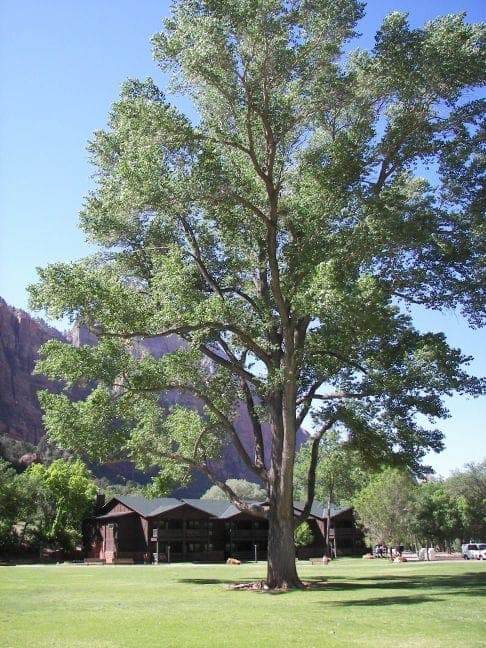
Amy Gaiennie, NPS / Public domain, via Wikimedia Commons
Populus fremontii: complete guide
Populus fremontii
Want to see Populus fremontii: complete guide in your garden?
1 minute, no credit card
Overview
Fremont's cottonwood (Populus fremontii), native to the southwestern United States and Mexico, is a fast-growing deciduous tree prized for its rapid development, upright form, and exceptional drought tolerance. This impressive specimen reaches heights of up to 50 meters in ideal conditions, though garden specimens typically remain somewhat smaller. The tree thrives along river bottoms and water courses from Arizona to California, Nevada, Utah, and New Mexico.
In landscape design, Fremont's cottonwood provides excellent shade, acts as an effective windbreak, and adapts remarkably well to arid and semi-arid climates. Its rapid growth rate makes it ideal for establishing shelter and privacy in large gardens and rural landscapes.
Appearance and bloom
Fremont's cottonwood displays an upright, columnar growth habit with smooth, yellowish-green bark on young stems. The leaves are triangular to diamond-shaped, typically 4 to 7 centimeters long, with a glossy, bright green surface that catches light beautifully. In spring, before full leaf emergence, the tree produces inconspicuous catkins.
Flowers appear as hanging catkins in March or April, varying by local climate conditions. The female catkins later develop into white, cotton-like seed pods that disperse on the wind, a characteristic feature of cottonwoods. These fluffy seeds can float considerable distances, ensuring natural propagation.
Ideal location
This tree performs best in full sun, requiring a minimum of 6 hours of direct sunlight daily. Position Fremont's cottonwood where complete sun exposure is available for optimal growth. The tree is highly drought-resistant and suits warm, dry regions perfectly. Avoid shaded locations, as insufficient light will restrict growth potential.
This species excels in large gardens, landscape projects, and commercial applications where rapid growth is desired. Use it as a windbreak, privacy screen, or focal point due to its fast development and dense canopy. It tolerates alkaline and saline soils that many trees find challenging.
Soil
Fremont's cottonwood adapts to a broad range of soil types, from sandy to clay loams. The tree prefers well-draining soil and tolerates both acidic and alkaline conditions (pH 6 to 8). In garden settings, ensuring good drainage is essential for long-term health.
The tree's deep root system provides exceptional drought tolerance, an advantage in water-limited regions. Never allow soil to become waterlogged, as this causes root rot and decline. For heavy clay soils, incorporate sand or gravel to improve drainage and air penetration.
Free design
Want to see Populus fremontii: complete guide in your garden? Make a free design now.
Watering
Once established, Fremont's cottonwood requires minimal supplemental water. During the first growing season, however, provide regular irrigation to develop a strong root system. Water deeply and thoroughly, approximately 1 to 2 times per week in early months.
Avoid overwatering, particularly in enclosed spaces where soil remains damp. During winter dormancy, water requirements drop significantly. In arid climates, mature trees thrive without supplemental watering once roots are fully developed and extend into deeper soil layers.
Pruning
Fremont's cottonwood grows rapidly and responds well to regular pruning. Prune during late winter or early spring while the tree remains dormant. This promotes stronger branch structure and a denser crown.
Remove dead, damaged, or crossing branches to maintain tree health. Thin the canopy lightly to allow air and light penetration into the interior. Given the rapid growth rate, annual pruning may be necessary to maintain desired size and form. Avoid removing more than one-third of the crown in a single year.
Maintenance calendar
January to March: Prune during dormancy; remove dead or damaged branches. April to May: Check root collar and soil moisture; establish watering routine. June to August: Water regularly, especially during dry periods; monitor for pest activity. September to October: Reduce watering as temperatures decline. November to December: Cease fertilizing; prepare for winter dormancy.
Winter hardiness
Fremont's cottonwood is moderately hardy (USDA zones 7 to 10). In colder regions, severe winters may damage the tree. Zone 6 gardeners can provide protection for marginal survival. The tree tolerates temperatures down to approximately -10 to -15 degrees Celsius.
Wrap the trunk with burlap or shade cloth during extreme winters. Avoid excessive fall fertilization, as this stimulates frost-tender new growth. In protected locations within colder zones, the tree can succeed with careful siting.
Companion plants
Fremont's cottonwood pairs well with other drought-tolerant trees and shrubs. Combine it with native species such as manzanita, ceanothus, or desert willow to create a low-maintenance landscape with regional character. These combinations establish a natural aesthetic suited to arid environments.
Avoid planting cottonwoods closer than 6 to 8 meters apart, as this creates competition for water and nutrients. Space adequately for mature canopy development.
Closing
Fremont's cottonwood is an impressive tree that rapidly provides shade, shelter, or privacy in warm, dry regions. For gardeners in arid climates, this species represents an excellent choice for establishing substantial landscape structure. Visit gardenworld.app to explore how to integrate this tree into your garden design and discover complementary planting combinations.
Want to see Populus fremontii: complete guide in your garden? Make a free design now.
Upload a photo, pick a style, and get a photorealistic design with plant list in under a minute.
No credit card required


Similar plants
Grey poplar: complete guide
Populus x canescens
Everything about Populus x canescens - a fast-growing hybrid poplar with silver-grey foliage, ideal as a windbreak or specimen tree in large gardens.
Populus adenopoda: complete guide
Populus adenopoda
Chinese aspen: a fast-growing tree for large gardens. Cultivation tips, pruning, and use as windbreak or shade tree.
Populus ciliata: complete guide
Populus ciliata
Himalayan poplar is a fast-growing slender tree (20-25m) ideal for large gardens. Elegant foliage, golden autumn color. Perfect windbreak and screening.