
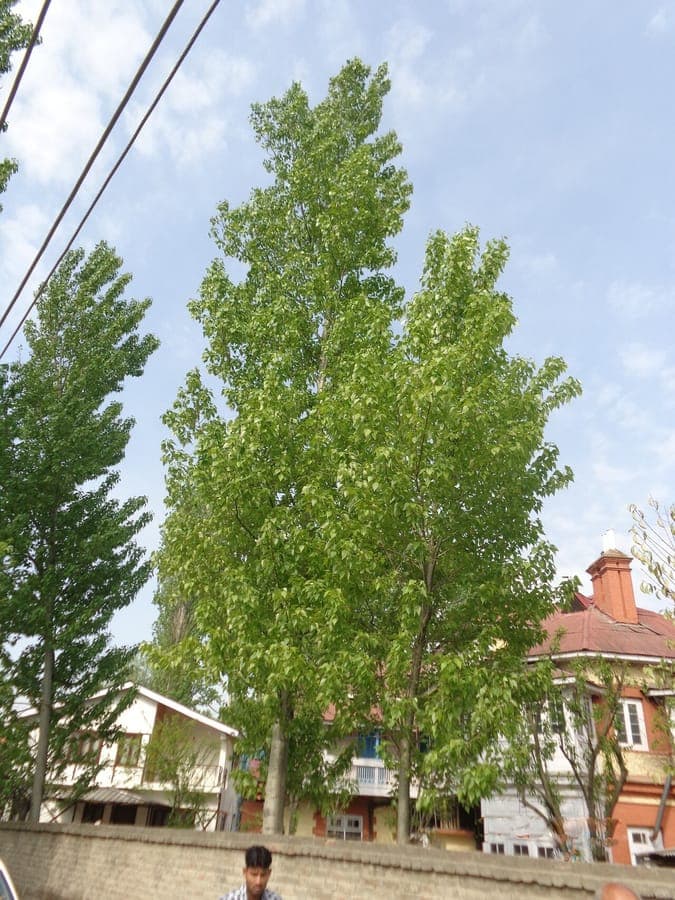
Dvellakat / CC BY 3.0, via Wikimedia Commons
Populus ciliata: complete guide
Populus ciliata
Want to see Populus ciliata: complete guide in your garden?
1 minute, no credit card
Overview
Populus ciliata, commonly known as Himalayan poplar, is an impressive tree from the Salicaceae family (willow family). This powerful, fast-growing tree is naturally native to the mountainous regions of the western and southwestern Himalaya, growing from Pakistan to China and Myanmar.
Himalayan poplar is renowned for its rapid growth and slender, elegant form. The tree can reach considerable height within a few years and is ideal for large gardens, estates, and commercial applications where rapid growth and visual screening are desired.
The tree is highly tolerant of diverse soil types and climates, though it grows best in temperate climates with adequate water availability. In Europe, this tree can thrive particularly well in average to warm climates.
Appearance and growth
Populus ciliata normally reaches a height of 20 to 25 meters in Europe, with a slender, columnar crown. The tree grows very rapidly - young trees can grow 1 to 1.5 meters annually under ideal conditions.
The leaves are rounded to elongate, approximately 5 to 8 centimeters long, gray-green in color with fine cilia (hairs) along the edges - hence the botanical name "ciliata". In autumn, the leaves turn a beautiful golden yellow.
The trunk grows straight and the tree forms a naturally columnar silhouette. This makes it ideal for creating vertical accents in the landscape. The branch structure is elegant and not overly dense.
Ideal location
Himalayan poplar grows best in sunny, open locations with a minimum of 6 hours of direct sunlight daily. The tree has no preference for shade and thrives best in full sun.
The tree is highly tolerant of windy locations and even forms an excellent windbreak. This makes it perfect for exposed slopes, open landscapes, or coastal areas.
Avoid very low, wet locations - while Populus ciliata is moisture-tolerant, it grows poorly in permanently waterlogged soil.
Soil
Populus ciliata is not fussy about soil type and grows in sandy, loamy, or even clayey soils. The tree grows better in slightly acidic to neutral soils, but is also tolerant of lightly alkaline substrates.
The ideal soil is well-draining but moisture-retaining. The tree prefers soils with a slightly higher organic content, which helps with water-holding capacity.
In very poor soils, some application of organic material at planting time can be beneficial. Avoid very heavy applications of extremely compact clay.
Free design
Want to see Populus ciliata: complete guide in your garden? Make a free design now.
Watering
During the first two years after planting, water regularly. Water weekly deeply into the soil during the growing season (May to September). This promotes deep rooting and stability.
Once mature, Populus ciliata can manage with less water, though regular watering during dry periods benefits growth.
In areas with annual rainfall of 600 mm or more, rainwater may be sufficient.
Pruning
Pruning is generally not necessary. Himalayan poplar grows naturally into a beautiful columnar form. Some light pruning can be done to remove dead branches or control form in the young stage.
Avoid heavy pruning cuts that leave large wounds - poplars can be sensitive to certain fungi through large wounds.
Maintenance calendar
Spring (March-May): Tree awakens from winter dormancy. Check for frost damage. Begin watering young trees. Monitor growth.
Summer (June-August): Peak growth period. Ensure regular water, especially young trees. Monitor for insects (poplar sawflies). Increase water during very hot periods.
Autumn (September-October): Growth slows. Beautiful yellow autumn color. No more watering needed.
Winter (November-February): Tree is dormant. No care needed. Inspect trunks for damage.
Winter hardiness
Populus ciliata is reasonably winter hardy to zone 6 (-15 to -20 degrees Celsius). In the Netherlands, Belgium, and southern Germany, this tree can overwinter outdoors without special protection.
In colder regions (Scandinavia, northern Germany, high mountains), protection may be needed in very severe winters. Young trees are more sensitive and may benefit from mulch layers at the base.
Companion plants
At the base of Populus ciliata, many shrubs and bushes can grow, especially since the tree allows considerable light. Good companions include:
- Forsythia species
- Hibiscus
- Deutzia species
- Low conifers
- Shade-tolerant groundcovers
The columnar character of the tree makes it ideal for formal garden designs alongside regularly planted rows of other trees.
Closing
Populus ciliata is an ideal choice for gardeners and landscape architects seeking rapid visual screening, windbreaks, or vertical accents. With its fast growth, elegant form, and tolerance for diverse conditions, this tree provides years of utility.
You'll find Himalayan poplar at tree nurseries and garden centers. In the UK and Northern Europe, many established nurseries stock this species. GardenWorld.app can help you design large garden and landscape schemes where Populus ciliata serves as a structural element.
With regular watering and patience, your tree will grow rapidly into a mature, majestic specimen.
Want to see Populus ciliata: complete guide in your garden? Make a free design now.
Upload a photo, pick a style, and get a photorealistic design with plant list in under a minute.
No credit card required


Similar plants
Grey poplar: complete guide
Populus x canescens
Everything about Populus x canescens - a fast-growing hybrid poplar with silver-grey foliage, ideal as a windbreak or specimen tree in large gardens.
Populus adenopoda: complete guide
Populus adenopoda
Chinese aspen: a fast-growing tree for large gardens. Cultivation tips, pruning, and use as windbreak or shade tree.
Populus fremontii: complete guide
Populus fremontii
Fremont's cottonwood is a majestic American tree with rapid growth and drought tolerance. Read our guide for cultivation tips and garden integration.