
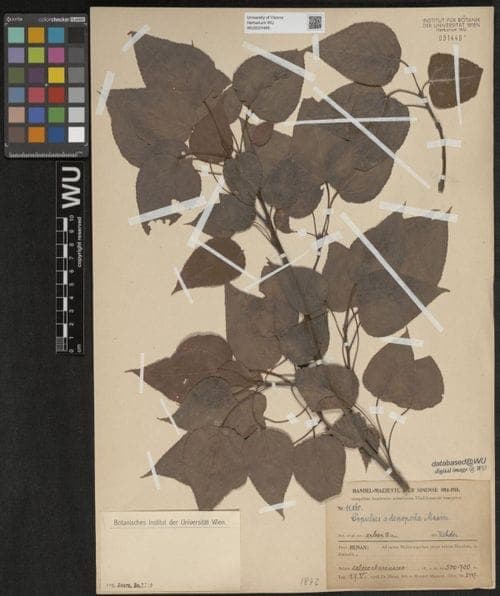
University of Vienna, Institute for Botany - Herbarium WU / CC BY 4.0, via Wikimedia Commons
Populus adenopoda: complete guide
Populus adenopoda
Want to see Populus adenopoda: complete guide in your garden?
1 minute, no credit card
Overview
Populus adenopoda, commonly known as Chinese aspen, is a fast-growing deciduous tree from the Salicaceae family. This native tree of China and the Himalayan region grows in moist mountain valleys and alluvial plains. With its slender form, bright green foliage, and rapid growth, this tree is ideal for large gardens, as a windbreak, or as a shade tree.
The tree reaches a height of 15 to 30 meters in maturity and exhibits a narrow, upright crown. Populus adenopoda grows extremely quickly in early years and can grow 60 to 90 centimeters annually under favorable conditions. This makes it an excellent choice for gardeners seeking rapid visual impact.
Appearance & Growth
Populus adenopoda grows as an upright, slender tree with a narrow, columnar silhouette. The leaves are small to medium-sized, approximately 5 to 10 centimeters long, heart-shaped to rounded, with smooth margins and a light green to yellowish-green underside. In autumn, leaves shift to yellow to yellow-red before dropping.
The tree produces typical aspen catkins (male flowers) in spring prior to leaf emergence. These catkins are approximately 5 to 8 centimeters long and give the tree a light, fluffy texture. The bark is smooth and grayish when young, becoming furrowed with age.
Ideal Location
Populus adenopoda is a sun-loving tree that thrives in full sunlight. Provide at least 6 to 8 hours of direct sunlight daily. The tree shows reduced growth in partial shade and does not flourish in complete shade.
This tree prefers open, exposed locations and tolerates certain degrees of wind well. For larger gardens and parks, plant as a stand-alone specimen or as part of a windbreak arrangement. Avoid planting close to house foundations, as the deep-rooting roots of aspens can cause significant foundation damage.
Soil
Populus adenopoda is highly flexible regarding soil types. The tree grows in soils of neutral to basic pH (6.5 to 7.5) and tolerates even poorly drained soils. This is advantageous since the tree can grow in waterlogged ground.
The tree prefers moist soils and grows more slowly in very dry conditions. For optimal growth, provide regular watering during dry periods. Avoid compacted soils and ensure sufficient depth for root development (minimum 60 centimeters). Add organic matter at planting.
Free design
Want to see Populus adenopoda: complete guide in your garden? Make a free design now.
Watering
Populus adenopoda requires regular watering, especially in the first year after planting. Water approximately 1 to 2 times weekly depending on rainfall and soil moisture levels. Do not allow soil to dry completely, especially during warm summers.
Once the tree is established (after 2 to 3 years), it can tolerate less frequent watering. Mature trees can usually survive without artificial irrigation except during very dry periods. Reduce watering in winter.
Pruning
Populus adenopoda requires regular pruning to maintain form and structure. Perform pruning in late winter or early spring before leaf emergence begins. Remove all dead, damaged, or crossing branches.
To maintain the slender silhouette, light pruning of branches may be necessary. Remove any water sprouts (growth from the root collar) that may appear. Heavy pruning causes weakening; instead use light to moderate pruning.
Maintenance Calendar
January-March: Late winter pruning. Remove dead branches. Preparation for growing season.
April-May: Rapid growth begins. Water regularly. Apply feeding (optional but beneficial).
June-September: Peak growth period. Water regularly during drought. Monitor for fungal infections.
October-November: Growth slows. Reduce watering. Leaf drop.
December: Dormant period. Minimal care required.
Winter Hardiness
Populus adenopoda is moderately winter hardy and tolerates temperatures to approximately -15 to -20 degrees Celsius. In northern regions, it may suffer damage during severe winters, especially young plant material.
Provide wind protection for young trees in the first year after planting. Mulch around the base of young trees with organic matter (approximately 5 centimeters thick) to protect roots. In very cold areas, protection may be needed during severe winters.
Companion Plants
Populus adenopoda works well as part of larger garden arrangements. Plant shade-tolerant shrubs and herbaceous plants beneath it such as Sambucus and Cornus. In park-like settings, combine with other fast-growing trees like Fraxinus.
Avoid dense planting beneath due to the strong, dominant crown of the tree. The foliage of Populus adenopoda also casts filtered shade, so grass or other open groundcover can grow underneath.
Closing Remarks
Populus adenopoda is a spectacular fast-growing tree perfect for large gardens and parks. With its slender form, rapid growth, and flexibility regarding soil types, it offers quick results and enduring beauty. Plant in full sunlight, provide regular watering in early years, and enjoy this Chinese tree for decades to come. Visit gardenworld.app for more tree selection information. Check gardenworld.app for creating impressive, green gardens with large trees.
Want to see Populus adenopoda: complete guide in your garden? Make a free design now.
Upload a photo, pick a style, and get a photorealistic design with plant list in under a minute.
No credit card required


Similar plants
Grey poplar: complete guide
Populus x canescens
Everything about Populus x canescens - a fast-growing hybrid poplar with silver-grey foliage, ideal as a windbreak or specimen tree in large gardens.
Populus fremontii: complete guide
Populus fremontii
Fremont's cottonwood is a majestic American tree with rapid growth and drought tolerance. Read our guide for cultivation tips and garden integration.
Populus ciliata: complete guide
Populus ciliata
Himalayan poplar is a fast-growing slender tree (20-25m) ideal for large gardens. Elegant foliage, golden autumn color. Perfect windbreak and screening.