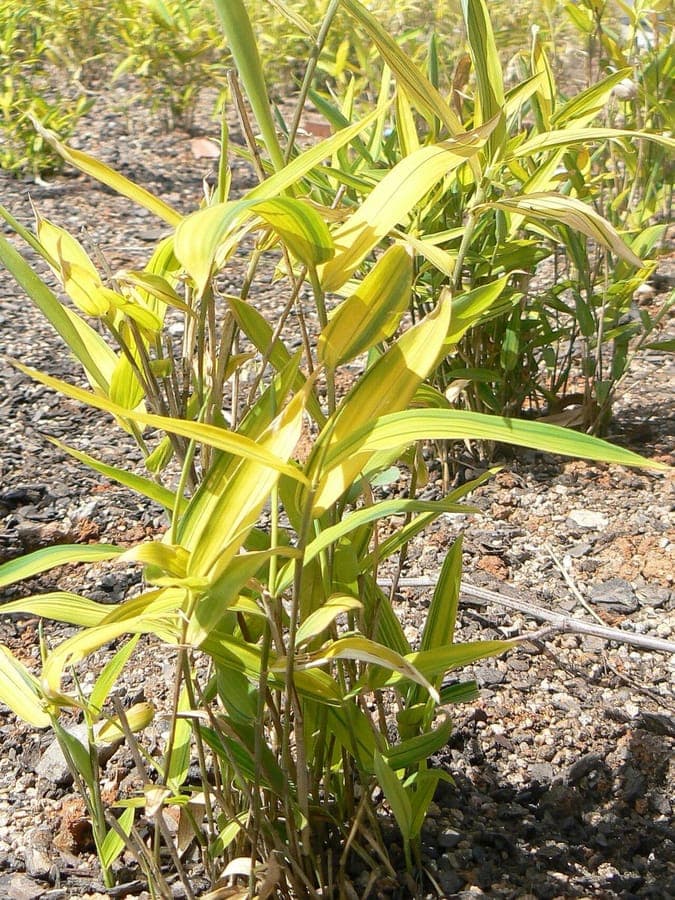
No machine-readable author provided. CavallBernat assumed (based on copyright claims). / Public domain, via Wikimedia Commons
Dwarf greenstripe bamboo (Pleioblastus viridistriatus): guide
Pleioblastus viridistriatus
Want to see Dwarf greenstripe bamboo (Pleioblastus viridistriatus): guide in your garden?
Full design in HD: €7.99
Look after your Dwarf greenstripe bamboo with the GardenWorld app
Identify plants with your camera and get a care calendar with reminders for this plant.


Overview
Pleioblastus viridistriatus is a low-growing bamboo from Japan, where it is known as kamuro-zasa. In English it is usually called dwarf greenstripe bamboo. Its golden-yellow leaves with fine green stripes light up a dull corner of the garden like few other plants. You may also find it under the older names Pleioblastus auricomus and Arundinaria viridistriata. It usually stays between 80 cm and 1.5 m tall, so it behaves more like ground cover or a low shrub than a tall screening bamboo.
Let there be no doubt: this is a running bamboo. Pleioblastus viridistriatus produces long underground rhizomes that spread in every direction and push up new shoots, sometimes half a metre or more from the parent plant. In poor, dry soil this happens slowly and the plant stays fairly compact. In moist, fertile soil after a warm summer, however, it can quickly colonise a large area, threading between perennials and travelling under a path or garden wall. Never plant it unconfined in a mixed border. Further down you will find how to install a root barrier.
Respect that limitation and you get a beautiful plant that provides colour almost all year. In a sunken container, a large pot or within a properly installed barrier, it is an asset in a Japanese-style garden, a shady courtyard or a crisp contemporary design.
Appearance and flowering
The leaves are the star. They grow 12 to 20 cm long and 2 to 3 cm wide, bright yellow to butter-coloured with narrow green stripes running lengthwise. The underside feels soft and slightly downy, almost velvety. The canes are thin, green to purplish and stand upright in a loose group. Colour is brightest in spring as the new leaves emerge; through summer the foliage turns somewhat greener, especially in shade.
The plant is technically evergreen, but after a hard winter the old leaves often look battered. That is why many gardeners cut the whole plant down almost to the ground in late winter. It sounds drastic, but within weeks it produces a carpet of fresh, glowing yellow leaves.
Flowering is very rare in this species and has no ornamental value. Bamboo can be weakened after flowering. If you spot flower spikes, cut them out and give the plant water and feed to help it recover.
Ideal position
For the best leaf colour, grow Pleioblastus viridistriatus in sun or light partial shade. The more light, the yellower the leaves; in deep shade they turn greener and growth becomes sparse. In a very hot, dry spot the leaf edges can scorch in July and August, so morning sun with some afternoon shelter is ideal.
Choose the spot with the rhizomes in mind. Keep at least a metre away from boundaries, patios and paths laid on a loose base. Do not plant it near a ditch, woodland edge or natural area, where it could spread out of sight. In a pot of at least 30 to 40 litres it looks lovely on a patio or balcony, and then there is no risk of spreading at all.
Soil requirements
It grows in almost any ordinary garden soil that does not stay waterlogged. Ideal is a humus-rich, moisture-retentive but free-draining soil with a pH of roughly 5.5 to 7. Remember that rich, moist soil speeds up rhizome growth. A slightly poorer soil keeps the plant more compact, which is often no bad thing.
A light dressing of compost in April is usually enough. Heavy nitrogen feeding produces lots of new shoots and a plant that pushes harder against its boundaries. After planting, mulch with 5 cm of bark or leaf mould to retain moisture and suppress weeds.
The root barrier
A root barrier, also called a rhizome barrier, is the most reliable way to keep Pleioblastus viridistriatus in check in open ground. Use purpose-made HDPE barrier at least 2 mm thick. Ordinary pond liner, weed membrane or thin plastic edging will not stop the sharp rhizome tips.
Dig a trench around the planned area about 60 cm deep. The rhizomes of this low species run shallow, mostly in the top 20 to 30 cm, so 60 cm is ample. Set the barrier upright with its top edge 5 cm above ground level, so you can see at once when a rhizome tries to creep over. Angle the bottom edge slightly inwards, so that rhizomes meeting the barrier are deflected upwards rather than diving underneath. Overlap the two ends by at least 20 cm and fix them with an aluminium clamping strip.
Be generous with the space: a circle 1.5 to 2 m across gives the plant room to look good for years. Check the top edge every autumn and cut off any rhizome that grows over it.
A simpler alternative is to slice down around the clump with a sharp spade every year, to about 30 cm deep, and dig out the severed rhizomes. That only works if you really do it every year. A large bottomless tub sunk to just below its rim is a third option.
Free preview
Want to see Dwarf greenstripe bamboo (Pleioblastus viridistriatus): guide in your garden? Make a free preview of your design.
Watering
Pleioblastus viridistriatus likes slightly moist soil. In its first year after planting, give a good can of water once a week in dry weather. An established plant in open ground only needs extra water during long droughts; rolled-up leaves show that it is thirsty.
Plants in pots dry out faster and need watering two or three times a week in summer, daily in a heatwave. Make sure there is a good drainage hole. Even in winter the compost should not dry out completely.
Pruning
The most important pruning job is also the simplest: cut or mow the whole plant down to 5 to 10 cm above ground in February or March. This removes the weathered winter foliage, and in April and May a dense mass of new shoots appears in the brightest yellow. Do not leave it too late, because once new shoots are up you will cut them off too.
If you prefer to keep the plant evergreen, simply remove untidy and dead canes at ground level instead. For the rest of the year no pruning is needed, apart from removing rhizomes that stray beyond the intended area.
Care calendar
February–March: Cut the whole plant down almost to the ground. Check the root barrier.
April: New shoots appear. Give a light dressing of compost. A good time to plant or divide.
May–June: Foliage at its most colourful. Keep new plantings moist. Spade off rhizomes outside the clump.
July–August: Water in dry spells, especially in pots. No feeding after July.
September–October: Check the edge of the root barrier again and remove any escaped rhizomes.
November–January: Dormant season. Leave the foliage as winter protection. Protect pots from freezing through.
The planting calendar at gardenworld.app shows you jobs like these at the right moment, tailored to the plants in your own garden.
Hardiness
Pleioblastus viridistriatus is hardy to about -20 °C. In open ground it comes through a normal British or northern European winter without trouble. In severe frost the leaves may brown or drop, but that is no disaster: the rhizomes reshoot in spring, and the spring cut-back makes everything fresh again.
Container plants are more vulnerable. Stand the pot against a wall and wrap it in hessian or bubble wrap during prolonged frost. A layer of leaves or straw on the compost also helps.
Bamboo is not poisonous to people, dogs or cats, so the plant is safe in a family garden.
Companion plants
The yellow foliage of Pleioblastus viridistriatus looks best beside dark green or red leaves. A Japanese maple (Acer palmatum) with purple-red foliage makes a striking contrast. Blue-green hostas and the evergreen sedge Carex morrowii also sit well nearby, as does the fern Dryopteris erythrosora with its coppery young fronds.
As a dark foreground, mondo grass (Ophiopogon japonicus) works beautifully. Plant these partners outside the root barrier so that the bamboo cannot overrun them in time. In a pot, the bamboo is best paired with a few low seasonal plants around the edge.
Final thoughts
Pleioblastus viridistriatus is one of the most colourful low bamboos there is, but it is not a plant to drop casually into a border. It runs by underground rhizomes, and without a barrier, a pot or yearly checks it is very hard to get rid of. With proper containment and a cut-back each spring, it rewards you with glowing yellow foliage from April until winter. To find out where it would look best in your garden, have a garden design made at gardenworld.app that takes its growth habit into account.
Frequently asked questions about Dwarf greenstripe bamboo
Is Dwarf greenstripe bamboo winter hardy?
Pleioblastus viridistriatus is hardy to about -20 °C. In open ground it comes through a normal British or northern European winter without trouble.
When and how do you prune Dwarf greenstripe bamboo?
The most important pruning job is also the simplest: cut or mow the whole plant down to 5 to 10 cm above ground in February or March. This removes the weathered winter foliage, and in April and May a dense mass of new shoots appears in the brightest yellow.
How much water does Dwarf greenstripe bamboo need?
Pleioblastus viridistriatus likes slightly moist soil. In its first year after planting, give a good can of water once a week in dry weather.
What soil does Dwarf greenstripe bamboo need?
It grows in almost any ordinary garden soil that does not stay waterlogged. Ideal is a humus-rich, moisture-retentive but free-draining soil with a pH of roughly 5.5 to 7.

See it in your garden
See Dwarf greenstripe bamboo in your garden
One photo of your garden and a few questions. You see the result in about a minute.
Try it with a photoIdentify this plant in your own garden. Identify a plant
Similar plants
Japanese Maple: complete guide
Acer palmatum
Everything about Japanese Maple (Acer palmatum): planting, pruning, cultivars and autumn colour. Expert tips for a spectacular ornamental tree in your garden.
Hosta: complete guide
Hosta
Everything about hostas (plantain lilies): varieties, planting, care and slug control. Expert tips for stunning foliage in shade gardens.
Carex morrowii: complete guide
Carex morrowii
Japanese sedge (Carex morrowii) is an elegant shade groundcover for cool gardens. Learn how to grow this bird-friendly sedge for year-round foliage interest.
