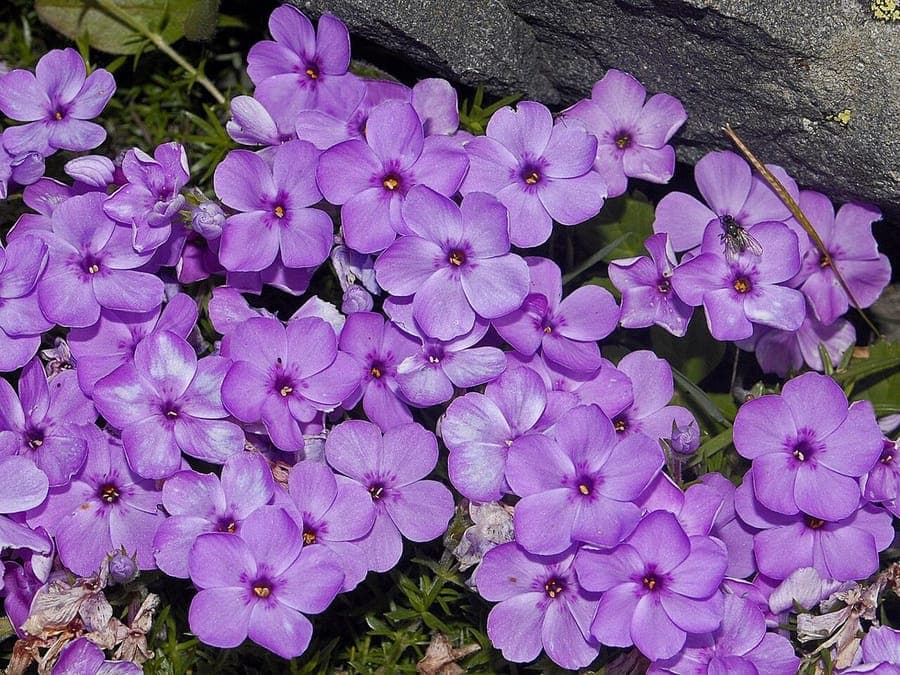
Hectonichus / CC BY-SA 3.0, via Wikimedia Commons
Tufted phlox (Phlox douglasii): complete guide
Phlox douglasii
Want to see Tufted phlox (Phlox douglasii): complete guide in your garden?
Full design in HD: €7.99
Look after your Tufted phlox with the GardenWorld app
Identify plants with your camera and get a care calendar with reminders for this plant.


Overview
Tufted phlox, also called Douglas phlox (Phlox douglasii), is a low, mat-forming perennial in the phlox family (Polemoniaceae). It is native to the north-western United States, mainly the Columbia Plateau of Washington and Oregon, where it grows on dry, rocky slopes and among sagebrush. The species honours the Scottish plant hunter David Douglas, who sent many North American plants back to Britain in the nineteenth century. In gardens it is a stalwart of rock gardens, dry-stone walls and the front of sunny borders.
In April and May the plant turns into a dense cushion of flowers, so packed that the foliage beneath almost disappears. Afterwards a fine, evergreen mat remains that looks neat all year. It closely resembles the better-known moss phlox (Phlox subulata) but is smaller and tighter: it reaches only 5 to 10 cm in height and 30 to 50 cm across, has shorter leaves and grows more slowly. That makes it ideal for a small rockery or for tucking between stones, where Phlox subulata would soon take over.
Phlox douglasii is not toxic to people, dogs or cats. It is not regarded as invasive anywhere in Europe; it rarely self-seeds and spreads only slowly above ground.
Appearance and bloom cycle
The leaves are narrow and needle-like, usually less than a centimetre long, and crowd closely along short, slightly woody stems. Together they form a firm, moss-like cushion that stays green through winter. After a few years, older growth in the centre may turn a little brown.
The flowers are about 1.5 cm across, with five rounded petals spreading flat from a narrow tube. Colours range from white and pale pink through lilac and lavender-blue to deep red and magenta. Many forms have a darker eye at the centre, which gives the cushion extra depth. They are lightly scented.
The main flush comes in April and May, sometimes stretching into early June depending on the weather. Bees, bumblebees and early butterflies visit the flowers. Well-known cultivars include 'Boothman's Variety' (mauve with a violet eye), 'Crackerjack' (vivid magenta-red), 'Red Admiral' (crimson), 'Iceberg' (white with a hint of blue) and 'Kelly's Eye' (pale pink with a dark eye). Several of these hold the Royal Horticultural Society's Award of Garden Merit.
Ideal location
Give Phlox douglasii a spot in full sun. Six hours or more of direct sun a day produces the densest carpet of flowers. It still blooms in light shade, but the cushion becomes looser and the display shorter. In real shade it will sulk.
This is a born rock-garden plant. Place it between stones, on top of a dry-stone wall, in a gravel bed, along the edge of a raised bed or in the cracks of a rarely used stone path. It also looks lovely spilling over the rim of a trough or container. In an ordinary border, give it the front row where taller neighbours will not shade it. Plant about 30 cm apart; the mats knit together after two or three years.
Soil requirements
Sharp drainage matters most. In the wild Phlox douglasii grows in stony, rather poor ground and it hates wet feet, especially in winter. Sandy or gritty soil is ideal. On heavy clay, work plenty of grit and coarse sand into the top 20 cm, or plant on a raised mound. A top dressing of gravel around the plant keeps the stems dry and weeds down.
Soil pH is not critical: slightly acidic to slightly alkaline soil suits it. It needs very little feeding; a handful of compost in spring is plenty, as too much nutrition makes the mat lax and floppy. For pots and troughs, use a mix of equal parts multipurpose compost and grit.
Free preview
Want to see Tufted phlox (Phlox douglasii): complete guide in your garden? Make a free preview of your design.
Watering
Once established, this phlox copes well with drought. Water new plants regularly for the first few weeks, whenever the top few centimetres of soil feel dry. After that, extra water is only needed during long, hot dry spells, and then a thorough soaking is better than frequent sprinkles.
Make sure water never stands around the plant. Cold, wet winters pose a bigger risk than dry summers. Pots and troughs dry out faster in summer: check them every few days and water when the compost feels dry, but never leave them standing in a saucer of water.
Pruning
After flowering, in late May or June, give the plant a light trim with shears. Remove the spent flowers along with a couple of centimetres of shoot tips. This keeps the cushion dense, helps prevent a bare centre and sometimes encourages a few extra flowers. Avoid cutting deep into old, woody growth, which is slow to regrow.
If the centre does become bare after several years, lift and divide the plant in spring or September and replant the young, healthy pieces from the edge. Cuttings also work well: take short tip cuttings of 3 to 5 cm in June and root them in a gritty mix.
Maintenance calendar
March: Clear away leaves and debris that have blown onto the mat so the cushion gets light and air. Add a handful of compost if you wish.
April and May: Full flower. Enjoy the show and water only in prolonged drought.
June: Trim lightly after flowering. A good month for taking cuttings.
July and August: Little to do. Water during heatwaves, especially pots and troughs. Weed carefully between the stems.
September and October: A good time to divide or plant, so new plants can root before winter. Top up the gravel around the plants.
November to February: Dormant season. Keep fallen leaves off the mat, as the plant may rot beneath a wet layer of foliage.
The plant calendar on gardenworld.app shows you month by month what needs doing in your rock garden and the rest of your plot.
Winter hardiness
Phlox douglasii is very hardy. It tolerates frost down to about -25 °C and comes through winter in Britain and the Low Countries without protection. The foliage stays green or takes on a slight bronze tint in severe cold.
Wet, not cold, is the real enemy. On heavy, waterlogged soil the plant may rot over winter. Make sure drainage is good and never pile a thick mulch of leaves or bark over the mat. Move pots and troughs under cover or against a wall during prolonged rain or hard frost.
Companion plants
Phlox douglasii is a classic rock-garden plant and feels at home among other low, sun-loving plants that flower at the same time. Aubretia (Aubrieta deltoidea) and the yellow-flowered gold dust (Aurinia saxatilis) create a colourful spring carpet with the phlox. For white, add perennial candytuft (Iberis sempervirens).
Later in the season, sea thrift (Armeria maritima) and rock rose (Helianthemum nummularium) take over. For structure after flowering, pair it with blue fescue (Festuca glauca) or wild thyme (Thymus serpyllum), which also forms low mats. Keep vigorous spreaders away, as they can smother these fine cushions.
Final thoughts
Phlox douglasii is a small plant with a big impact. In spring it forms a glowing cushion of flowers, and for the rest of the year a fine, evergreen mat that softens stones and edges beautifully. Full sun, open, free-draining soil and a light trim after flowering are all it asks.
Planning a rock garden, dry-stone wall or gravel bed where low cushion plants work together? On gardenworld.app you can create a garden design that takes sun, slope and soil type into account. Tuck a few mats between your stones this autumn or next spring, and you will have a cheerful herald of spring for years to come.
Frequently asked questions about Tufted phlox
Is Tufted phlox winter hardy?
Phlox douglasii is very hardy. It tolerates frost down to about -25 °C and comes through winter in Britain and the Low Countries without protection.
When and how do you prune Tufted phlox?
After flowering, in late May or June, give the plant a light trim with shears. Remove the spent flowers along with a couple of centimetres of shoot tips.
How much water does Tufted phlox need?
Once established, this phlox copes well with drought. Water new plants regularly for the first few weeks, whenever the top few centimetres of soil feel dry.
Where does Tufted phlox grow best?
Give Phlox douglasii a spot in full sun. Six hours or more of direct sun a day produces the densest carpet of flowers.
What soil does Tufted phlox need?
Sharp drainage matters most. In the wild Phlox douglasii grows in stony, rather poor ground and it hates wet feet, especially in winter.

See it in your garden
See Tufted phlox in your garden
One photo of your garden and a few questions. You see the result in about a minute.
Try it with a photoIdentify this plant in your own garden. Identify a plant
Similar plants
Aubretia: complete guide
Aubrieta deltoidea
Everything you need to grow and care for Aubretia: ideal location, soil, watering, pruning and maintenance calendar for this spring bloomer.
Basket-of-gold: complete guide
Aurinia saxatilis
Everything you need to grow and care for Aurinia saxatilis, a low-maintenance, golden-flowering perennial perfect for rock gardens and sunny borders.
Evergreen candytuft: complete guide
Iberis sempervirens
Discover the evergreen candytuft, a winter-green succulent with countless white flowers. Care, cultivation, and maintenance advice for this popular front-garden plant.
