
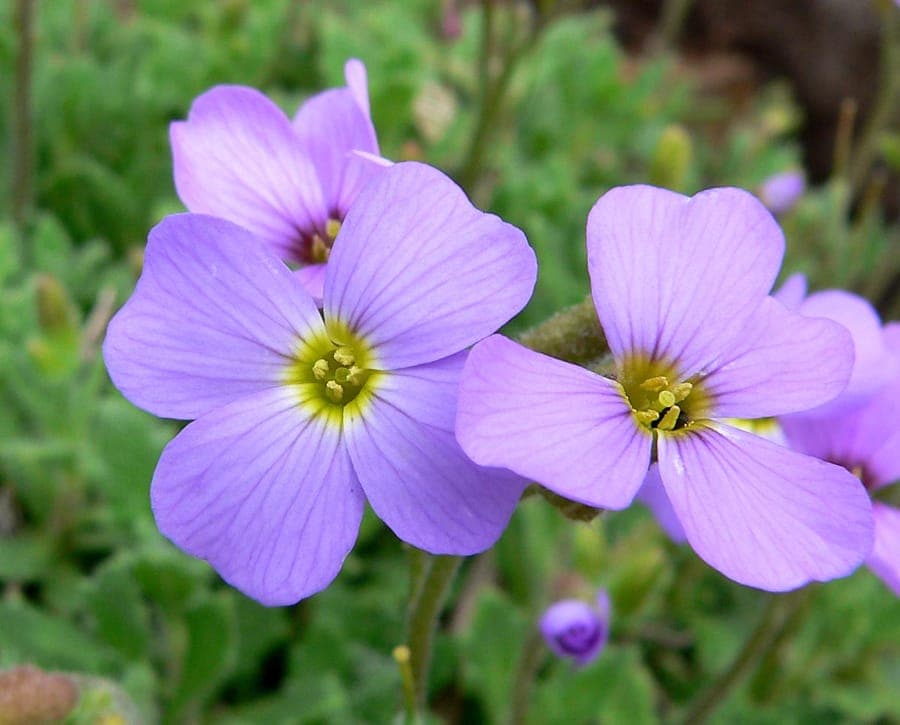
Stan Shebs / CC BY-SA 3.0, via Wikimedia Commons
Aubretia: complete guide
Aubrieta deltoidea
Want to see Aubretia: complete guide in your garden?
1 minute, no credit card
Overview
Aubrieta deltoidea, commonly known as Aubretia, is a charming, creeping perennial that brings a burst of colour to gardens every spring. Native to rocky slopes in Greece, Crete, Turkey, and parts of Sicily, this hardy little plant thrives in crevices, walls, and rock gardens. It's a staple in cottage-style landscapes and works beautifully as a ground cover where grass won't grow. With its mat-forming habit and vibrant blooms, it's no surprise gardeners keep coming back to it. On gardenworld.app, you can design a planting scheme that highlights Aubretia's cascading effect along pathways or stone borders.
Belonging to the Brassicaceae family, Aubretia shares lineage with cabbages and mustards, though it's grown purely for ornament. It typically reaches 10–15 cm in height but spreads up to 40 cm wide, making it ideal for filling gaps. The bloom period runs from April to June, depending on climate, and in milder zones, a second flush may appear in early autumn.
Appearance & bloom cycle
Aubretia forms a dense carpet of small, dark green, triangular leaves - the 'deltoidea' in its name refers to this delta-like shape. In spring, the foliage disappears under a blanket of tiny, four-petaled flowers in shades of violet, pink, magenta, and occasionally white. Each flower is about 1 cm across, but they appear in such numbers that the plant looks like a solid sheet of colour.
Flowering lasts 4 to 6 weeks. Deadheading isn't essential, but a light trim right after blooming encourages bushier growth and reduces self-seeding. If left unchecked, it can spread into nearby cracks or between pavers, which is charming in a wild garden but might need managing in formal ones.
Ideal location
Aubretia thrives in full sun to light shade, scoring a 7 out of 10 on the light scale. At least 6 hours of direct sun ensures the best bloom display. It's perfect for south-facing rockeries, dry stone walls, or between stepping stones. Avoid dense shade or areas with heavy overhanging foliage, as this reduces flowering and encourages leggy growth.
In hotter climates (USDA zones 7–8), afternoon shade helps prevent stress during summer. Good air circulation is key - it keeps foliage dry and minimises fungal issues. Use gardenworld.app to map sun patterns in your garden and find the optimal spot for your Aubretia.
Soil requirements
This plant prefers neutral to slightly alkaline soil with a pH between 7.0 and 7.5. It needs excellent drainage - sandy or gravelly soils are ideal. Heavy clay must be amended with grit or coarse sand to prevent waterlogging, which quickly leads to root rot.
Avoid rich, nitrogen-heavy composts. Aubretia blooms better on lean soils. A top dressing of gravel not only improves drainage but also gives a tidy, natural look and suppresses weeds.
Free design
Want to see Aubretia: complete guide in your garden? Make a free design now.
Watering
Once established, Aubretia is moderately drought-tolerant. Young plants need consistent moisture for the first growing season. Water weekly during dry springs or early summers, aiming at the base to keep leaves dry.
Overwatering is a common mistake. Let the soil dry slightly between waterings. In winter, rainfall is usually sufficient unless conditions are unusually dry.
Pruning
After flowering, give Aubretia a light trim - cut back by about 5 cm. This prevents the stems from becoming woody and keeps the plant compact. Shears or hand pruning works fine. Avoid cutting into old, bare wood; it rarely regenerates.
If the plant starts to look tired in late summer, a second light trim in August helps maintain shape and may encourage fresh foliage.
Maintenance calendar
- January: Check for winter damage. No action needed.
- February: Remove any dead foliage. Prepare for new growth.
- March: Light feeding with low-nitrogen fertiliser. Watch for slugs.
- April: Bloom begins. Water during dry spells.
- May: Peak flowering. Trim lightly after bloom.
- June: Remove seed pods to limit spreading.
- July: Monitor for drought stress. Water if needed.
- August: Optional second trim for neatness.
- September: Possible late bloom. Stop feeding.
- October: Apply gravel mulch to protect crowns.
- November: No care required. Plant enters dormancy.
- December: Protect young plants with spruce boughs in harsh winters.
Winter hardiness
Aubretia is hardy in USDA zones 5 to 8, tolerating temperatures down to -20°C when well-drained. Poor winter survival usually stems from wet soil, not cold. In areas with heavy winter rain, elevate the planting site or add drainage layers.
In the UK and northern Europe, it's generally evergreen but may suffer in prolonged wet freezes. Gravel mulch around the base helps shed moisture and prevents rot.
Companion plants
Pair Aubretia with other sun-loving, low-growers like creeping thyme, sedum, dianthus, or Arabis. It contrasts beautifully with silver-foliaged plants such as Lamb's ear or woolly yarrow. Avoid aggressive spreaders like mint or ivy that can overwhelm it.
It also works well with spring bulbs - plant tulips or grape hyacinths behind it for layered colour.
Closing
Aubretia deltoidea is a reliable, low-effort perennial that delivers high visual impact. It's perfect for softening hardscapes, adding early colour, and filling awkward spaces. Just give it sun, sharp drainage, and a quick trim after blooming, and it'll return year after year.
You can find healthy Aubretia plants at garden centres across the UK and US. Look for compact, bushy specimens without yellowing leaves. With proper placement and care, it becomes a dependable feature in any garden. Plan your layout on gardenworld.app to visualise how Aubretia fits into your overall design.
Want to see Aubretia: complete guide in your garden? Make a free design now.
Upload a photo, pick a style, and get a photorealistic design with plant list in under a minute.
No credit card required


Similar plants
Brassica cretica: complete guide
Brassica cretica
Brassica cretica, the Cretan cabbage, grows wild on Aegean cliffs. Discover how to grow this drought-tolerant, yellow-flowered Mediterranean perennial.
Corsican cabbage: complete guide
Brassica insularis
Corsican cabbage is a rare Mediterranean rock cabbage with white flowers and blue-green leaves. Location, soil and winter protection.
Prostrate cabbage: complete guide
Brassica procumbens
Prostrate cabbage is a creeping North African cliff plant with yellow flowers. Discover location, soil type and winter protection.