
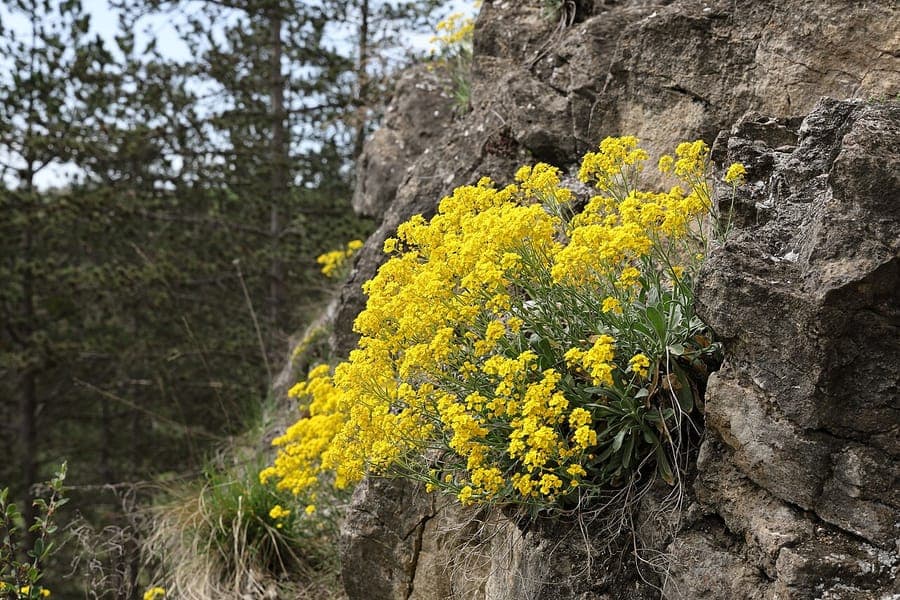
T. Kebert / CC BY-SA 4.0, via Wikimedia Commons
Basket-of-gold: complete guide
Aurinia saxatilis
Want to see Basket-of-gold: complete guide in your garden?
1 minute, no credit card
Overview
Basket-of-gold (Aurinia saxatilis) is a tough, low-growing perennial that lights up the garden in early spring with a carpet of golden-yellow flowers. Native to rocky slopes in central and southern Europe-countries like Austria, Greece, and Italy-it's naturally adapted to dry, well-drained soils and full sun. Reaching just 15–25 cm in height, it spreads 30–45 cm wide, forming dense, cushion-like mounds that bloom heavily from March through May.
This plant is a go-to for gardeners who want bold color with minimal effort. It's drought-tolerant, deer-resistant, and rarely troubled by pests or disease. Whether you're designing a rock garden, planting a dry slope, or edging a sunny path, Basket-of-gold delivers. On gardenworld.app, you can create a custom planting plan that positions this plant where it'll thrive and shine.
Appearance & bloom cycle
Basket-of-gold has narrow, grey-green leaves covered in a fine waxy bloom, helping it retain moisture. In early spring, the entire plant disappears under a blanket of small, four-petaled yellow flowers, each about 1 cm across. The bloom period typically lasts 6–8 weeks, starting in late March in milder zones and extending into May.
After flowering, seed pods form and gradually dry. While the plant remains evergreen in most climates, its visual appeal drops in summer. That's why pruning after bloom is so important-it keeps the plant compact and prevents it from becoming leggy. If left unchecked, it may self-seed, which can be useful for filling gaps but may require thinning in tidy gardens.
Ideal location
Full sun is non-negotiable. Basket-of-gold needs at least 6–8 hours of direct sunlight daily. It performs best on south- or west-facing slopes, rock walls, or raised beds where drainage is fast and reliable. Partial shade leads to weaker growth, fewer flowers, and increased risk of fungal issues.
It's excellent for dry areas under trees or along paved paths where moisture is limited. Also works well in containers on sunny patios. If you're sketching out a new garden layout, gardenworld.app lets you simulate sun exposure and place Basket-of-gold exactly where light and soil conditions align.
Soil requirements
Well-drained soil is essential. This plant hates wet feet. Sandy, gravelly, or loamy soils are ideal. It tolerates poor soils and even chalky or alkaline conditions (pH 6.0–7.5). Avoid heavy clay or rich, organic mixes-these retain too much moisture and encourage root rot. If your soil is dense, amend it with grit or coarse sand to improve drainage.
Don't fertilize heavily. Too much nitrogen leads to floppy growth and fewer blooms. A light top-dressing of compost every few years is plenty.
Free design
Want to see Basket-of-gold: complete guide in your garden? Make a free design now.
Watering
Once established, Basket-of-gold is extremely drought-tolerant. During its first growing season, water weekly if rainfall is less than 2.5 cm. Give about 5–10 litres per square metre. After that, it rarely needs supplemental watering unless faced with prolonged drought.
Overwatering is the biggest threat. Standing water, especially in winter, will kill the plant. Water only at the base and avoid wetting the foliage to reduce fungal risk.
Pruning
Prune hard right after flowering-usually in late May or early June. Cut the plant back by two-thirds, leaving 5–8 cm of growth above the crown. This keeps it tight and bushy and prevents it from splitting apart in the centre. Use clean shears to avoid spreading disease.
If the plant starts to look tired in summer, a light trim can refresh it. Avoid pruning in autumn or winter, as this removes protective growth and exposes the crown to moisture.
Maintenance calendar
- Jan–Feb: Check for frost heave or waterlogged crowns. Keep area clear of debris.
- Mar–May: Peak bloom. No feeding required.
- Jun: Prune after flowering. Remove any dead or damaged stems.
- Jul–Aug: Minimal care. Watch for powdery mildew in humid summers.
- Sep: Transplant any self-sown seedlings if desired.
- Oct–Dec: Clear fallen leaves. Do not mulch heavily-keep crown dry.
Winter hardiness
Basket-of-gold is hardy in USDA zones 4–8. It withstands temperatures down to -20°C without issue. In colder zones, a light mulch of gravel can help protect the crown from freeze-thaw cycles. In wet winters, ensure the planting site stays dry-this is more critical than cold tolerance.
Avoid organic mulches like bark or leaves, which trap moisture. Stick to inorganic options like crushed rock or gravel around the base.
Companion plants
Pair Basket-of-gold with other sun-loving, drought-tolerant plants: Creeping phlox, Sedum, Lavender, or Catmint. The contrast between golden flowers and silver foliage (like Artemisia) is especially striking. Avoid moisture-loving plants like Astilbe or Ferns, which need different conditions.
Use gardenworld.app to mix and match companion plants in a virtual garden, previewing color and texture combinations before planting.
Closing
Basket-of-gold is a reliable, radiant performer in the spring garden. It asks for little-just sun, sharp drainage, and a quick trim after blooming-and gives back with weeks of vibrant color. Whether you're filling a rockery or edging a sunny border, it's a standout choice. Pick up healthy plants from trusted garden centres, give them the right spot, and enjoy a plant that keeps on delivering year after year.
Want to see Basket-of-gold: complete guide in your garden? Make a free design now.
Upload a photo, pick a style, and get a photorealistic design with plant list in under a minute.
No credit card required


Similar plants
Brassica cretica: complete guide
Brassica cretica
Brassica cretica, the Cretan cabbage, grows wild on Aegean cliffs. Discover how to grow this drought-tolerant, yellow-flowered Mediterranean perennial.
Corsican cabbage: complete guide
Brassica insularis
Corsican cabbage is a rare Mediterranean rock cabbage with white flowers and blue-green leaves. Location, soil and winter protection.
Prostrate cabbage: complete guide
Brassica procumbens
Prostrate cabbage is a creeping North African cliff plant with yellow flowers. Discover location, soil type and winter protection.