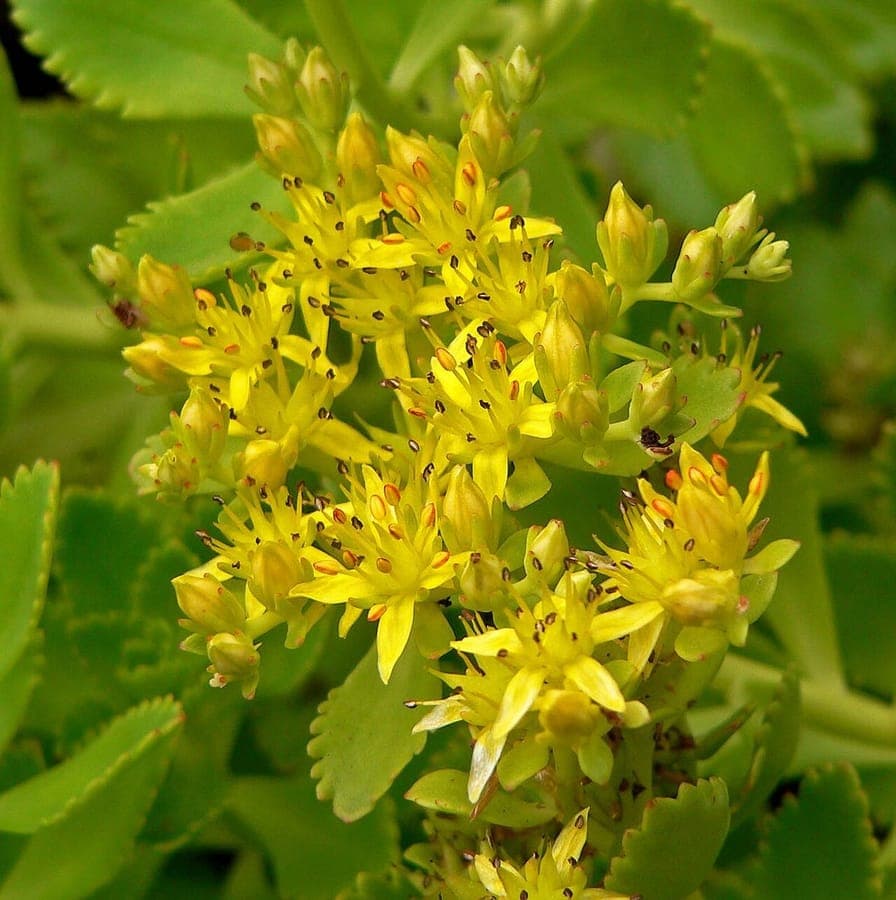
Stan Shebs / CC BY-SA 3.0, via Wikimedia Commons
Phedimus takesimensis: complete guide
Phedimus takesimensis
Want to see Phedimus takesimensis: complete guide in your garden?
Full design in HD: €7.99
Look after your Phedimus takesimensis with the GardenWorld app
Identify plants with your camera and get a care calendar with reminders for this plant.


Overview
Phedimus takesimensis is a tough, low-growing stonecrop that grows wild on Ulleungdo, a volcanic island off the east coast of Korea. Its species name refers to Takeshima, an old Japanese name for that island. Nurseries often still sell it as Sedum takesimense, the name it carried for many years before botanists moved the group around the Kamchatka stonecrop into the genus Phedimus. You may therefore see either name on the label; both refer to the same plant.
What makes it so useful in the garden is the pairing of fresh, almost glossy green foliage with a long and generous summer display of bright yellow flowers. It stays low, usually 15 to 25 cm, and creeps slowly outwards on short, woody rhizomes to form a dense mat 40 to 60 cm across. That makes it a dependable groundcover for dry, sunny spots where lawn and many perennials struggle.
Two cultivars dominate garden centres. 'Golden Carpet' (sometimes 'Gold Carpet') is a green-leaved form that flowers so freely the whole plant turns yellow in July. 'Atlantis' arose as a bud sport of 'Golden Carpet' and has leaves with a green centre and a broad creamy-yellow margin. It was named Chelsea Plant of the Year in 2019, which brought the species to the attention of gardeners right across Europe. If you would like to see how it fits into a wider scheme of paths, gravel and borders, you can have a garden design made on gardenworld.app that takes sun, soil and levels into account.
Appearance and bloom cycle
The leaves are fleshy without being thick, spoon- to paddle-shaped, 2 to 4 cm long and clearly scalloped towards the tip. They are a bright, light green, sometimes edged with red in full sun. Stems start upright and later arch a little under the weight of the flowers, giving the plant a cushion-like outline.
Flowering usually starts in June and continues into August, with a smaller second flush after a warm summer. Each flower is a star about 1.5 cm wide, with five pointed yellow petals and prominent stamens tipped with orange to brown anthers. They are carried in flat to slightly domed clusters just above the foliage. Bees, bumblebees and hoverflies visit constantly, which brings a hot, dry corner of the garden to life.
After flowering, small star-shaped seed heads develop and fade to rusty red and brown. Many gardeners leave them in place for their autumn interest. In winter the upper stems die back in part, but small pink to red buds and tiny rosettes remain visible at the base. In mild winters the plant can stay largely green. Compared with related stonecrops, Phedimus takesimensis feels a little sturdier and fuller, with broader leaves and a denser habit.
Ideal location
Give it full sun or at most light shade. The more sun it gets, the more compact the growth and the heavier the flowering. In too much shade the stems stretch, the clump flops open and flowering is sparse. Six hours or more of direct sun a day suits it best.
It works well along the edge of a gravel garden, in a rockery, at the front of a sunny border, between large stepping stones or along the top of a dry-stone wall. It also does well on a green roof with a substrate depth of at least 8 to 10 cm. In a wide bowl or trough on the patio it is a rewarding plant that needs very little attention. For a closed carpet, plant about 30 cm apart, or five to seven plants per square metre.
Soil requirements
Drainage matters more than anything else. Phedimus takesimensis copes with poor, sandy, gravelly and chalky ground, and also grows in ordinary garden soil as long as water does not sit around its roots in winter. On heavy clay, mix coarse sand, grit or lava gravel into the top 20 cm when planting. A slightly raised planting spot helps as well.
Soil pH is not critical; anything from slightly acidic to slightly alkaline is fine. Feeding is rarely needed. Too much fertiliser, especially nitrogen, produces soft, floppy growth and stems that collapse after flowering. At most, work a little compost into the soil at planting time and leave it at that. In containers, use ordinary potting compost mixed with a third to a half of coarse grit.
Free preview
Want to see Phedimus takesimensis: complete guide in your garden? Make a free preview of your design.
Watering
Once through its first growing season, this plant looks after itself. The fleshy leaves store water, so it rides out dry summers with ease. In the first few weeks after planting, water regularly, roughly one good soaking a week, so the roots can establish.
After that, only water during long dry spells of more than three or four weeks, and then give one thorough soak rather than frequent sprinkles. Pots and troughs dry out faster; check them every few days in summer and let the compost dry out between waterings. If a pot stands in a saucer, tip away any excess water. Wet roots in winter are the biggest threat to this stonecrop.
Pruning
Phedimus takesimensis needs very little pruning. You can snip off the faded flower clusters after flowering if you prefer a tidy look, but they can equally stay until spring, as the dried seed heads add texture in autumn.
In March, once the new buds at the base are visible, cut the old stems back to just above them. This makes room for fresh growth. If a mat becomes bare in the middle after several years, lift it in spring, divide it and replant the young outer pieces. Cuttings are just as easy: a 5 to 8 cm piece of stem roots in damp sand within a few weeks.
On the variegated 'Atlantis', an all-green shoot appears now and then. Cut it out at the base, otherwise the more vigorous green growth will gradually take over.
Maintenance calendar
March-April: Cut old stems back to above the new buds. Divide or move plants if needed. A good time to plant.
May: Growth is in full swing. Watch for slugs and snails, which enjoy the young leaves, and weed between young plants.
June-August: Main flowering period. Water only during long droughts. Take cuttings from non-flowering shoots if you want more plants.
September-October: Leave the faded flower heads or trim them off. Planting in open ground is still possible until mid October.
November-February: Dormant season. Move pots against a wall or under cover so they do not sit in wet compost.
To keep track of these jobs, the plant calendar on gardenworld.app shows month by month what your garden needs.
Winter hardiness
This species is very hardy and tolerates temperatures down to roughly -25 °C in free-draining soil. In Britain and the Low Countries it overwinters without any protection. The top growth may be cut back by frost, but the plant reshoots from the base in spring.
As with lavender, wet is more dangerous than cold. Rhizomes sitting in cold, waterlogged clay for months can rot. In pots the root ball freezes through more quickly; a frost-proof container with a good drainage hole, raised on pot feet, prevents most problems.
Toxicity and animals
Phedimus takesimensis is not regarded as poisonous to people, dogs or cats, and no serious poisonings are on record. The leaves are not meant to be eaten, of course, and large amounts may cause a mild stomach upset in pets. Rabbits usually leave it alone; slugs, unfortunately, do not always.
Companion plants
In a dry, sunny border this stonecrop makes a lovely low foreground layer. Place it in front of taller succulents such as Hylotelephium spectabile, which flowers pink later in the season and so extends the display. Blue fescue (Festuca glauca) gives a cool contrast to the bright yellow flower heads.
Between stepping stones, combine it with creeping thyme (Thymus serpyllum) and thrift (Armeria maritima). In a trough or on a wall, houseleeks (Sempervivum tectorum) and small alliums are good partners. In a modern gravel garden, repeating 'Atlantis' among ornamental grasses and lavender works particularly well, because the variegated foliage lightens the planting even outside the flowering season. Avoid aggressive groundcovers, which will smother this stonecrop within a few years.
Final thoughts
Phedimus takesimensis is the stonecrop for anyone after a low, reliable plant that flowers year after year with very little fuss. Sun, free-draining soil and a single trim in spring are all it asks for. In return you get a fresh green or variegated carpet that overflows with yellow stars in summer and draws in insects.
Choose 'Golden Carpet' for the most flowers and 'Atlantis' if the foliage should steal the show outside the flowering season too. Plant in small groups, let them get on with it for a few years, and you will have a patch of garden that largely looks after itself, even in the drier summers that are becoming more common.
Frequently asked questions about Phedimus takesimensis
Is Phedimus takesimensis winter hardy?
This species is very hardy and tolerates temperatures down to roughly -25 °C in free-draining soil. In Britain and the Low Countries it overwinters without any protection.
When and how do you prune Phedimus takesimensis?
Phedimus takesimensis needs very little pruning. You can snip off the faded flower clusters after flowering if you prefer a tidy look, but they can equally stay until spring, as the dried seed heads add texture in autumn.
How much water does Phedimus takesimensis need?
Once through its first growing season, this plant looks after itself. The fleshy leaves store water, so it rides out dry summers with ease.
Where does Phedimus takesimensis grow best?
Give it full sun or at most light shade. The more sun it gets, the more compact the growth and the heavier the flowering.
What soil does Phedimus takesimensis need?
Drainage matters more than anything else. Phedimus takesimensis copes with poor, sandy, gravelly and chalky ground, and also grows in ordinary garden soil as long as water does not sit around its roots in winter.

See it in your garden
See Phedimus takesimensis in your garden
One photo of your garden and a few questions. You see the result in about a minute.
Try it with a photoIdentify this plant in your own garden. Identify a plant
Similar plants
Showy stonecrop: complete guide
Hylotelephium spectabile
Everything about Showy stonecrop (Hylotelephium spectabile): flowering, cultivation and care. Tips for successful frost resistance, drought tolerance and maintenance in borders and containers.
Blue fescue: complete guide
Festuca glauca
Festuca glauca, or blue fescue, is a low-maintenance ornamental grass with silvery-blue foliage. Perfect for sunny, dry borders and rock gardens.
Breckland thyme: complete guide
Thymus serpyllum
Discover Breckland thyme - a creeping herb with purple flowers, aromatic foliage, and winter hardiness. Ideal for borders, garden edges, and stone gardens.
