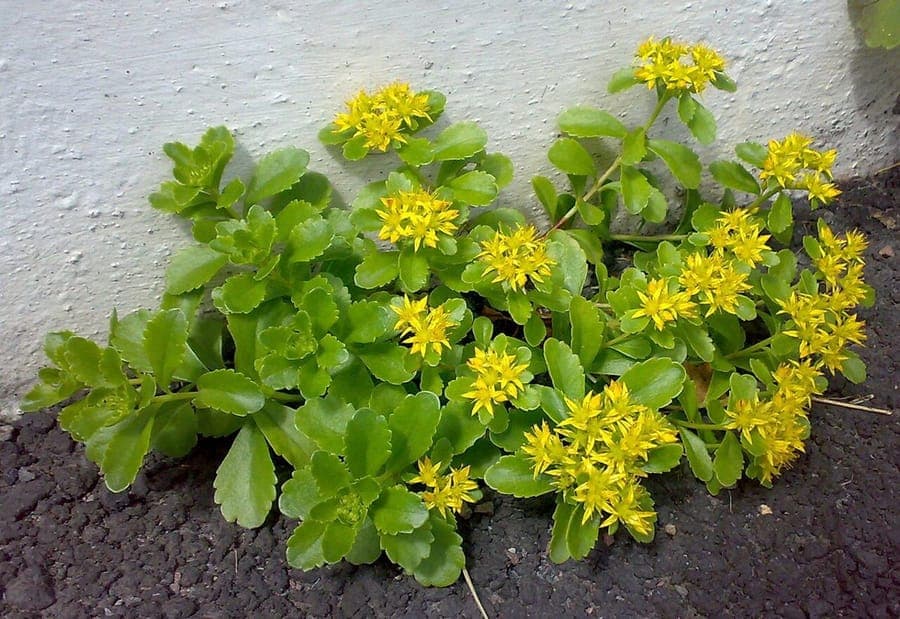
Bjoertvedt / CC BY-SA 3.0, via Wikimedia Commons
Kamchatka stonecrop (Phedimus kamtschaticus): complete guide
Phedimus kamtschaticus
Want to see Kamchatka stonecrop (Phedimus kamtschaticus): complete guide in your garden?
Full design in HD: €7.99
Look after your Kamchatka stonecrop with the GardenWorld app
Identify plants with your camera and get a care calendar with reminders for this plant.


Overview
Kamchatka stonecrop (Phedimus kamtschaticus) is one of the toughest succulents you can plant in a European garden. It grows wild in the Russian Far East, where the Kamchatka peninsula gave it its name, and further south in north-east China, Korea and Japan. A plant from that part of the world is hardly going to be troubled by a British or Belgian winter.
For many years it was known as Sedum kamtschaticum, and that is still the name on many labels and in green-roof catalogues. Botanists have since moved it to the genus Phedimus, alongside relatives such as Phedimus spurius. In the nursery trade it is also sold as orange stonecrop, a nod to the warm tint in its flowers.
What sets it apart from most other stonecrops is its seasonal rhythm. In winter it retreats completely to a cluster of reddish buds at ground level. In April fresh green, toothed leaves push up, and by midsummer the plant is covered in golden to orange-yellow stars. It is a staple of extensive green roofs, yet just as useful at the front of a sunny border. Not sure where it would fit in your plot? On gardenworld.app you can have a garden design created that puts tough groundcovers like this exactly where they will thrive.
Appearance and bloom cycle
Kamchatka stonecrop forms a loose clump 10 to 20 cm tall and 30 to 40 cm wide. The stems first lean outwards and then curve upwards from a woody rootstock. Unlike the needle-leaved stonecrops, its leaves are flat, spoon-shaped to obovate, 2 to 4 cm long and clearly toothed in the upper half. They are glossy mid-green and fleshy, though much thinner than those of houseleeks or reflexed stonecrop.
Flowering begins in June and carries on into August. At the end of each stem a flat, branched head appears, packed with star-shaped flowers just over 1 cm across, each with five pointed petals. The colour is golden yellow, often with an orange glow in the centre. Bees, bumblebees and small butterflies love them. After flowering, the star-shaped seed pods turn orange-red to rusty brown. These are decorative in their own right and stand well into autumn.
The best-known cultivar is 'Variegatum', with cream to white-edged leaves and more orange flowers. 'Weihenstephaner Gold', which flowers very generously in golden yellow, is also commonly sold under this species, although some botanists place it with the closely related Phedimus floriferus.
Ideal location
A sunny spot gives the most flowers and the sturdiest growth. Unlike many stonecrops, this species copes reasonably well with light partial shade, for example a bed that gets morning sun and afternoon shade. Flowering is a little less generous there, and the stems grow slightly longer.
Use it as groundcover on a sunny bank, at the front of a border, along a path, in a rock garden or in a gravel garden. On green roofs it is a real workhorse: it knits together quickly, tolerates rooftop heat and reliably returns every spring. Because it disappears above ground in winter, it is less suitable if you want a green carpet all year. In that case, mix it with evergreen stonecrops.
It also does well in pots and troughs, provided water can drain away freely.
Soil requirements
Kamchatka stonecrop is a little less fussy than true alpine plants. Ordinary, well-drained garden soil is fine, as are sandy, gritty and chalky soils. A moderately fertile soil gives fresher growth than very poor sand, but too much feeding makes the stems floppy.
On heavy clay, improve the soil with coarse sand or grit, or plant on a slightly raised bed. The rootstock does not like sitting in water over winter. On a green roof, a substrate layer of 6 to 10 cm is sufficient.
Free preview
Want to see Kamchatka stonecrop (Phedimus kamtschaticus): complete guide in your garden? Make a free preview of your design.
Watering
After planting, water during dry spells for a few weeks until the plant has settled in. After that it is extremely drought tolerant. During long heatwaves the leaves may take on a reddish tinge and growth may pause, but this is a healthy response. Only in pots or on a thin green roof, after weeks without rain, is an extra drink worthwhile.
In winter the plant is dormant and needs no water at all. Stand pots against a sheltered wall or under the eaves.
Pruning
Pruning is straightforward. In autumn the stems die back and turn brown. You can leave them standing, as the seed heads look attractive and give shelter to small insects. Cut them down to just above ground level in February or early March, before the new buds start to grow. Take care not to damage the red buds at the base.
If you would like a second, smaller flush of flowers, cut off the faded heads at the end of July. Propagation is easy: divide the clump in March or April, or take 5 cm cuttings in summer, which root quickly in damp sand. Seed can be sown in spring too, although seedlings of named cultivars may not come true.
Kamchatka stonecrop is not known to be poisonous to people or pets. Even so, it is sensible not to let children or animals graze on it, as succulents eaten in quantity can irritate the stomach. Slugs sometimes nibble the young shoots in spring.
Maintenance calendar
February and early March: Cut back last year's dead stems. Check that the red buds at the base look healthy.
March and April: New growth appears. An ideal time to plant or divide. Keep an eye out for slugs on the young shoots.
May: The clumps fill out. Weed between young plants while the ground is still visible.
June to August: Flowering season. Deadhead for a second flush if you like, or leave the heads for their seed pods.
September and October: The seed pods turn rusty brown. Planting is still possible until mid-October.
November to January: Dormancy. The plant has vanished or stands as brown stems. Mark its position so you do not dig into it by accident.
Winter hardiness
Its origins say it all: Kamchatka stonecrop tolerates frost down to around -35 °C. In the British Isles and the Low Countries it is fully hardy, even in severe winters and even in containers. Because it retreats to its rootstock in winter, ice and cold winds do it no harm.
The only real danger is wet, compacted soil in which the rootstock may rot. In a free-draining spot it comes back faithfully year after year.
Companion plants
Because Kamchatka stonecrop vanishes in winter, it makes a clever partner for early bulbs. Crocuses such as Crocus tommasinianus and grape hyacinths (Muscari armeniacum) flower on the bare ground in February and March and are then neatly hidden by the new stonecrop foliage. An evergreen stonecrop such as white stonecrop (Sedum album) keeps the area green in the meantime.
In summer it looks lovely with maiden pink (Dianthus deltoides) and its small pink stars, and with wild marjoram (Origanum vulgare), which flowers purple later in the season and draws in bees just as well. On a green roof, combine it with other stonecrops and low herbs for a display that runs from May to September.
Final thoughts
Phedimus kamtschaticus, formerly Sedum kamtschaticum, is a near-indestructible succulent that glows gold in summer and waits quietly underground in winter. It shrugs off drought, heat and hard frost, and asks only for a spot where water does not linger.
Want to know when to cut back, divide or add a few bulbs? The planting calendar on gardenworld.app sets out the jobs for you, month by month.
Frequently asked questions about Kamchatka stonecrop
Is Kamchatka stonecrop winter hardy?
Its origins say it all: Kamchatka stonecrop tolerates frost down to around -35 °C. In the British Isles and the Low Countries it is fully hardy, even in severe winters and even in containers.
When and how do you prune Kamchatka stonecrop?
Pruning is straightforward. In autumn the stems die back and turn brown.
How much water does Kamchatka stonecrop need?
After planting, water during dry spells for a few weeks until the plant has settled in. After that it is extremely drought tolerant.
Where does Kamchatka stonecrop grow best?
A sunny spot gives the most flowers and the sturdiest growth. Unlike many stonecrops, this species copes reasonably well with light partial shade, for example a bed that gets morning sun and afternoon shade.
What soil does Kamchatka stonecrop need?
Kamchatka stonecrop is a little less fussy than true alpine plants. Ordinary, well-drained garden soil is fine, as are sandy, gritty and chalky soils.

See it in your garden
See Kamchatka stonecrop in your garden
One photo of your garden and a few questions. You see the result in about a minute.
Try it with a photoIdentify this plant in your own garden. Identify a plant
Similar plants
White stonecrop: complete guide
Sedum album
Discover everything about White stonecrop: sun needs, watering, bloom season, and where to plant. Ideal for dry gardens and rock walls.
Early crocus: complete guide
Crocus tommasinianus
Crocus tommasinianus blooms early in spring and naturalizes easily. Learn how to plant, care for and combine this hardy, low-maintenance bulb.
Common grape-hyacinth: complete guide
Muscari armeniacum
Muscari armeniacum blooms in early spring with dense clusters of blue, grape-like flowers. Hardy, low-maintenance, and bee-friendly, it's perfect for borders, lawns, and naturalized plantings.
