
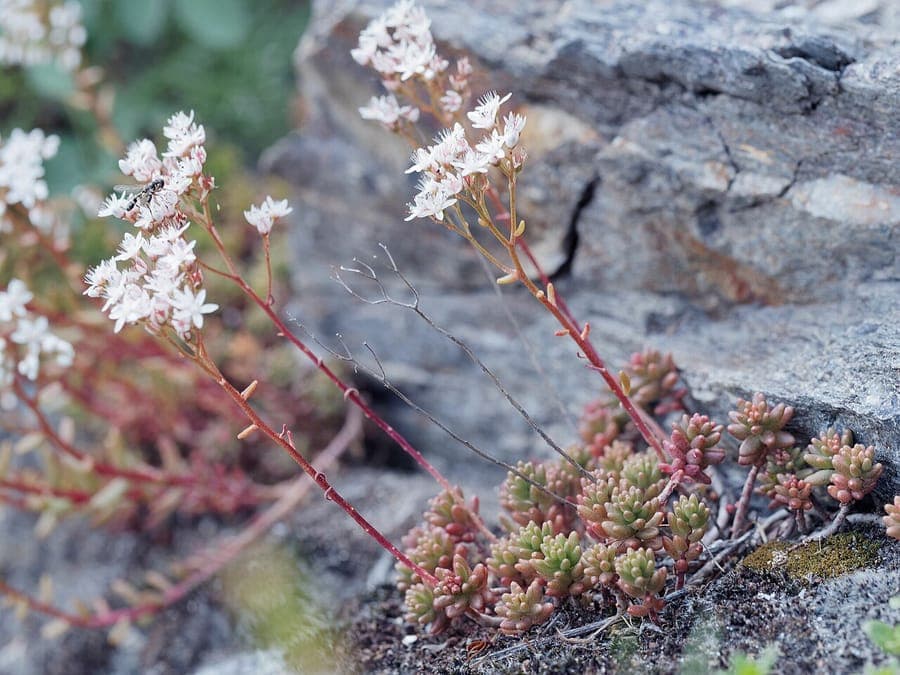
(c) Thierry Arbault, some rights reserved (CC BY) / CC BY 4.0, via Wikimedia Commons
White stonecrop: complete guide
Sedum album
Want to see White stonecrop: complete guide in your garden?
1 minute, no credit card
Overview
Sedum album, commonly known as White stonecrop, is a tough, low-growing succulent that thrives in tough conditions. Native to regions like Albania, Denmark, and Finland, this hardy plant has adapted to poor soils, intense sun, and dry spells. It's a favourite among gardeners looking for a reliable ground cover that doesn't demand constant care. Reaching just 5–10 cm in height but spreading up to 30 cm wide, it's perfect for filling gaps between paving stones, rockeries, or dry slopes. On gardenworld.app you can design a drought-resistant layout that integrates White stonecrop seamlessly into your garden's harshest spots.
The plant forms dense mats over time, suppressing weeds and stabilising soil. It's evergreen in milder climates and semi-evergreen where winters are harsher. Growth starts in early spring and slows down by late autumn. Hardy to USDA zones 5–9, it handles winter lows down to -20°C without protection.
Appearance & bloom cycle
White stonecrop features fleshy, oval leaves that grow in tight clusters along trailing stems. The foliage ranges from bright green to bronze or pinkish in full sun, especially during dry periods. In mid-summer-typically from June through August-it produces flat clusters of small white flowers, often with a pale pink or yellowish tinge. Each flower is about 1 cm across, and the bloom lasts for four to six weeks.
The flowers attract pollinators like bees and hoverflies, making this plant a quiet but valuable contributor to garden biodiversity. After blooming, seed capsules form and release tiny seeds that may germinate nearby if conditions are right. The plant stays compact and tidy all season, rarely needing staking or support.
Ideal location
This succulent loves full sun-rate it a solid 9 out of 10 for light. It performs best in south or southwest-facing areas where it gets at least 6–8 hours of direct sunlight daily. Avoid shady or damp corners; too little light leads to leggy growth and reduced flowering. Ideal spots include rock gardens, stone walls, gravel beds, or between pavers on a patio.
It's particularly useful in areas where other plants struggle, such as under mature trees with dense canopies or on hot, dry banks. If you're unsure whether your garden gets enough sun, check the sunlight analysis tools on gardenworld.app to plan your Sedum album placement wisely.
Free design
Want to see White stonecrop: complete guide in your garden? Make a free design now.
Soil requirements
Sedum album thrives in lean, well-drained soil with a pH between 6.5 and 7.0. Rich, compost-heavy soils encourage floppy growth and increase the risk of root rot. A mix of gritty sand, gravel, and a small amount of loam works best. Avoid adding fertiliser-it's unnecessary and can do more harm than good.
If your garden has heavy clay, raise the bed or build a shallow rock garden with a base layer of crushed stone for drainage. The key is to prevent water from pooling around the roots. Potted plants need a cactus mix and a container with drainage holes.
Watering
Once established, White stonecrop is extremely drought-tolerant. Water only during prolonged dry spells, especially in the first year. Deep, infrequent watering is better than daily sprinkling. Always water at soil level in the morning to prevent fungal issues on wet foliage.
In most UK and US climates, rainfall is sufficient. Overwatering is the most common cause of failure with this plant. When in doubt, wait-succulents like Sedum album prefer to be slightly dry.
Pruning
Pruning isn't usually required. However, in early spring (March–April), you can trim back any dead or straggly growth to encourage fresh, compact foliage. Use clean, sharp snips and cut just above a leaf node. If the plant spreads too far, you can lift and divide it or share cuttings with fellow gardeners.
Avoid pruning in late autumn, as this can leave fresh wounds exposed to winter moisture. Also, don't cut into old woody stems-they rarely re-sprout.
Maintenance calendar
- Jan: Check for winter damage
- Feb: Prepare for new growth
- Mar: Remove old stems
- Apr: Monitor for pests
- May: No action needed
- Jun: Bloom begins
- Jul: Peak flowering
- Aug: Seeds form
- Sep: Watch for fungal signs
- Oct: Final check
- Nov: Leave undisturbed
- Dec: Dormant period
Winter hardiness
Sedum album is reliably hardy in USDA zones 5–9. In colder zones, the top growth may die back, but the roots usually survive and resprout in spring. No winter protection is needed in the ground. For container-grown plants, move pots to a sheltered, dry spot to avoid root saturation during freeze-thaw cycles.
Companion plants
Pair White stonecrop with other drought-tolerant perennials like Thymus, Sedum spectabile, or Echinacea. Its white flowers contrast well with purple or yellow blooms. Avoid moisture-loving plants like hostas or ferns, which create conflicting care needs.
Closing
White stonecrop is a no-fuss, high-impact plant for tough garden spots. It's perfect for beginners and seasoned gardeners alike. Look for it at garden centres like B&Q, Wyevale, or local independents. With gardenworld.app, you can map out spacing and companion planting to maximise visual impact with minimal effort.
Want to see White stonecrop: complete guide in your garden? Make a free design now.
Upload a photo, pick a style, and get a photorealistic design with plant list in under a minute.
No credit card required


Similar plants
Sedum nevadense: complete guide
Sedum nevadense
Discover Sedum nevadense, the stunning alpine stonecrop from the Pyrenees. Expert care tips, growing requirements, and design ideas for rock gardens.
Aizoon stonecrop: complete guide
Phedimus aizoon
Everything about Phedimus aizoon - the frost-tolerant aizoon stonecrop from Siberia with bright yellow flowers. Planting, care and garden use.
Roseroot: complete guide
Rhodiola rosea
Everything about roseroot (Rhodiola rosea): a tough hardy succulent ideal for rock gardens, green roofs, and dry sunny positions.