Uleli / CC BY-SA 3.0, via Wikimedia Commons
Giant fleece flower (Persicaria polymorpha): complete guide
Persicaria polymorpha
Want to see Giant fleece flower (Persicaria polymorpha): complete guide in your garden?
Full design in HD: €7.99
Look after your Giant fleece flower with the GardenWorld app
Identify plants with your camera and get a care calendar with reminders for this plant.


Overview
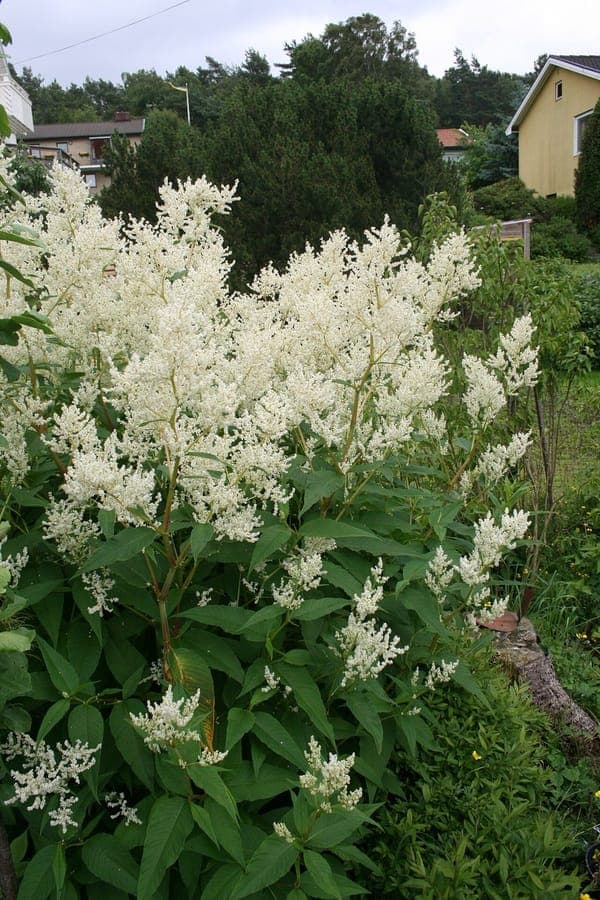
Persicaria polymorpha, often called giant fleece flower or white dragon, is a big, clump-forming perennial that covers itself in large, creamy-white flower plumes in early summer. At 1.5 to 2 metres tall and more than a metre across, it behaves more like a shrub than a typical border plant, yet every winter it dies right back to the ground. In spring it shoots up again in a matter of weeks, and by June there is once more an impressive, billowing mound.
The name is a horticultural one that has been in the trade for decades. Botanists now generally treat the plant as a hybrid between Koenigia alpina and the Asian Koenigia weyrichii, in which case it is known as Koenigia × fennica or Persicaria × fennica. In practice nurseries almost always sell it as Persicaria polymorpha, sometimes as the selection 'Johanniswolke', which holds the RHS Award of Garden Merit.
One point matters a great deal: this knotweed is not a thug. It forms a steady clump and does not send out long underground runners, unlike the notorious Japanese knotweed (Reynoutria japonica), which is controlled as an invasive species across much of Europe and is subject to legal restrictions in Britain. You can plant Persicaria polymorpha in a border with complete confidence. If you would like to see where such a large specimen would look its best, on gardenworld.app you can create a garden design that takes the size and aspect of your plot into account.
Appearance and bloom cycle
The leaves are large, lance-shaped to broadly oval, 15 to 25 cm long and fresh green with a prominent midrib. The sturdy stems are often flushed red and grow strongly upright, so the plant rarely flops and needs no staking. Together they form a dense, bushy clump that already makes a handsome green mass before flowering begins.
Flowering starts in late May or June and continues into August. Branched plumes packed with tiny cream flowers appear at the tops of the stems, each panicle up to 20 cm across. From a distance the plant looks like a white cloud, which explains the German cultivar name 'Johanniswolke', the cloud of St John's Day in late June. As the flowers age they often take on a soft pink or rusty tint, and the faded plumes remain decorative for weeks.
The blooms have a light, sweetish scent and are busy with bees, bumblebees, hoverflies and butterflies. In autumn the foliage turns yellow-brown before the plant retreats underground.
Ideal location
Persicaria polymorpha grows best in full sun to partial shade. In sun it flowers most freely and stays most compact. It also does well in partial shade, but becomes a little looser and produces fewer plumes.
Above all, give it room. Allow at least a square metre and preferably a bit more. It works beautifully as a specimen in a lawn, as a focal point at the back of a deep border, as a summer screen, or to hide a compost bay or seating area from view. In a small garden it can make a surprisingly good single statement plant, provided the rest of the planting stays lower.
A site sheltered from strong wind is a bonus, although the stems are tough enough to cope with an ordinary summer storm.
Soil requirements
This plant likes fertile, humus-rich soil that stays evenly moist. Loam and light clay are ideal. It will grow on sandy soil too, but then you need to dig in plenty of compost at planting time and water more often in summer. Soil pH is not critical; slightly acidic to neutral suits it well, and mildly alkaline ground is tolerated.
When planting, dig a generous hole about 40 cm deep and wide and mix the excavated soil with well-rotted compost. The plant develops a deep, vigorous root system and dislikes being moved once established, so choose its permanent position from the start. A mulch of compost around the base each spring is all the feeding it needs.
Free preview
Want to see Giant fleece flower (Persicaria polymorpha): complete guide in your garden? Make a free preview of your design.
Watering
In its first year the plant needs regular watering, especially during a dry spring. In the summer after planting, give it a full can or a few minutes with the hose each week. Once well rooted, it largely looks after itself in moisture-retentive soil.
During prolonged drought and heat the large leaves soon show when the plant is thirsty: they hang limp and may brown at the edges. Water deeply when that happens, ideally in the morning or evening. A mulch of compost or bark chippings helps keep moisture in the ground.
Pruning
Pruning is simple. In late winter or early spring, cut all the old, withered stems down to just above ground level before the new shoots appear. You can tidy up in autumn if you prefer, but leaving the stems standing gives insects somewhere to shelter over winter.
After the main flush of flowers you can remove the spent plumes if you do not like their look. This tidies the plant and sometimes encourages a small second flush. If you leave them, they turn rusty brown and stay attractive into autumn. Division is rarely needed; do it only in March or April if the clump really has grown too large, using a sharp spade.
Maintenance calendar
- February - March: cut old stems to just above the ground, mulch around the base with compost.
- April: new shoots appear; a good time to plant or, if necessary, divide.
- May: rapid growth; water during dry spells.
- June - August: peak flowering, with bees and butterflies visiting.
- August - September: remove spent plumes if you wish.
- October - November: foliage colours and the plant dies down.
- December - January: dormant season, nothing to do.
To keep track of these jobs month by month, the planting calendar on gardenworld.app reminds you what needs doing and when.
Winter hardiness
Persicaria polymorpha is very hardy and survives frosts well below -20 °C without trouble. Throughout Britain, Ireland and the Low Countries it needs no winter protection. Because the plant dies back completely each year, frost cannot damage the top growth; the buds overwinter safely below ground.
Only in soil that stays wet all winter can the rootstock rot. On heavy, wet clay, improve drainage by working grit or compost into the top layer. A late spring frost can occasionally scorch the young shoots, but the plant simply grows away again afterwards.
Little is known about toxicity. The plant is not listed as poisonous to people or pets, but like many knotweeds it may contain oxalic acid, so discourage children and animals from eating it.
Companion plants
With its size and light, white flowers, this knotweed is an ideal partner for sturdy grasses and colourful summer perennials. It looks superb with Chinese silver grass (Miscanthus sinensis), which takes over in late summer once the knotweed plumes have faded. Feather reed grass (Calamagrostis × acutiflora) adds a crisp vertical contrast with its upright stems.
For colour in front, choose purple coneflower (Echinacea purpurea), which flowers in July and August, or great burnet (Sanguisorba officinalis) with its dark red bobbles. For late summer and autumn, New England asters (Symphyotrichum novae-angliae) bring purple and pink accents. Together they make a border that holds interest from June to October.
Final thoughts
Persicaria polymorpha is one of the finest large perennials for anyone who wants quick volume and a long, white summer display without the commitment of a shrub. It does not spread invasively, needs no staking, is very hardy and asks for little more than fertile, moist soil and one cut-back a year. Give it space, plant it in spring, and you will have a white summer cloud for years to come, lifting the whole garden and drawing in bees from far and wide.
Frequently asked questions about Giant fleece flower
Is Giant fleece flower winter hardy?
Persicaria polymorpha is very hardy and survives frosts well below -20 °C without trouble. Throughout Britain, Ireland and the Low Countries it needs no winter protection.
When and how do you prune Giant fleece flower?
Pruning is simple. In late winter or early spring, cut all the old, withered stems down to just above ground level before the new shoots appear.
How much water does Giant fleece flower need?
In its first year the plant needs regular watering, especially during a dry spring. In the summer after planting, give it a full can or a few minutes with the hose each week.
Where does Giant fleece flower grow best?
Persicaria polymorpha grows best in full sun to partial shade. In sun it flowers most freely and stays most compact.
What soil does Giant fleece flower need?
This plant likes fertile, humus-rich soil that stays evenly moist. Loam and light clay are ideal.

See it in your garden
See Giant fleece flower in your garden
One photo of your garden and a few questions. You see the result in about a minute.
Try it with a photoIdentify this plant in your own garden. Identify a plant
Similar plants
Chinese Silver Grass: complete guide
Miscanthus sinensis
Everything about Chinese Silver Grass (Miscanthus sinensis): planting, cutting back, cultivars and winter silhouette. Expert tips for a spectacular ornamental grass.
Feather reed grass: complete guide
Calamagrostis × acutiflora
Feather reed grass (Calamagrostis × acutiflora 'Karl Foerster'): a bolt-upright, sterile ornamental grass. Position, planting, cutting back in late February and partners.
Purple coneflower: complete guide
Echinacea purpurea
Everything about Purple Coneflower (Echinacea purpurea): planting, care, pruning and combinations. Expert tips for a thriving prairie-style garden.
