en:user:Peon374 / Public domain, via Wikimedia Commons
Vietnamese coriander: complete guide
Persicaria odorata
Want to see Vietnamese coriander: complete guide in your garden?
Full design in HD: €7.99
Look after your Vietnamese coriander with the GardenWorld app
Identify plants with your camera and get a care calendar with reminders for this plant.


Overview
Vietnamese coriander (Persicaria odorata) is a tropical kitchen herb from the knotweed family, Polygonaceae. Across Southeast Asia it grows in almost every home garden and turns up in bunches at every market. In Vietnam it is called rau răm, while in Malaysia and Singapore it is known as daun kesum or laksa leaf. Despite the name, it is not related to true coriander at all. The smell and flavour are similar, though, with an extra hit of lemon and a peppery warmth that lingers on the tongue.
Anyone who has sown ordinary coriander knows the frustration: the first warm spell sends it straight to seed and the leafy harvest is over. Persicaria odorata does not behave like that. It is a perennial that keeps producing fresh shoots all summer, provided it stays warm and moist. That makes it a rewarding herb for a container on the patio or a sunny kitchen windowsill. It is not hardy in north-west Europe, so treat it as a pot plant that spends the winter indoors. On gardenworld.app you can have a garden design made that gives a cluster of herb pots by the kitchen door a permanent spot, so fresh leaves are always within reach.
Appearance and bloom cycle
The plant forms a loose, sprawling to upright clump 30 to 60 cm tall. Its stems are succulent, green to reddish and clearly jointed. Each node carries a thin papery sheath, a hallmark of the knotweed family. Wherever a node touches the soil it roots readily, so the plant slowly creeps outwards across a wide container.
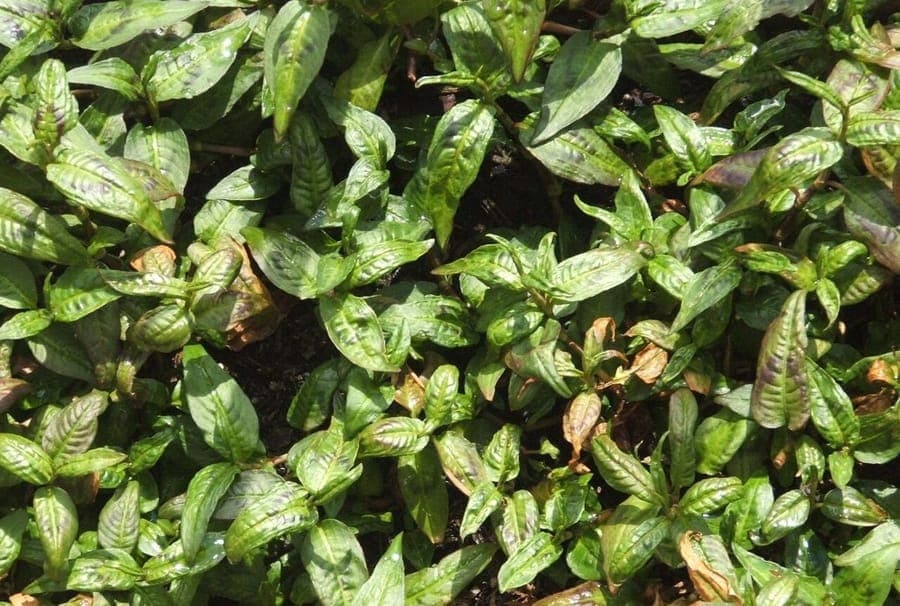
The leaves are lance-shaped, 5 to 10 cm long and tapering to a point, with a glossy upper surface. The giveaway feature is a dark, purplish-brown chevron in the middle of each leaf. In cool weather or bright light the foliage can take on a coppery tint, as you can see in the photo above. Crush a leaf between your fingers and the coriander-like scent is unmistakable.
Flowers are rarely seen in western Europe. In the tropics, small pink to white blooms appear in slender spikes in autumn, but even there the plant is propagated almost entirely from cuttings.
Ideal location
In the wild, Vietnamese coriander grows in warm, damp places, often along ditches and the edges of paddy fields. In summer, give it a bright, sheltered spot with morning sun and light shade through the hottest part of the day. In full afternoon sun the leaves scorch easily, especially if the compost dries out even briefly. An east-facing wall or the dappled light under a pergola is ideal.
Only move the plant outdoors once nights stay above 10 °C, which is usually from mid-May. Indoors it does well on a bright east- or west-facing windowsill. A kitchen with a little extra humidity suits it perfectly. It dislikes cold draughts and the dry air above a radiator, which cause brown leaf edges and can invite red spider mite.
Soil requirements
Choose a humus-rich compost that holds moisture well. Standard multipurpose compost with roughly a fifth of garden compost or leaf mould mixed in works nicely. The plant prefers slightly acidic to neutral conditions, with a pH between 6 and 7. A pot at least 25 cm across gives enough room for a full clump. In a wider, shallower trough the rooting stems can spread more freely.
Planting in open ground is possible, but only for the summer months and only where the soil never dries out. The damp margin of a pond or a bed next to a water butt are good options. Between May and September, feed every two to three weeks with a liquid organic fertiliser such as a seaweed extract. Too much nitrogen makes the growth soft and weakens the aroma.
Watering
Water is the key to success. Persicaria odorata wants soil that is always moist and is perfectly happy with its pot standing in a saucer of water for a while. That is unusual for a herb: most Mediterranean herbs would rot in those conditions. In summer a container plant often needs watering every day. A dry pot is easy to spot by the drooping stems, and the plant usually recovers quickly if you stand it in a bucket of water for fifteen minutes.
In winter, indoors and at lower temperatures, water less. Keep the compost lightly moist, but do not leave it sodden in a cool room. Rainwater or water at room temperature is best.
Free preview
Want to see Vietnamese coriander: complete guide in your garden? Make a free preview of your design.
Pruning
With this herb, pruning and harvesting go together. Pinch out or snip the stem tips regularly, just above a node. Two or three new shoots will break from that point, making the plant bushier and more compact. Left to its own devices, it produces long, bare stems that flop over.
In spring, before moving the plant outside, cut all long and woody stems back to about 10 cm above the compost. The trimmed tips make perfect cuttings: stand them in a glass of water and white roots appear within a week. After a fortnight, pot them up in compost. That way you always have a spare plant in case the parent does not survive the winter.
Harvesting and uses
You can start harvesting as soon as the plant has formed a sturdy clump, usually a few weeks after potting. Pick young, fresh leaves or snip whole shoot tips. Flavour is strongest in young foliage.
Vietnamese coriander is almost always eaten raw or added at the very last moment, because long cooking drives off the aroma. In Vietnamese cooking it goes into chicken or prawn salads, fresh rice-paper rolls and the plate of herbs served alongside noodle soup. In Malaysia and Singapore it is essential in laksa, a spicy noodle soup. It also works well with eggs, cucumber, mango and grilled fish. Use a little less than you would of ordinary coriander, because the taste is stronger.
Fresh leaves keep for a few days wrapped in a damp tea towel in the fridge, or with the stems in a glass of water. Drying is not recommended, as the leaves lose most of their aroma. Freezing them in ice cube trays, or finely chopped in a little oil, works better. There are no reports of toxicity to people or pets with normal culinary use.
Maintenance calendar
March–April: Cut the plant back, repot into fresh compost and root a few cuttings as backups. Keep it indoors in good light for now.
May: Harden the plant off gradually from mid-May, once nights stay above 10 °C. Start in a shady spot.
June–August: Peak growth. Water daily in hot weather, feed every two to three weeks and harvest often.
September: Take more cuttings as insurance. Bring the plant indoors before night temperatures fall below 8 °C.
October–February: Bright position indoors, ideally between 12 and 20 °C. Less water, no feed. Check now and then for spider mite and aphids.
Winter hardiness
Persicaria odorata is not hardy. It cannot tolerate frost and already suffers when temperatures stay below 5 °C for long. In the UK and the Low Countries it has to spend the winter indoors. A bright, cool room, a frost-free conservatory or a kitchen windowsill is enough. In a warm living room it keeps growing, but then it needs plenty of light to avoid becoming leggy.
A handy alternative is to take a few cuttings in September, root them in a glass of water and overwinter only those small plants on the windowsill. The large parent plant can then go on the compost heap. Come spring, you have young, vigorous plants that quickly fill out again.
Companion plants
In a container garden, Vietnamese coriander sits well with other herbs that enjoy warmth and moisture. Lemongrass (Cymbopogon citratus) and basil (Ocimum basilicum) together make a complete Asian herb corner. Ginger (Zingiber officinale) in a large tub alongside rounds off the theme. Spearmint (Mentha spicata) shares its liking for damp soil, but keep them in separate pots: both are vigorous growers that soon crowd each other out.
True coriander (Coriandrum sativum) can be sown in spring and autumn while the weather is cool, and Vietnamese coriander takes over during the hot summer months. Avoid sharing a container with drought-loving herbs such as thyme or rosemary, whose water needs are the exact opposite.
Final thoughts
Persicaria odorata is a herb for anyone who enjoys Asian cooking and wants a plant that gives leaves all summer without bolting. It asks for warmth, plenty of water and a frost-free winter home, and repays you with a steady supply of fragrant foliage. Keep a few cuttings rooting in a glass of water and you will never lose it.
Want to know the best time to take cuttings, repot or bring it indoors? The plant calendar on gardenworld.app lines up those moments for you, so your herb corner stays in good shape all year round.
Frequently asked questions about Vietnamese coriander
Is Vietnamese coriander winter hardy?
Persicaria odorata is not hardy. It cannot tolerate frost and already suffers when temperatures stay below 5 °C for long.
When and how do you prune Vietnamese coriander?
With this herb, pruning and harvesting go together. Pinch out or snip the stem tips regularly, just above a node.
How much water does Vietnamese coriander need?
Water is the key to success. Persicaria odorata wants soil that is always moist and is perfectly happy with its pot standing in a saucer of water for a while.
Where does Vietnamese coriander grow best?
In the wild, Vietnamese coriander grows in warm, damp places, often along ditches and the edges of paddy fields. In summer, give it a bright, sheltered spot with morning sun and light shade through the hottest part of the day.
What soil does Vietnamese coriander need?
Choose a humus-rich compost that holds moisture well. Standard multipurpose compost with roughly a fifth of garden compost or leaf mould mixed in works nicely.

See it in your garden
See Vietnamese coriander in your garden
One photo of your garden and a few questions. You see the result in about a minute.
Try it with a photoIdentify this plant in your own garden. Identify a plant
Similar plants
Lemongrass: complete guide
Cymbopogon Citratus
Everything you need to know about Lemongrass - growing, caring and enjoying this plant in your garden.
Basil: complete guide
Ocimum basilicum
Discover how to grow Ocimum basilicum successfully in your garden or on your balcony. From light needs to harvesting tips, everything you need to know.
Ginger: complete guide
Zingiber officinale
Ginger is a tropical herb with aromatic foliage and underground rhizomes packed with flavor and wellness benefits. Learn how to grow fresh ginger at home.
