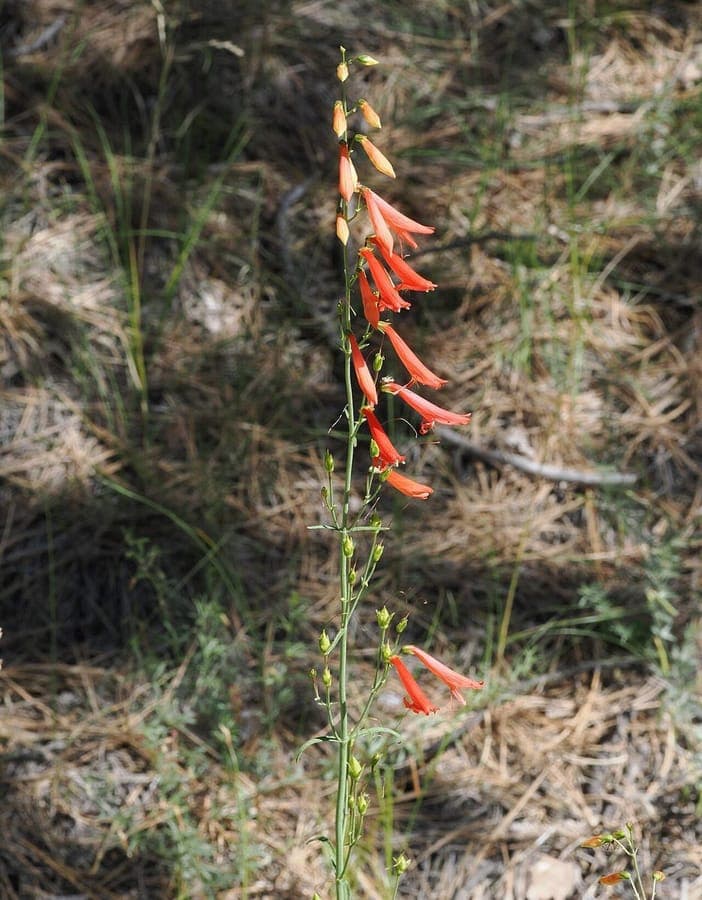
Wendy McCrady https://www.inaturalist.org/people/wendybirds / CC BY 4.0, via Wikimedia Commons
Beardlip penstemon: complete guide to Penstemon barbatus
Penstemon barbatus
Want to see Beardlip penstemon: complete guide to Penstemon barbatus in your garden?
Full design in HD: €7.99
Look after your Beardlip penstemon with the GardenWorld app
Identify plants with your camera and get a care calendar with reminders for this plant.


Overview
Beardlip penstemon (Penstemon barbatus) is a slender, eye-catching perennial with tall stems hung with nodding, scarlet tubular flowers. It blooms in high summer, just when many borders pause for breath, and adds an airy vertical accent among lower plants. It is also known as golden-beard penstemon and, in parts of North America, scarlet bugler.
The species belongs to the family Plantaginaceae and grows wild in the south-western United States and Mexico, across Arizona, New Mexico, Colorado, Utah and Texas. There it grows on dry mountain slopes and in open pine forest, often between 1,200 and 3,000 m. That origin explains why Penstemon barbatus is one of the hardier penstemons: it is used to cold winters, but not to wet ones.
The species name barbatus means bearded and refers to the yellow hairs on the lower lip of the flower. In the garden it belongs in sunny, dry borders, gravel gardens and prairie-style plantings. If you are planning a new border, gardenworld.app can create a garden design for you that gives airy, drought-tolerant perennials like this a natural place beside grasses and other summer flowers.
Appearance and bloom cycle
Penstemon barbatus starts the year as a low rosette of lance-shaped, blue-green leaves, which stay partly green in mild winters. From June, slim upright flower stems rise to 60–120 cm, carrying narrow leaves in opposite pairs. A mature clump spreads to 30–45 cm.
The flowers hang in loose, often one-sided sprays along the upper part of the stems. Each is 2.5–3 cm long, tubular and two-lipped: the upper lip juts forward, while the lower lip curls back and carries a small beard of yellow hairs. The classic colour is scarlet to orange-red, as in the photograph, which shows the plant in its natural habitat among dry pine needles. Garden selections also come in pink, coral, purple and white.
Flowering runs from June to August and can continue into September if you remove spent stems promptly. In the wild, hummingbirds are the main pollinators; in European gardens, bumblebees visit the flowers. Well-known cultivars include 'Coccineus' (scarlet, tall and reliably hardy), 'Jingle Bells' (red, around 60 cm), 'Elfin Pink' (soft pink, compact) and the low-growing Pinacolada Series in several colours.
Ideal location
This penstemon wants full sun. At least six hours of direct sunlight a day keeps the stems sturdy and flowering generous. In partial shade the stems become weak and flop over. A south- or west-facing border, a gravel garden or a sunny bank is ideal.
Choose an open, airy position. Good air movement keeps the foliage dry and helps prevent fungal problems. Wind is rarely an issue, as the stems are thin but wiry. Plant in groups of three to five, spaced 30–40 cm apart, so the red flower sprays seem to hover above the border like a swarm. Because the growth is so see-through, you can place them further forward in a border than their height might suggest.
Soil requirements
Drainage is everything. Penstemon barbatus grows best in poor to moderately fertile, sandy or gravelly soil that never stays wet for long. On heavy clay, dig a generous amount of grit or coarse sand into the top 30 cm, or plant on a raised bed or a slope. If water sits around the crown in winter, the plant will rot.
Neutral to slightly alkaline soil, pH 6.5 to 8, suits it best. Feed little or not at all. In rich soil the plant grows too fast, the stems become floppy and it lives for a shorter time. A thin layer of compost at planting time is plenty. A gravel mulch around the plant keeps the crown dry and suppresses weeds.
Watering
After its first year, Penstemon barbatus is very drought tolerant. In the first season, water thoroughly once a week during dry spells so that the roots grow deep. After that, extra water is only needed during long, hot droughts.
Water at the base of the plant, and water deeply rather than little and often. Too much water, especially in autumn and winter, is a far greater risk than drought. It can also be grown in a container, provided the pot is large, drains well and the compost is allowed to dry out between waterings.
Free preview
Want to see Beardlip penstemon: complete guide to Penstemon barbatus in your garden? Make a free preview of your design.
Pruning
In summer, cut faded flower stems back to just above the basal rosette. A second, smaller flush often follows. If you want the plant to self-seed, leave a few stems until the seed capsules are brown and dry.
Do not cut back to the ground in autumn. The leafy rosette and the lower parts of the stems protect the crown through winter. Wait until April, when you can see new growth, then remove the old stems and any frost-damaged leaves.
Penstemon barbatus is a fairly short-lived perennial that often flowers less after three or four years. Rejuvenate it by dividing in spring or by potting up self-sown seedlings. Cuttings from non-flowering shoots in late summer also root well.
Maintenance calendar
February–March: Sow indoors at 15–20 °C, barely covering the seed. A few weeks in the fridge before sowing sometimes improves germination.
April: Remove old stems and frost-damaged leaves as soon as new growth appears. A good month for planting and dividing.
May: Plant out seedlings after the last frost. Add a layer of gravel around the crown.
June–August: Flowering season. Cut back spent stems and water only during prolonged drought.
September: Take cuttings from non-flowering shoots. Let some seed capsules ripen if you would like self-sown seedlings.
October–March: Leave the rosette undisturbed. Make sure fallen leaves and standing water do not collect on the crown.
The planting calendar on gardenworld.app helps you keep track of these tasks and reminds you when it is time to cut back or divide.
Winter hardiness
Penstemon barbatus is among the hardiest penstemons. In free-draining soil the species tolerates hard frost to around -20 °C and can stay outdoors throughout the UK and the Low Countries. German trials showed that some compact cultivars are less tough: at -16.5 °C, plants of the Twizzle Series and 'Rondo' were lost, while 'Coccineus' came through well. For cold, wet gardens, choose the species or 'Coccineus'.
Wet feet, not cold, are the real threat. A plant in heavy, waterlogged soil often dies in winter even when frosts are mild. In colder areas, a loose covering of dry leaves or conifer branches over the rosette helps.
Penstemon barbatus is not known to be toxic to people or pets. As with any ornamental, it is still best to discourage dogs and cats from chewing it. The species is not invasive in Europe.
Companion plants
The slender red stems of Penstemon barbatus look best among plants with a calmer shape. Balkan clary (Salvia nemorosa), with its violet-blue spikes, makes a strong colour contrast and enjoys the same dry, sunny spot. Yarrow (Achillea millefolium), with flat heads in yellow, white or terracotta, adds a horizontal line beneath the upright stems.
Ornamental grasses strengthen the airy effect. Mexican feather grass (Nassella tenuissima) lets its soft plumes sway between the red tubes and needs the same lean, free-draining soil. For a prairie-style border, add purple coneflower (Echinacea purpurea) and anise hyssop (Agastache foeniculum); both attract plenty of bees and butterflies and flower at the same time.
Avoid moisture-loving partners such as hostas or astilbes. Their damp, rich soil is exactly what this penstemon cannot tolerate.
Final thoughts
Penstemon barbatus gives a great deal for very little effort: months of scarlet flowers, visits from bumblebees and a light, vertical line in the border. Full sun, poor and free-draining soil, almost no watering after the first year and no autumn cut-back are the ground rules.
This spring, plant a group of five in a sunny gravel border, pair them with salvia and feather grass, and let them self-seed now and then. That way you will always have young plants ready to replace the older ones.
Frequently asked questions about Beardlip penstemon
Is Beardlip penstemon winter hardy?
Penstemon barbatus is among the hardiest penstemons. In free-draining soil the species tolerates hard frost to around -20 °C and can stay outdoors throughout the UK and the Low Countries.
When and how do you prune Beardlip penstemon?
In summer, cut faded flower stems back to just above the basal rosette. A second, smaller flush often follows.
How much water does Beardlip penstemon need?
After its first year, Penstemon barbatus is very drought tolerant. In the first season, water thoroughly once a week during dry spells so that the roots grow deep.
Where does Beardlip penstemon grow best?
This penstemon wants full sun. At least six hours of direct sunlight a day keeps the stems sturdy and flowering generous.
What soil does Beardlip penstemon need?
Drainage is everything. Penstemon barbatus grows best in poor to moderately fertile, sandy or gravelly soil that never stays wet for long.

See it in your garden
See Beardlip penstemon in your garden
One photo of your garden and a few questions. You see the result in about a minute.
Try it with a photoIdentify this plant in your own garden. Identify a plant
Similar plants
Woodland sage: complete guide
Salvia nemorosa
Everything about Woodland Sage (Salvia nemorosa): planting, care, pruning and combinations. Expert tips for months of blue-violet flower spikes.
Yarrow: complete guide
Achillea millefolium
Master Achillea millefolium care: low-maintenance perennial for sun, poor soil, drought resistance, and colorful blooms year after year.
Argentine needlegrass: complete guide
Nassella tenuissima
Nassella tenuissima, the finest ornamental grass. Elegant, silvery threadlike awns that dance in the slightest breeze. Drought hardy.
