
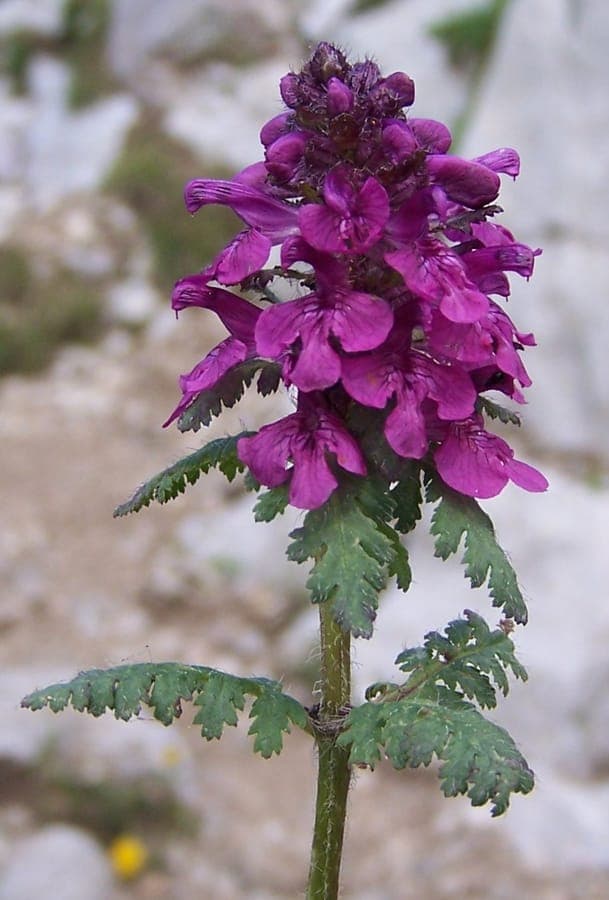
Jerzy Opioła / CC BY-SA 3.0, via Wikimedia Commons
Pedicularis verticillata: complete guide
Pedicularis verticillata
Want to see Pedicularis verticillata: complete guide in your garden?
1 minute, no credit card
Overview
Pedicularis verticillata, commonly known as Whorled Lousewort, is a remarkable alpine herb from the Orobanchaceae family. This rare mountain dweller originates from subalpine and subarctic regions of Eurasia and North America. The plant is celebrated for its distinctive flower arrangement in vertical rings and its remarkable adaptation to extreme alpine environments.
Appearance and Bloom Time
Pedicularis verticillata is a small, densely compact herb typically reaching 20 to 40 centimeters in height. The distinctive characteristic is the flower arrangement: bright yellow flowers grow in dense, orderly rings (whorls) along the flower spike, creating a highly geometric and structured appearance.
The blooming period extends from July through September, which is relatively late for alpine plants. This timing helps the plant avoid competition with earlier-flowering mountain species.
Ideal Location
This alpine herb demands a completely sunny location with excellent air circulation. The plant thrives on rock faces, within crevices between stones, and on open mountain slopes. It also performs well in alpine scree gardens where water drains rapidly.
Protection from harsh mountain winds is beneficial but not mandatory. An open, well-ventilated site is paramount.
Soil
The plant requires exceptionally well-draining, rocky soil. Heavy materials like clay are unsuitable. An ideal medium combines coarse sand, stone chips (30-40 percent), and peat (20 percent). Neutral to slightly acidic pH is optimal.
Growing in skeleton-like mountain soils is normal; nutrient supplementation is unnecessary.
Free design
Want to see Pedicularis verticillata: complete guide in your garden? Make a free design now.
Watering
As the plant originates from mountain areas with substantial precipitation, it prefers consistently moist soil. However, waterlogging is unacceptable. The planting site must drain well. Water regularly during growth periods while preventing stagnation.
The plant demonstrates good drought tolerance once established.
Pruning
Minimal pruning is required. Remove spent flowers only after the blooming period concludes. The plant naturally tidies itself.
Maintenance Calendar
- June: New foliage and flower bud development
- July-September: Blooming period, enjoy unique yellow flower rings
- October: Seed maturation, allow seeds to naturally disperse
- November-June: Winter dormancy, minimal watering
Winter Hardiness
Pedicularis verticillata is extremely winter hardy, tolerating extremely low temperatures of -20 degrees Celsius or lower. This is a significant advantage in Northern European climates. The critical element is drainage during wet periods.
Companion Planting
This alpine herb excels in rock gardens with other mountain plants such as additional Pedicularis species, saxifraga, and alpine primroses. The unique flower structure provides a striking focal point. In larger alpine gardens, plant in clusters of three to five specimens.
Closing Thoughts
Pedicularis verticillata is a truly exceptional plant for serious alpine collectors. With attention to drainage and properly prepared alpine soil, this plant rewards you with years of extraordinary flower architecture and alpine beauty. Discover with gardenworld.app how to transform your front yard into an alpine masterpiece.
With gardenworld.app, you can design your complete front garden incorporating alpine elements. Learn how to successfully integrate rare alpine plants and receive expert recommendations for authentic alpine conditions.
Want to see Pedicularis verticillata: complete guide in your garden? Make a free design now.
Upload a photo, pick a style, and get a photorealistic design with plant list in under a minute.
No credit card required


Similar plants
Northwestern Indian paintbrush: complete guide
Castilleja angustifolia
All about Castilleja angustifolia, the northwestern Indian paintbrush from dry western US steppes. Growing, care, and companion plant advice.
Wavyleaf Indian paintbrush: complete guide
Castilleja applegatei
Everything about Castilleja applegatei, the wavyleaf paintbrush from Oregon and California. Host plants, care, location, and garden use covered.
Bushy bird's-beak: complete guide
Cordylanthus ramosus
Complete guide to Cordylanthus ramosus, the hemiparasitic annual of western US steppes: ecology, host plants, cultivation and uses.