
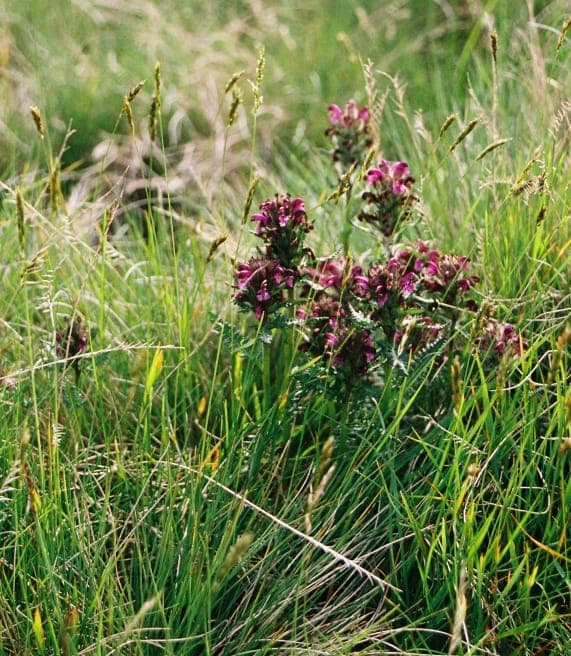
poloeschatolo / CC BY 2.5, via Wikimedia Commons
Pedicularis sudetica: complete guide
Pedicularis sudetica
Want to see Pedicularis sudetica: complete guide in your garden?
1 minute, no credit card
Overview
Pedicularis sudetica, the Sudetic lousewort or Alpine lousewort, is a fascinating mountain plant from the Orobanchaceae family. This unique plant grows naturally in the Sudeten Mountains, the Urals, and other mountain chains in Northern Europe and Asia.
What makes Pedicularis sudetica special is that it is semi-parasitic - it draws nutrition from other plants through underground root connections. This makes it an ecologically intriguing plant of interest to both botanists and gardeners.
Appearance and bloom
The plant grows as a compact, upright herb, usually 20-50 cm tall. The leaves are elongated, deeply incised (pinnatifid), green with sometimes purple tints, especially in young leaves.
The flowers are very characteristic and interesting. They appear in dense spikes at the end of the stem. The flowers are purple-pink to violet, sometimes almost magenta. The flower tube is curved and has a distinctive shape - a strong upper tooth with an incurved, two-cleft lower lip.
The flowers resemble small parrot-beak shapes, which is very recognizable to botanists. Blooming period extends from June to August in mountain environment.
Ideal location
Pedicularis sudetica prefers mountainous, cool environment with good daylight. A position with partial shade is better than full sun - the plant dislikes intense heat.
The plant grows best in places where it is cooler, e.g., on north-facing mountainsides. In cultivation, partial shade (2-4 hours sun) works well.
Temperature: This is a cool-loving plant. Optimal temperatures are between 10-18 degrees Celsius. Warm, dry conditions cause stress.
Soil
As important as light is soil composition. The Sudetic lousewort requires well-drained, very nutrient-poor soil. In cultivation, a mixture of peat moss, coarse sand and gravel (1:2:1) works well.
The pH preference is acidic: 5.5-6.5. Very nutrient-poor soil is desirable - this promotes flowering. Grass plants where it grows help the plant via parasitism.
Free design
Want to see Pedicularis sudetica: complete guide in your garden? Make a free design now.
Watering
Water regularly but moderately. The plant prefers evenly moist soil, not waterlogged. During growth period (spring-summer) water regularly.
Slowly reduce water in summer and autumn. The plant tolerates some drought during rest period.
Drainage is important: the plant is sensitive to stagnant water. Pots must have very good drainage holes.
Pruning
Pruning is not necessary. The plant has a naturally compact habit. Remove faded flowers (deadheading) to encourage additional flowering buds.
After blooming, seed material can be collected - the seed capsules open and release hundreds of tiny seeds.
Maintenance calendar
January-March: Rest. Minimal watering. April: Growth begins. Start regular watering. May-August: Growth and bloom. Water regularly. No feeding - plant is nutrient-poor-maintaining. September-October: Seed formation. Gradually reduce water. November-December: Preparation for winter. Minimal feeding.
Winter hardiness
Pedicularis sudetica is very winter hardy. This is actually an advantage in cold climates. The plant prefers cold winters and can tolerate quite a bit of frost.
In warm climates, the plant can be grown in alpine houses or cool greenhouses to maintain ideal temperatures.
Companion plants
Pedicularis sudetica combines well with other alpine and mountain plants:
- Draba species (Alpine blooming)
- Pulsatilla (Pasque flowers)
- Saxifraga (Stone breakers)
- Silene alpestris (Alpine campion)
- Other Arctic alpine flowers
Closing
Pedicularis sudetica is a fascinating plant for those wanting to grow something special. Its unique flower shape, semi-parasitic nature, and preference for mountain environment make it an interesting addition to the plant collection. Provide cool conditions, well-drained, nutrient-poor soil, and you'll be rewarded with this alpine jewel.
Seed is available through specialized seed suppliers. Good luck with this mountain flower! More plant guides found on gardenworld.app.
Want to see Pedicularis sudetica: complete guide in your garden? Make a free design now.
Upload a photo, pick a style, and get a photorealistic design with plant list in under a minute.
No credit card required


Similar plants
Northwestern Indian paintbrush: complete guide
Castilleja angustifolia
All about Castilleja angustifolia, the northwestern Indian paintbrush from dry western US steppes. Growing, care, and companion plant advice.
Wavyleaf Indian paintbrush: complete guide
Castilleja applegatei
Everything about Castilleja applegatei, the wavyleaf paintbrush from Oregon and California. Host plants, care, location, and garden use covered.
Bushy bird's-beak: complete guide
Cordylanthus ramosus
Complete guide to Cordylanthus ramosus, the hemiparasitic annual of western US steppes: ecology, host plants, cultivation and uses.