
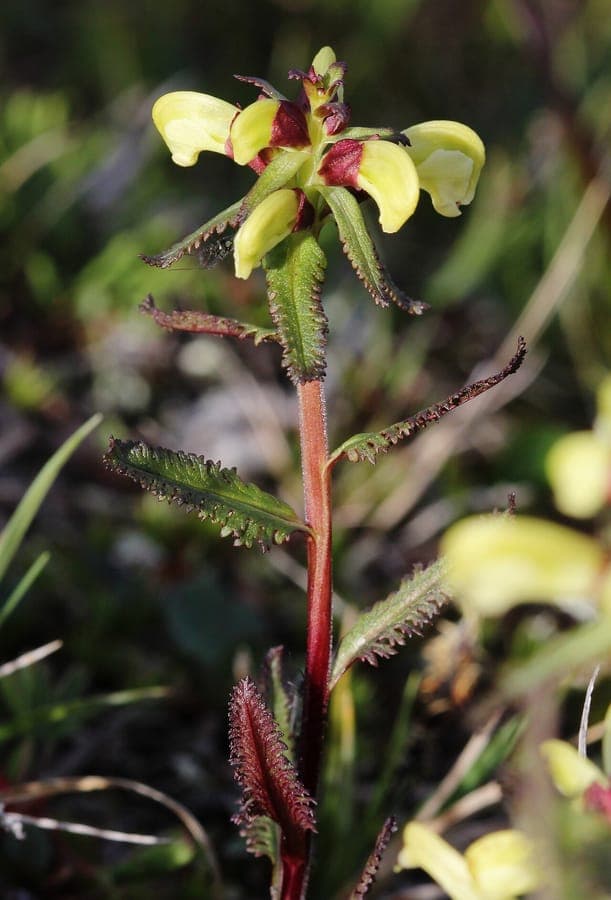
Alinja / CC BY-SA 3.0, via Wikimedia Commons
Lapland lousewort: complete guide
Pedicularis lapponica
Want to see Lapland lousewort: complete guide in your garden?
1 minute, no credit card
Overview
Pedicularis lapponica, known as Lapland lousewort or Lapland betony, is a petite alpine plant from the arctic and subarctic regions of Northern Europe and Asia. This plant grows in subalpine areas where it has adapted to extreme cold and short growing seasons. It is a stunning choice for alpine gardens and rock gardens where its native habitat can be replicated.
Appearance and bloom
Pedicularis lapponica is a compact herbaceous plant usually reaching 15-30 centimeters high. The plant grows in small rosettes with elongated, finely-divided leaves. The flowers are the highlight: red to pink, sometimes nearly purple, blooming in clusters from June to August. The flower structure is characteristic of the genus, with a two-lipped form that attracts insects. After flowering, seed capsules form.
Ideal location
This alpine wonder demands cool, well-ventilated locations. Plant it in full sun to part-shade, depending on climate. In warmer climates, some afternoon shade can help. Good drainage is absolutely essential; the plant tolerates waterlogging not at all. Ideal in alpine troughs, rock gardens, or raised beds.
Soil
The soil must be very well-draining. Use a mixture of alpine soil, stone chips, gravel, and sand. The plant tolerates poor soil well. pH between 6 and 7 is ideal. Do not add much organic material; this plant prefers sparse conditions.
Watering
Must water regularly during the growing season but should NEVER stand in water. In rainy seasons, rainwater may suffice. Ensure water drains quickly. In dry periods, water carefully, always on the dry side. In winter, minimal watering.
Free design
Want to see Lapland lousewort: complete guide in your garden? Make a free design now.
Pruning
Pruning is not really necessary. Remove only dead leaves and spent flowers to keep the plant neat. The plant grows naturally compact.
Maintenance calendar
April-May: Growth begins, light watering, no feeding needed. June-July: Blooming period, regular water checks, feeding only if needed (light feeding). August: Bloom ends, seed formation, gradually reduce watering. September-March: Rest period, minimal feeding, protection against extreme frost and moisture.
Winter hardiness
Pedicularis lapponica is highly winter hardy, adapted to arctic conditions down to -30 degrees Celsius and lower. The problem is not frost tolerance but excess moisture in winter. Ensure excellent drainage, especially in wet winters. Protection against heavy snow accumulation can help.
Companion plants
Combine with other alpine plants such as saxifrage, sedums, alpine phlox, and dwarf conifers. All neighbors should prefer the same well-draining conditions.
Closing
Lapland lousewort is for specialist gardeners who love alpine plants. With correct conditions (coolness, drainage, light feeding), it grows steadily and blooms annually. It requires patience and attention to detail, but rewards with rare beauty. Seek this plant from specialized alpine plant nurseries. For complete garden designs with alpine plantings, check gardenworld.app.
Visit gardenworld.app for alpine garden designs with rare mountain plants.
Want to see Lapland lousewort: complete guide in your garden? Make a free design now.
Upload a photo, pick a style, and get a photorealistic design with plant list in under a minute.
No credit card required


Similar plants
Northwestern Indian paintbrush: complete guide
Castilleja angustifolia
All about Castilleja angustifolia, the northwestern Indian paintbrush from dry western US steppes. Growing, care, and companion plant advice.
Wavyleaf Indian paintbrush: complete guide
Castilleja applegatei
Everything about Castilleja applegatei, the wavyleaf paintbrush from Oregon and California. Host plants, care, location, and garden use covered.
Bushy bird's-beak: complete guide
Cordylanthus ramosus
Complete guide to Cordylanthus ramosus, the hemiparasitic annual of western US steppes: ecology, host plants, cultivation and uses.