
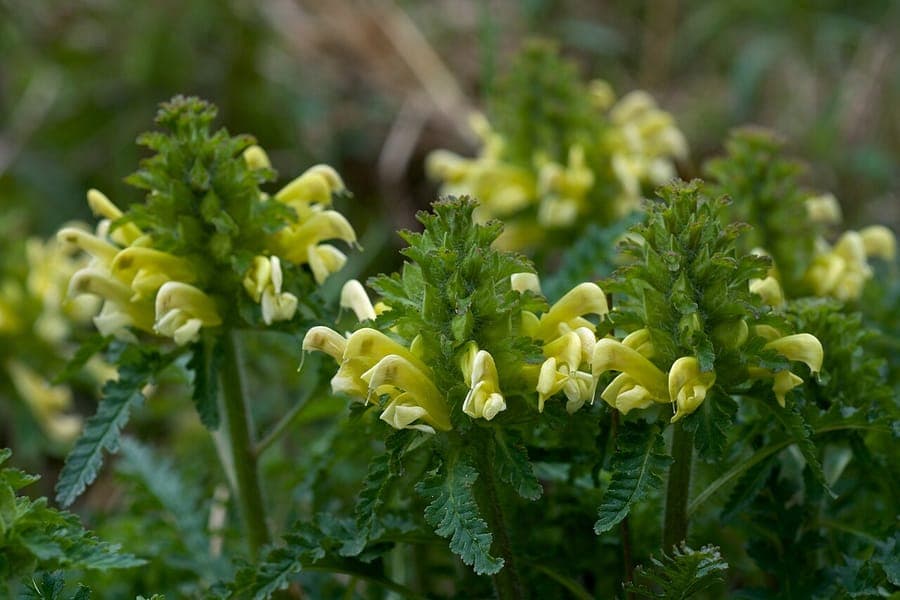
Eric Hunt / CC BY-SA 4.0, via Wikimedia Commons
Wood betony: complete guide
Pedicularis canadensis
Want to see Wood betony: complete guide in your garden?
1 minute, no credit card
Overview
Wood betony (Pedicularis canadensis) is one of eastern North America's most intriguing native wildflowers. A member of the broomrape family (Orobanchaceae), it grows as a hemiparasite - a plant capable of independent photosynthesis, yet one that simultaneously taps water and nutrients from the roots of neighbouring grasses through specialised root connections called haustoria. This remarkable dual strategy sets it apart from most garden perennials and makes it a fascinating choice for naturalistic planting schemes.
Described by Linnaeus in 1767, wood betony ranges across an enormous territory: from eastern Canada and New England south through the Appalachians and the Midwest to Mexico. It colonises open woodlands, woodland edges, prairies, and meadows where the soil is lean and grasses abound. Common names include early lousewort, Canadian wood betony, and common lousewort - the so-called lousewort name is an old folk belief that livestock grazing near the plant would become infested with lice, which is entirely unfounded.
For the garden designer working with native North American plants, wood betony is a standout early-season bloomer. Its deeply divided fern-like foliage and vivid yellow to red-yellow flowers provide colour from April through June, bridging the gap between early spring ephemerals and the main summer prairie flush. Plan your naturalistic planting scheme at gardenworld.app and discover how wood betony fits alongside other prairie and woodland-edge species.
Appearance & bloom cycle
Wood betony is a low-growing, clump-forming perennial reaching 15 to 40 cm in height and spreading 20 to 30 cm wide. Its basal leaves are deeply pinnately divided - each leaflet further toothed or lobed - creating a lacy, fern-like appearance that remains ornamental even when the plant is not in bloom. Leaves alternate along the flowering stem, which emerges from the rosette in mid-spring.
Bloom begins in April in warmer regions, May in cooler areas, and continues into June. Flowers are gathered in dense, compact spikes atop sturdy stems. Each flower is bilabiate (two-lipped): a hooded upper lip (galea) arches over a spreading three-lobed lower lip. Colour varies across populations: pure yellow forms are common in the Midwest; bicoloured yellow-and-red forms (f. bicolor) predominate across much of the eastern range; deep orange-red forms occur in the Southeast. Pollinators - particularly bumblebees - visit the flowers enthusiastically, working their way along the spike from base to tip.
After flowering, small oval seed capsules develop. By midsummer these split open to disperse seed, and the plant begins to die back to its root crown, entering summer dormancy. The fleshy, bundled roots persist underground through winter, sprouting again the following March or April. Established clumps can persist for decades in congenial conditions.
Ideal location
Wood betony thrives in partial shade, mirroring the dappled conditions of open woodland and forest edges where it grows naturally. Full sun is tolerable in cooler climates or when moisture is consistently available, but excessive direct sun in warm regions causes leaf scorch and premature senescence. A north-facing slope, a site beneath a light tree canopy, or a transition zone between full sun and woodland shade all work well.
The single most critical factor for success is the presence of suitable host plants. Wood betony parasitises the roots of grasses and small forbs; without hosts, it struggles and may fail after one season. Always plant it alongside native grasses such as little bluestem (Schizachyrium scoparium), prairie dropseed (Sporobolus heterolepis), or sideoats grama (Bouteloua curtipendula). The host roots must be present and established in the immediate root zone.
Avoid compacted, heavily trodden soils. A site with existing grass cover, moderate soil moisture, and good drainage is ideal. Waterlogged conditions promote root rot and kill the plant quickly.
Soil requirements
Wood betony is adapted to lean, well-drained soils and performs best where fertility is low. Rich, heavily amended garden beds actually disadvantage it, because vigorous competitors overwhelm a plant that is naturally adapted to lean conditions. The preferred pH range is 4.0 to 7.0, with an optimum around 5.0 to 6.5 (slightly acidic to neutral).
Sandy loam to loamy sand suits it perfectly. On heavy clay, drainage must be improved with coarse sand and organic matter worked 20 to 30 cm deep. Do not add slow-release fertiliser, compost, or manure at planting time; the resulting flush of competitor growth will outpace the slow-establishing wood betony. If the soil is extremely infertile sand, a very light top-dressing of leaf mould (2 to 3 cm) applied once at planting helps initial establishment without feeding competing grasses excessively.
Avoid disturbing the existing grass root network more than necessary. The haustorial connections form along pre-existing root channels, and a lightly disturbed soil profile retains more root material for the young Pedicularis to parasitise.
Free design
Want to see Wood betony: complete guide in your garden? Make a free design now.
Watering
Once established - typically by the second growing season - wood betony is moderately drought-tolerant, especially in a partially shaded position. During the first season after planting, water regularly to maintain light, even soil moisture: roughly once per week during dry spells, twice per week during extended heat or drought.
From year two onwards, supplemental watering is rarely needed unless the site is extremely exposed or the summer is exceptionally dry. The plant's summer dormancy period (July through September) means it needs almost no water at all once the foliage has died back. Avoid irrigation during dormancy; soggy soil around a dormant crown invites fungal problems.
Drip irrigation or targeted hand-watering at the base of the plant is preferable to overhead irrigation, which can promote foliar disease. Water in the morning whenever possible to allow the foliage to dry before nightfall.
Pruning
Wood betony requires minimal pruning. After the seed capsules have ripened and opened in midsummer - typically late June to early July - the flower stems can be cut back to the base. If you want the plant to self-seed and expand its colony, allow the capsules to split naturally before removing stems.
The basal foliage rosette may remain partly green into early autumn in cool, moist conditions; do not remove it prematurely, as it continues to feed the root crown. As temperatures drop and the leaves yellow and die back naturally, they can be gently pulled away. Never dig up what appears to be a dormant or dead crown before mid-spring of the following year - the plant re-sprouts late and may appear absent when it is merely dormant.
No shaping or formal pruning is needed or advisable. The plant maintains its own neat, low habit naturally.
Maintenance calendar
March: Watch for first leaf emergence from the root crown. Remove previous year's dead stems if not already done. Ensure host grass companions are also breaking dormancy.
April–May: Flowering period. Water lightly during dry spells. No fertilisation. Monitor for slugs in wet springs.
June: Blooming ends; seed capsules forming. Allow capsules to ripen if self-seeding is desired. Remove stems after capsule split if a tidier appearance is preferred.
July–August: Plant dies back to root crown. Minimal watering. Mark the spot to avoid accidental disturbance.
September–October: Remove dead foliage. Apply 3 to 5 cm of leaf-mould mulch around the crown to conserve moisture and moderate soil temperature.
November–February: Plant fully dormant. No maintenance required. Root crowns withstand temperatures to -35 °C (USDA zone 3) without protection.
Winter hardiness
Wood betony is remarkably winter hardy, rated for USDA zones 3 through 8. In zone 3 conditions - cold continental climates with minimum temperatures around -35 °C - established plants survive without any protection, provided drainage is good and roots are not sitting in frozen water.
The plant's deciduous habit means all aerial parts die back completely by late autumn. The fleshy root crown overwinters safely underground and breaks dormancy in early spring as soil temperatures warm above 5 °C. In mild maritime climates (zones 7 and 8), a few basal leaves may persist through winter, but this is not detrimental to the plant.
In garden centres across the UK and northern Europe, wood betony is still relatively uncommon; sourcing from specialist native plant nurseries is recommended. Once established in an appropriate site with the right host companions, it will reliably return season after season with zero additional winter protection.
Companion plants
Choosing the right companion plants is essential for wood betony's long-term success, since it needs host roots within reach. Build your planting scheme around native grasses first, then add flowering forbs that share the same site conditions.
Recommended companions:
- Little bluestem (Schizachyrium scoparium) - premier host grass; warm-season, fine texture, vivid orange autumn colour
- Prairie dropseed (Sporobolus heterolepis) - elegant fine-textured host, fragrant flowers in late summer
- Wild columbine (Aquilegia canadensis) - early-season bloom, similar shade tolerance
- Wild blue phlox (Phlox divaricata) - low-growing, spring bloom, same partial shade conditions
- Bloodroot (Sanguinaria canadensis) - early spring ephemeral, beautiful white flowers before wood betony blooms
- Wild ginger (Asarum canadense) - ground-level companion, shares woodland-edge conditions
Avoid aggressive colonisers such as creeping Jenny (Lysimachia nummularia) or common periwinkle (Vinca minor), which can overwhelm wood betony's relatively modest growth habit. Maintain a planting distance of 25 to 35 cm between wood betony and its nearest neighbours.
Discover more native plant combination ideas and garden design inspiration at gardenworld.app.
Closing
Wood betony rewards the patient, ecologically minded gardener with a window into one of nature's most remarkable plant strategies. Its hemiparasitic lifestyle, its early and genuinely beautiful bloom, and its critical role as a food source for early-season bumblebees make it far more than a botanical curiosity - it is a functional and beautiful component of any native plant garden or meadow planting.
Succeed with it by starting with good-quality potted plants from a reputable native plant nursery, installing them alongside their grass hosts, and resisting the urge to fertilise or over-water. Given the right lean, partially shaded home, wood betony will establish quietly and then reward you season after season with its distinctive spring display.
Want to see Wood betony: complete guide in your garden? Make a free design now.
Upload a photo, pick a style, and get a photorealistic design with plant list in under a minute.
10,000+ gardens designed already
No credit card required


Similar plants
Northwestern Indian paintbrush: complete guide
Castilleja angustifolia
All about Castilleja angustifolia, the northwestern Indian paintbrush from dry western US steppes. Growing, care, and companion plant advice.
Wavyleaf Indian paintbrush: complete guide
Castilleja applegatei
Everything about Castilleja applegatei, the wavyleaf paintbrush from Oregon and California. Host plants, care, location, and garden use covered.
Bushy bird's-beak: complete guide
Cordylanthus ramosus
Complete guide to Cordylanthus ramosus, the hemiparasitic annual of western US steppes: ecology, host plants, cultivation and uses.