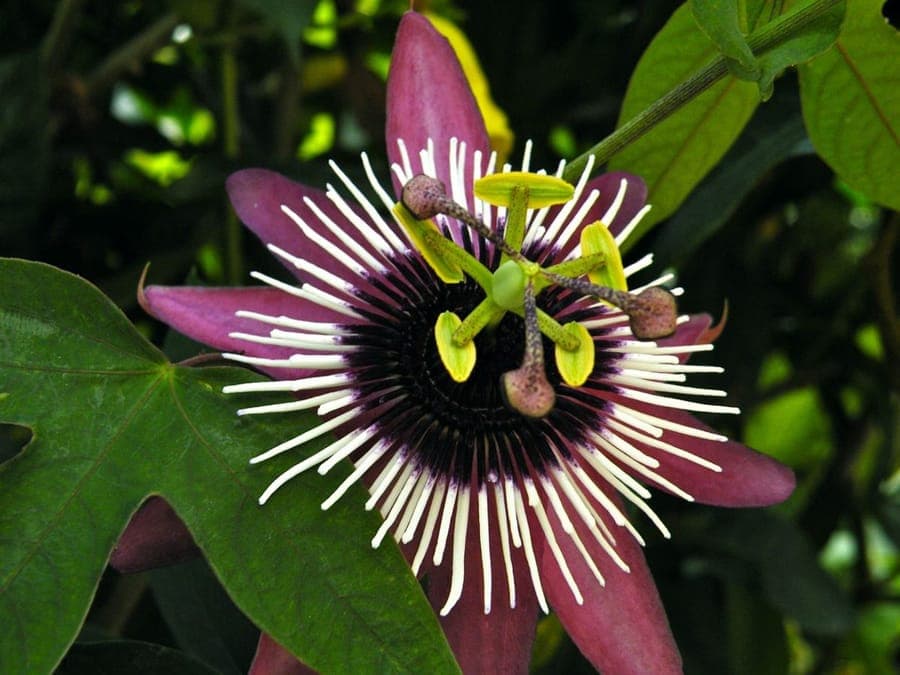
Retromoderns / CC BY-SA 2.0, via Wikimedia Commons
Passiflora × violacea: violet passion flower for pots and conservatories
Passiflora × violacea
Want to see Passiflora × violacea: violet passion flower for pots and conservatories in your garden?
Full design in HD: €7.99
Look after your Passiflora × violacea with the GardenWorld app
Identify plants with your camera and get a care calendar with reminders for this plant.


Overview
Passiflora × violacea, the violet passion flower, is one of the oldest passion flower hybrids in cultivation. The British nurseryman Thomas Milne crossed the red Passiflora racemosa with the blue Passiflora caerulea in 1819, and the result was a climber with large purple flowers that soon became a favourite in Victorian glasshouses. Two centuries on it is still widely grown, mostly as a container plant for patios, balconies and conservatories. The best-known selection is 'Victoria', with deep violet flowers, and the plant holds the RHS Award of Garden Merit.
Unlike the blue passion flower (Passiflora caerulea), which often survives outdoors against a sheltered wall in much of Britain, Passiflora × violacea is distinctly tender. Treat it as a summer guest that lives outside from late May to October and spends the winter somewhere frost-protected. In a cool conservatory it can grow into a lush climber of 3 to 5 metres; in a pot it stays smaller, especially if you cut it back each year.
The plant climbs by tendrils, so it needs support from the start. More on that below.
Appearance and bloom cycle
The flowers are the star. They are 8 to 10 cm across, with ten spreading purple-pink to violet tepals. On top sits the classic ring of fine filaments, the corona, which in this hybrid is tipped white and darkens to deep purple, almost black, towards the centre. In the middle, five stamens with large yellow anthers and three club-tipped styles stand on a short column. Each flower lasts only a day or so, but the plant produces so many buds that you see blooms from July well into October. Under glass flowering can start earlier.
The leaves are deeply three-lobed, glossy mid-green and 6 to 10 cm long. Coiled tendrils grow from the leaf axils and grip wire, mesh or twigs. The stems are thin and pliable. Fruit rarely forms on this hybrid in our climate, and any egg-shaped fruit that does appear is not meant for eating. Passion flower leaves and unripe fruit contain cyanogenic glycosides, so keep children and pets from nibbling them; larger amounts can cause stomach upset.
Ideal location
Passiflora × violacea wants light and warmth. Full sun or light dappled shade on a sheltered patio is ideal, and a south- or west-facing wall that stores heat does wonders for flowering. The more sun, the more flowers; in shade you mainly get long, bare stems.
Only move the plant outside once the risk of frost has passed, usually from the second half of May. Choose a spot out of the wind, because strong gusts tear the thin leaves and snap young shoots. In a conservatory it can stay inside all year, provided you ventilate well in summer. Above 30 °C without air movement, red spider mite and whitefly quickly move in.
Providing support
A tendril climber needs something to wrap around. Put up a sturdy trellis, an obelisk or a mesh panel at planting time. Wires or mesh no thicker than about 1 cm work best, because tendrils cannot grip thick battens. In a container, an obelisk of 1.5 to 2 metres works very well; on a wall, run horizontal wires 25 to 30 cm apart, held 5 cm from the brickwork so air can circulate.
Guide young shoots by hand for the first few weeks and tie them in loosely with soft twine. After that the tendrils do the work. Fan the shoots out: stems trained sideways flower more freely than those shooting straight up.
Soil requirements
In a container, use a good, peat-free multipurpose or loam-based compost with about a fifth of grit or perlite mixed in for drainage. A pot of 30 to 40 litres is enough for a mature plant. A pot that is too large leads to lots of leaf and few flowers, as passion flowers bloom better with slightly restricted roots. Make sure there is a drainage hole and a layer of crocks or clay pebbles.
If you plant in the border of a conservatory, a humus-rich, free-draining soil with a pH between 6 and 7.5 suits it well. Avoid anywhere that waterlogs. From May to August, feed every two weeks with a liquid fertiliser for flowering plants that is relatively high in potassium. Too much nitrogen gives long shoots with no buds.
Free preview
Want to see Passiflora × violacea: violet passion flower for pots and conservatories in your garden? Make a free preview of your design.
Watering
During the growing season Passiflora × violacea is thirsty, especially in a pot in full sun. On hot summer days you will need to water daily. Water until it runs out of the bottom of the pot, then let the top 2 cm dry a little before the next drink. Do not leave the pot standing in a saucer of water.
From October, reduce watering. During the winter rest, at temperatures between 5 and 10 °C, keep the rootball just moist: a small amount every two to three weeks is enough. Wet compost in a cold room is the quickest route to root rot.
Pruning
Pruning matters with this passion flower, because it flowers on the current season's growth. Left alone, it turns into a tangle with all the flowers at the very top. The main pruning time is late February or March, before new growth starts. Shorten all side shoots to two or three buds from the main framework, and remove dead, weak and crossing stems completely.
If the plant has to come indoors for winter, you can cut it back hard in October, to around 50 to 80 cm, so it is easier to move. In summer, remove the odd overlong shoot or tuck it back into the support. Wear gloves when pruning, as the sap can mildly irritate sensitive skin.
Maintenance calendar
February–March: Main pruning back to the framework. Repot into fresh compost if needed. Move the plant somewhere a little lighter and warmer to start it into growth.
April: Gradually increase watering. Tie young shoots to the support. Start feeding lightly.
May: From the second half of May the pot can go outside. Harden it off for a week in light shade first.
June–September: Full growth and flowering. Water daily in warm weather and feed fortnightly until the end of August. Check for red spider mite and aphids.
October: Reduce watering, cut back if needed and bring the plant in before the first frost.
November–January: Keep cool and light at 5 to 10 °C. Little water, no feeding.
For a month-by-month overview of all your plants, the plant calendar on gardenworld.app is handy, especially when you have several tender container plants to bring in at once.
Winter hardiness
Passiflora × violacea is not hardy. The RHS rates it H2, meaning it needs an unheated but frost-free space. Some growers report that 'Victoria' survives a brief frost of a few degrees below zero in a very sheltered spot, but do not rely on that in most British gardens. In prolonged frost the top growth dies and often the roots too.
Overwinter it in a cool greenhouse, a porch, a stairwell or an unheated spare room with a window. Ideal temperatures are between 5 and 10 °C. In a warm living room it starts into growth too early and produces weak, pale shoots that attract pests. If you have nowhere suitable, take cuttings in August: 10 cm tip cuttings root readily in a gritty mix under a plastic cover.
Companion plants
A pot of Passiflora × violacea on a patio looks even better with company. Mandevilla (Mandevilla sanderi) has the same needs and adds pink or red trumpet flowers. African lily (Agapanthus africanus) in a neighbouring pot gives blue globes on tall stems that look superb with the purple. Cape leadwort (Plumbago auriculata), with sky-blue clusters, belongs to the same group of container plants that overwinter frost-free.
For scent, add Jasminum polyanthum, which flowers in spring and fills the gap before the passion flower gets going. If you also want a passion flower that can stay in the ground, plant the blue Passiflora caerulea against a sheltered wall and keep the violet hybrid in a pot on the terrace.
Final thoughts
Passiflora × violacea is for gardeners who love lavish, almost exotic flowers and do not mind carrying a pot indoors in autumn. Sun, a sturdy support, plenty of water in summer and a firm prune in spring are the four keys. Get those right and it rewards you for months with violet stars that open afresh every morning.
Want to see how a patio with containers and climbing frames could look at your home? On gardenworld.app you can have a garden design made based on your own space and light. Move your passion flower outside in late May, give it something to climb and enjoy flowers that stop visitors in their tracks until autumn.
Frequently asked questions about Passiflora × violacea
Is Passiflora × violacea winter hardy?
Passiflora × violacea is not hardy. The RHS rates it H2, meaning it needs an unheated but frost-free space.
When and how do you prune Passiflora × violacea?
Pruning matters with this passion flower, because it flowers on the current season's growth. Left alone, it turns into a tangle with all the flowers at the very top.
How much water does Passiflora × violacea need?
During the growing season Passiflora × violacea is thirsty, especially in a pot in full sun. On hot summer days you will need to water daily.
Where does Passiflora × violacea grow best?
Passiflora × violacea wants light and warmth. Full sun or light dappled shade on a sheltered patio is ideal, and a south- or west-facing wall that stores heat does wonders for flowering.
What soil does Passiflora × violacea need?
In a container, use a good, peat-free multipurpose or loam-based compost with about a fifth of grit or perlite mixed in for drainage. A pot of 30 to 40 litres is enough for a mature plant.

See it in your garden
See Passiflora × violacea in your garden
One photo of your garden and a few questions. You see the result in about a minute.
Try it with a photoIdentify this plant in your own garden. Identify a plant
Similar plants
Brazilian passionflower: complete guide
Passiflora caerulea
A detailed guide to growing Passiflora caerulea: ideal conditions, soil, watering, pruning, and seasonal care for UK and US gardeners.
Mandevilla sanderi: complete guide to dipladenia, Brazilian jasmine vine
Mandevilla sanderi
Learn how to grow Mandevilla sanderi, a stunning flowering vine with pink trumpet blooms. Support, watering, and light requirements explained.
Plumbago: complete guide
Plumbago auriculata
Discover everything about Plumbago auriculata: care instructions, growth habits, appearance, and how to successfully grow this stunning climbing plant in your garden.
