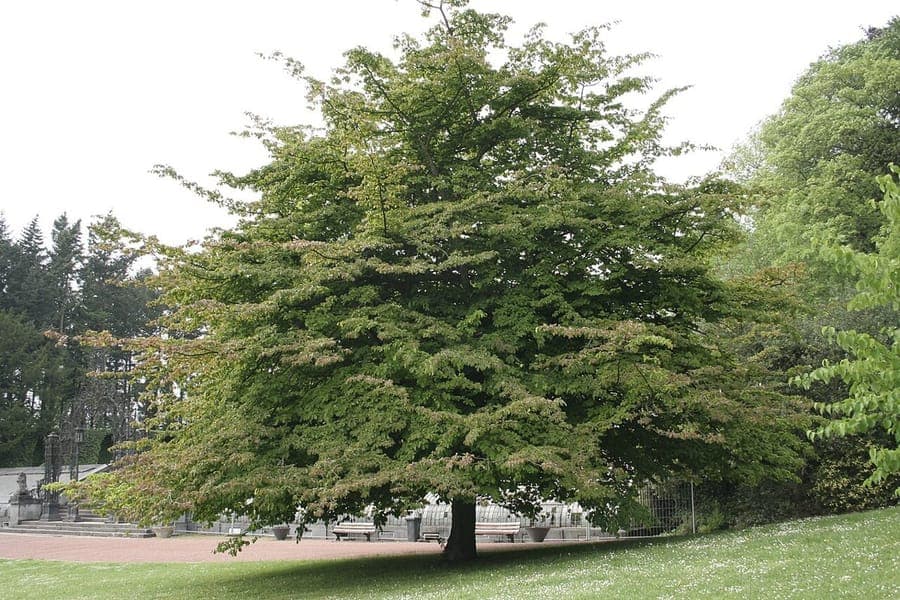
Jean-Pol GRANDMONT / CC BY 2.5, via Wikimedia Commons
Persian ironwood (Parrotia persica): complete guide
Parrotia persica
Want to see Persian ironwood (Parrotia persica): complete guide in your garden?
Full design in HD: €7.99
Look after your Persian ironwood with the GardenWorld app
Identify plants with your camera and get a care calendar with reminders for this plant.


Overview
Persian ironwood (Parrotia persica) is one of those rare trees that earns its place in every season. In autumn the leaves turn yellow, orange, crimson and purple, often all on the same tree at once. In late winter small red flowers appear on the bare branches, and on older specimens the bark flakes away in patches of grey, green and cream, much like a plane tree. For anyone who wants a garden that still looks good in November and February, it is a superb choice.
The species belongs to the witch hazel family (Hamamelidaceae) and grows wild in the Hyrcanian forests along the Caspian Sea, in northern Iran and southern Azerbaijan. The name ironwood refers to its exceptionally hard, heavy timber, which was traditionally used for tools and posts in its homeland.
In gardens Parrotia persica usually develops into a broad, small tree or large multi-stemmed shrub of 6 to 10 metres, often wider than it is tall. The branches grow strikingly horizontally in layers, giving the crown a tiered, spreading outline. At gardenworld.app you can have a garden design made in which Persian ironwood takes centre stage as a specimen tree, for instance on a lawn or beside a terrace, with enough room to develop its wide shape.
Appearance and flowering
The leaves are oval to obovate, 6 to 10 centimetres long, with a wavy, coarsely toothed edge in the upper half. In spring they unfurl with a reddish-brown to purple margin; in summer they are glossy mid-green and fairly leathery. They resemble those of beech or witch hazel, which makes sense given the close relationship with Hamamelis.
Flowering takes place between January and March, depending on the weather. The flowers have no petals. What you see are clusters of crimson stamens surrounded by dark brown, hairy bracts. Close up they are surprisingly attractive; from a distance they give the bare crown a soft reddish haze. They are small, but because they appear at the barest time of year, they still catch the eye. Small woody seed capsules follow, which attract little attention in gardens.
Autumn colour is the main attraction. From late September into November the foliage changes gradually. The outside of the crown, which receives the most sun, often turns the brightest red, while the interior stays yellow and orange. In a sunny position on soil that is not too rich, the display is at its most intense. Once the leaves have fallen, the bark comes into view: smooth and grey-brown on young trees, flaking into a mosaic of grey, green, brown and cream on trees of around ten years and older.
Ideal position
Give Persian ironwood a spot in full sun or light partial shade. The more sun, the more spectacular the autumn colour. In deep shade the tree will grow, but the leaves will mostly turn just yellow and the crown will be thinner.
Think carefully about space before planting. The tree grows slowly to moderately, around 20 to 40 centimetres a year, but eventually becomes wider than tall. A crown spread of 8 to 10 metres is not unusual on mature trees. Plant it at least 5 metres from walls, fences and other trees. For a smaller garden, choose 'Vanessa' or 'Persian Spire', which stay narrower.
Shelter is not essential. The tree copes well with wind and suits open gardens. It is worth placing it where you can see it from the house, though: the winter flowers and autumn colour look their best in low, raking light. A dark background, such as a yew hedge or a group of conifers, makes the orange and red tones stand out even more.
Soil requirements
Parrotia persica is less fussy than its cousin the witch hazel. It grows in almost any well-drained garden soil that is not too dry. A humus-rich, slightly acidic to neutral soil with a pH between 5.5 and 7 is ideal, but the tree also tolerates chalky soil. On alkaline ground the autumn colour may be a little less red.
It dislikes soil that stays waterlogged for long periods. On heavy clay, work plenty of compost and some coarse grit into the planting hole and surrounding soil so excess water can drain away. Make the planting hole twice as wide as the root ball but no deeper: the top of the root ball should sit level with the surrounding ground. A 5 centimetre mulch of leaf mould or wood chips keeps the soil cool and moist and feeds soil life.
Feeding is hardly necessary. A handful of organic fertiliser or a layer of compost in March is plenty on poor sandy soil. Too much nitrogen produces long, soft shoots and weaker autumn colour.
Free preview
Want to see Persian ironwood (Parrotia persica): complete guide in your garden? Make a free preview of your design.
Watering
Regular watering matters during the first two years after planting. In dry spells give each tree 20 to 30 litres a week, ideally in one go so the water soaks deep into the soil. A low ridge of soil around the trunk helps keep the water where it is needed.
Once established, Persian ironwood is fairly drought tolerant. Only during prolonged heat and drought, which recent summers have brought more often, is an extra soak welcome.
Pruning
Pruning Parrotia persica is largely unnecessary. Its natural, layered habit is exactly what makes the tree so appealing, and heavy pruning spoils it. Limit yourself to removing dead, diseased or damaged wood and branches that rub against each other.
The best time to prune is after flowering in March, or in summer once the main flush of growth is over. Use sharp, clean secateurs or a pruning saw and cut just outside the branch collar so the wound can callus over properly. Wound sealants are not needed.
Care calendar
January to March: Flowers on the bare branches. Enjoy the red stamens and check the tree for winter damage. Carry out any formative pruning in late February or early March.
April and May: The leaves emerge with a reddish edge. Top up the mulch and water young trees if spring is dry.
June to August: Main growing season. Water young trees well in dry weeks. Remove water shoots and badly placed branches in summer.
September to November: Autumn colour. A good time to plant new trees while the soil is still warm. Leave fallen leaves under the tree as a natural mulch, or compost them.
The plant calendar at gardenworld.app gives you a month-by-month overview of the jobs for your Persian ironwood and the rest of your garden.
Hardiness
Persian ironwood is very hardy and tolerates frosts well below -20 °C without protection, so it is perfectly at home across Britain and the rest of north-western Europe. A hard late frost may damage the early flowers, but that does the tree no harm: it simply leafs out as usual and flowers again the following winter.
The tree suffers from few pests and diseases. On very wet soil honey fungus can occasionally strike, which is another reason to ensure good drainage. There are no known reports of toxicity to people or pets, but as with any ornamental tree, the leaves and seeds are not for eating.
Companion plants
Beneath and around Persian ironwood, choose plants that reinforce the seasons. For winter and early spring, snowdrops (Galanthus nivalis), winter aconites and crocuses are ideal under the bare crown: they flower at the same time as the tree and make use of the light before the leaves emerge.
As ground cover beneath the canopy, Geranium macrorrhizum is a reliable choice. It copes with the dry, shady soil under a tree and turns red itself in autumn. Ferns, Epimedium and shade-loving grasses provide a calm green carpet.
For an autumn garden, combine Parrotia with other trees and shrubs that colour well. Sweet gum (Liquidambar styraciflua) for larger gardens, snowy mespilus (Amelanchier lamarckii) and Japanese maples (Acer palmatum) together create a palette from yellow to deep red. A dark yew hedge as a backdrop makes all those colours glow.
Final thoughts
Persian ironwood is a tree for patient gardeners. It is not fast, but it becomes more beautiful every year: first through its autumn colour, later through its tiered habit and flaking bark as well. It needs little care, rarely suffers from disease, tolerates most soils and shrugs off our winters.
The key is to give it enough room from the start. A Parrotia persica that can spread freely will, after twenty years, be one of the most striking trees in the neighbourhood. Plant it in autumn, water it for the first couple of years and let the tree do the rest.
Frequently asked questions about Persian ironwood
Is Persian ironwood winter hardy?
Persian ironwood is very hardy and tolerates frosts well below -20 °C without protection, so it is perfectly at home across Britain and the rest of north-western Europe. A hard late frost may damage the early flowers, but that does the tree no harm: it simply leafs out as usual and flowers again the following winter.
When and how do you prune Persian ironwood?
Pruning Parrotia persica is largely unnecessary. Its natural, layered habit is exactly what makes the tree so appealing, and heavy pruning spoils it.
How much water does Persian ironwood need?
Regular watering matters during the first two years after planting. In dry spells give each tree 20 to 30 litres a week, ideally in one go so the water soaks deep into the soil.
What soil does Persian ironwood need?
Parrotia persica is less fussy than its cousin the witch hazel. It grows in almost any well-drained garden soil that is not too dry.

See it in your garden
See Persian ironwood in your garden
One photo of your garden and a few questions. You see the result in about a minute.
Try it with a photoIdentify this plant in your own garden. Identify a plant
Similar plants
Sweet gum: complete guide
Liquidambar styraciflua
Discover how to grow Liquidambar styraciflua, a handsome tree with outstanding autumn color and persistent ornamental seed balls.
Juneberry: complete guide
Amelanchier lamarckii
Everything about the Juneberry (Amelanchier lamarckii): spring blossom, autumn colour, edible berries and care. Expert tips for this versatile four-season tree.
Japanese Maple: complete guide
Acer palmatum
Everything about Japanese Maple (Acer palmatum): planting, pruning, cultivars and autumn colour. Expert tips for a spectacular ornamental tree in your garden.
