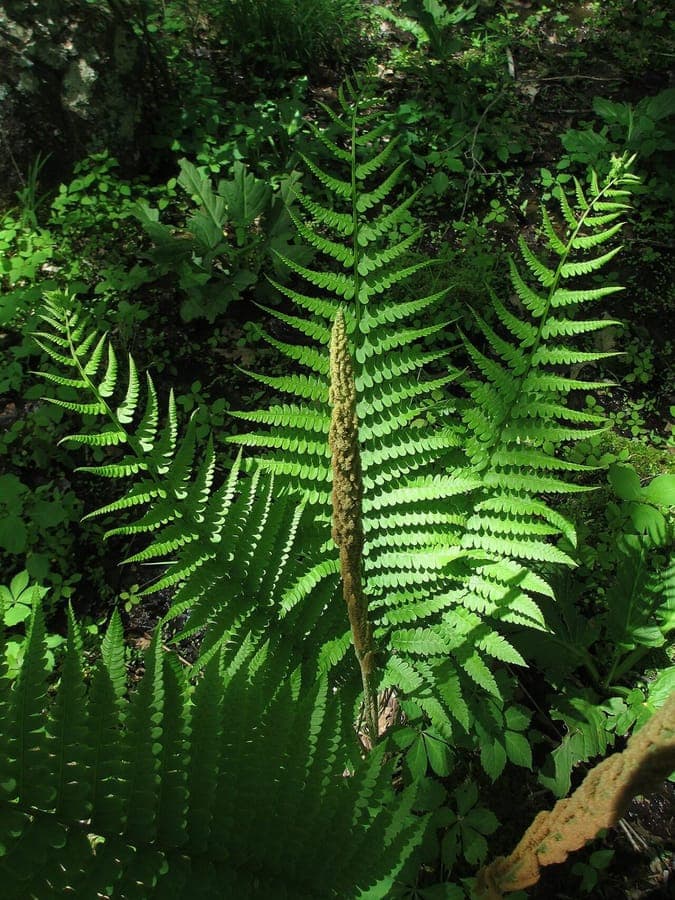
Antepenultimate / CC BY-SA 4.0, via Wikimedia Commons
Cinnamon fern: complete guide
Osmundastrum cinnamomeum
Want to see Cinnamon fern: complete guide in your garden?
Full design in HD: €7.99
Look after your Cinnamon fern with the GardenWorld app
Identify plants with your camera and get a care calendar with reminders for this plant.


Overview
The cinnamon fern (Osmundastrum cinnamomeum) is one of the most striking ferns for a damp garden. It takes its name from the separate, upright spore-bearing fronds that rise from the centre of the plant in spring and then turn cinnamon brown. For a long time it was known as Osmunda cinnamomea and grouped with the royal ferns. DNA studies have since given it a genus of its own, Osmundastrum, but you will still often see the old name on nursery labels.
In the wild the cinnamon fern grows in eastern North America, from Newfoundland to Florida, and also in East Asia, including Japan, Korea, China and the Russian Far East. It is found in swampy woods, along stream banks and in wet heathland on acidic soil. That origin tells you straight away what it needs in the garden: moisture, humus and fairly acidic ground.
A mature plant reaches 60 to 150 cm in height and 60 to 90 cm across. It forms a broad, vase-shaped clump on a thick, slowly expanding rootstock and does not run. This is a deciduous fern: in autumn the fronds turn yellow to orange-brown before dying back. If you would like to know whether your garden has a suitable wet corner, or how to create one, you can have a garden design made on gardenworld.app that gives pond edges and moist borders their proper place.
Appearance and foliage
Ferns do not flower; they reproduce by spores. With the cinnamon fern, however, the process is so visible that it almost feels like flowering. In April the croziers push through the soil, thickly covered in silvery-white to rusty woolly hairs. The fertile fronds shoot up first from the heart of the plant: straight, narrow stems of 30 to 60 cm with no ordinary leaf, densely packed with spore cases. They start green, turn cinnamon brown in May and wither in June once the spores have been shed.
Around these fertile fronds the sterile green fronds unfurl. They are pinnate with deeply lobed leaflets and a fresh, light green colour that darkens slightly later in summer. A handy identification feature sits on the underside: at the base of each leaflet there is a small tuft of rusty hairs. That separates it from the related interrupted fern (Osmunda claytoniana), whose spore-bearing sections sit in the middle of the green frond.
In autumn the cinnamon fern becomes a feature again. In October the fronds turn buttery yellow to warm orange-brown, especially in a sunny, wet spot. After the first frosts they collapse and break down.
Ideal location
This fern loves moisture at its roots. A partially shaded spot beside a pond, stream or ditch, or in a low-lying part of the garden, is ideal. In soil that is wet enough it tolerates a fair amount of sun, and the autumn colour then becomes more intense. On a dry site in full sun, however, the foliage scorches quickly and the plant stays small.
Give it space: plant it about 75 to 90 cm from other large plants so the vase shape can develop. It looks magnificent as a single specimen at the water's edge, while a group of three under trees in a damp woodland area creates an almost primeval effect. A sheltered position out of strong wind keeps the tall fronds upright.
Soil requirements
The cinnamon fern needs wet to moist, humus-rich, acidic soil. A pH of roughly 4.5 to 6.5 is ideal; on chalky or limy ground it struggles and the foliage yellows. Peaty soil, acidic loam or sandy soil rich in organic matter that never dries out is perfect.
If you have ordinary garden soil, mix plenty of leaf mould, conifer-based compost or peat-free ericaceous compost into the top 30 cm when planting. Set the rootstock so that the crown sits at soil level. A few centimetres of leaf mould or fine bark mulch holds in moisture and feeds the soil. Use rainwater for watering where you can, especially in hard-water areas. Artificial fertiliser is unnecessary; a layer of leaf mould in spring is enough.
Free preview
Want to see Cinnamon fern: complete guide in your garden? Make a free preview of your design.
Watering
Water is the key to success with Osmundastrum cinnamomeum. The soil should never dry out, particularly in spring and summer when the plant is growing strongly. In a naturally wet spot, such as a pond margin, there is little to do. In an ordinary border, water deeply two or three times a week during dry spells.
The cinnamon fern copes well with short periods of standing water, as long as the crown is not submerged for long. If you grow it in a large container, choose one with a small drainage hole and stand it in a saucer so there is always a reserve of water. Brown, curling frond edges in summer are almost always a sign of too little water or too much sun.
Pruning
Pruning the cinnamon fern is simple. The fertile fronds wither of their own accord in June; you can cut them off at the base if they look untidy, or leave them. The green fronds die back in late autumn. Leave them over winter, as they protect the crown from frost and give shelter to insects.
In late February or early March, cut the dead foliage off just above the ground before the new woolly croziers appear. Work carefully, because the young shoots are already waiting in the crown. Old clumps can be divided in early spring with a sharp spade, but the rootstock is tough and woody, and it is usually better to let the plant grow undisturbed.
Maintenance calendar
January-February: Dormant season. Leave the dead fronds in place as protection.
March: Cut away old foliage. Spread a layer of leaf mould or fine bark around the plant.
April: The woolly croziers and fertile fronds appear. A good time to plant or divide.
May-June: The fertile fronds turn cinnamon brown and wither. Keep the soil constantly moist.
July-August: Water during dry spells, especially away from a pond margin. Watch for scorch in strong sun.
September-October: Beautiful yellow to orange-brown autumn colour. Another good planting window.
November-December: The fronds die back. Leave them standing until spring.
If you would like to see which plants need attention in which month, the planting calendar on gardenworld.app gives a monthly overview of planting times, pruning and routine care.
Winter hardiness
The cinnamon fern is exceptionally hardy. It grows naturally as far north as Canada and survives temperatures down to about -35 °C (USDA zone 3). In Britain and the rest of north-west Europe it never needs winter protection. Late spring frosts can occasionally damage the young shoots, but the plant soon produces new fronds.
Containers are a different matter. A wet root ball can freeze solid, and not every plant survives that. Stand pots against a wall in winter and insulate them with hessian or bubble wrap, or plant the fern out in the ground.
On toxicity: in North America the young fiddleheads were sometimes eaten in the past, but this is not recommended today. Related ferns are known to contain harmful compounds, and too little is certain about the safety of this species. So do not eat it, and keep rabbits and guinea pigs away from it. There are no clear reports of serious poisoning in dogs or cats.
Companion plants
With its preference for wet, acidic soil, the cinnamon fern fits perfectly into a pond-side or bog garden. The royal fern (Osmunda regalis), its close relative, makes a superb partner: both are large, but the royal fern has broader, more divided foliage and bronze young growth. Marsh marigold (Caltha palustris) flowers golden yellow at the feet of the ferns in April, just as the woolly croziers appear.
For late spring and summer flowers, choose Japanese primrose (Primula japonica) with its tiered whorls of pink, red or white, or Siberian iris (Iris sibirica) with its narrow, upright leaves. Later in summer, Ligularia dentata adds orange daisies above large, dark leaves. Meadowsweet, sedges and rodgersias also suit this look. Avoid American skunk cabbage (Lysichiton americanus): it is on the EU list of invasive species and may no longer be sold or planted.
Final thoughts
Osmundastrum cinnamomeum is a fern for anyone with a wet corner who wants to see something special there. In spring the woolly croziers and cinnamon-brown fertile fronds put on a show few other plants can match, in summer it forms a fresh green vase, and in autumn it turns golden yellow. Give it moisture, acidic humus-rich soil and a spot in partial shade, and over the decades it will grow into an impressive clump.
Frequently asked questions about Cinnamon fern
Is Cinnamon fern winter hardy?
The cinnamon fern is exceptionally hardy. It grows naturally as far north as Canada and survives temperatures down to about -35 °C (USDA zone 3).
When and how do you prune Cinnamon fern?
Pruning the cinnamon fern is simple. The fertile fronds wither of their own accord in June; you can cut them off at the base if they look untidy, or leave them.
How much water does Cinnamon fern need?
Water is the key to success with Osmundastrum cinnamomeum. The soil should never dry out, particularly in spring and summer when the plant is growing strongly.
Where does Cinnamon fern grow best?
This fern loves moisture at its roots. A partially shaded spot beside a pond, stream or ditch, or in a low-lying part of the garden, is ideal.
What soil does Cinnamon fern need?
The cinnamon fern needs wet to moist, humus-rich, acidic soil. A pH of roughly 4.5 to 6.5 is ideal; on chalky or limy ground it struggles and the foliage yellows.

See it in your garden
See Cinnamon fern in your garden
One photo of your garden and a few questions. You see the result in about a minute.
Try it with a photoIdentify this plant in your own garden. Identify a plant
Similar plants
Royal fern: complete guide
Osmunda regalis
Learn how to grow and care for Royal fern (Osmunda regalis) in your garden. Ideal light, soil, watering, and companion plants included.
Cowflock: complete guide
Caltha palustris
Discover everything about Caltha palustris: ideal growing conditions, care tips, and how to use this spring-blooming perennial in wet garden areas.
Primula japonica: complete guide
Primula japonica
Japanese primrose is an elegant perennial with tiered flower spikes in pink, red, or white hues. This plant thrives in moist, humus-rich soils with partial shade. Ideal for water features, bog gardens, and shaded borders.
